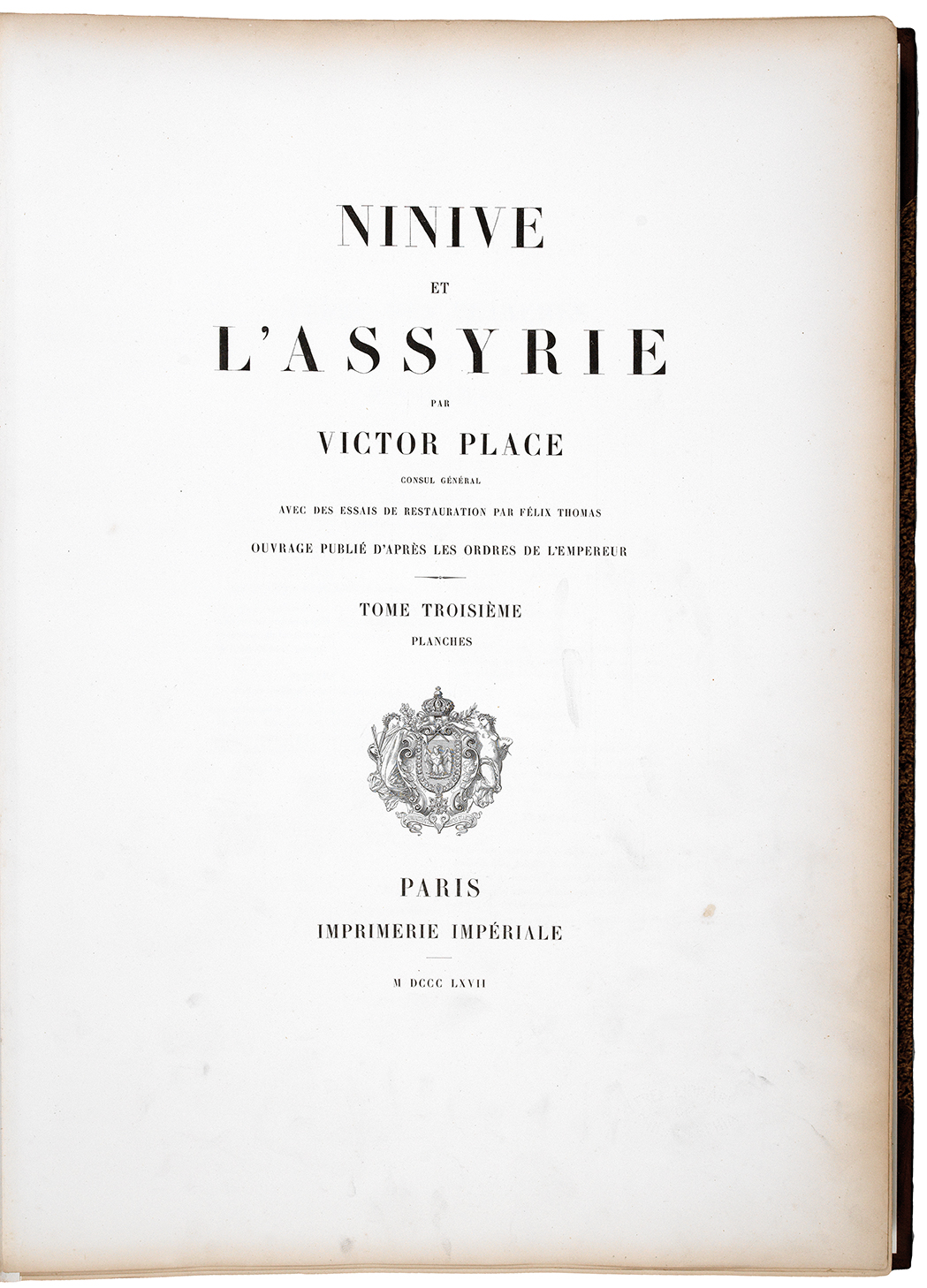
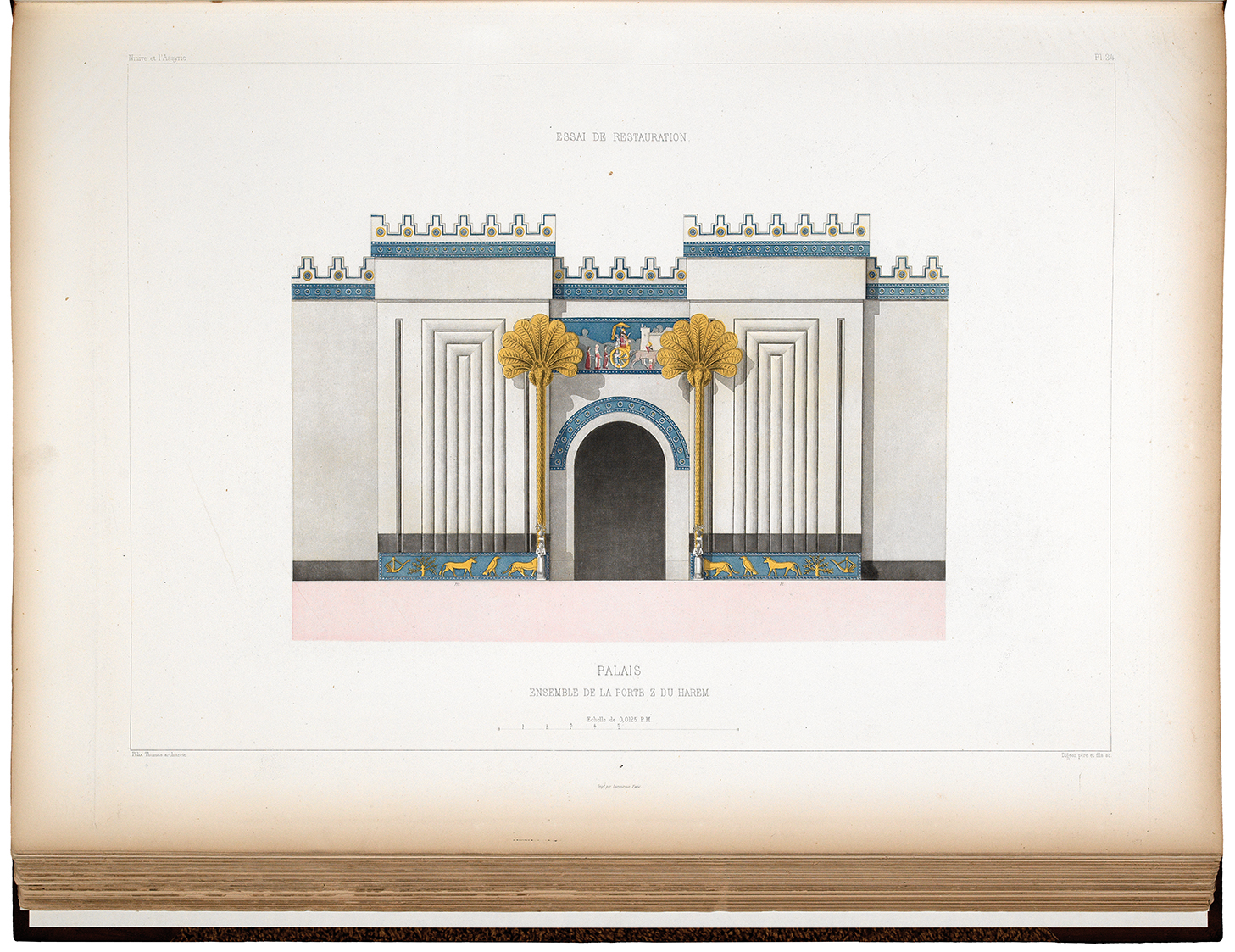
Ninive et l'Assyrie ... avec des Essais de Restaurations par Félix Thomas. Ouvrage Publié d'Aprés les Ordres de l'Empereur
Place, Victor
Paris. Imprimerie Impériale. 1867–1870
Sold
The first and sole edition of Victor Place's magnum opus and a founding work of Assyriology, 'Ninive et l'Assyrie'.
Vicaire (see below) suggests that 'cent exemplaires seulement ont été mis dans le commerce'.
Paul-Emile Botta, the French consul in Mosul had first discovered the vestiges of the great city of what he considered Nineveh in 1843 and subsequently many of the most important pieces were transported to the Louvre. Victor Place (1819 - 1875) became the new French consul in Mosul in 1851, at the same time succeeding Botta as chief architect of the Nineveh project between 1852 - 1854; together with Jules Oppert and Fulgence Fresnel, Place took part in the excavations which had been started by Botta at Khorsabad. It was in Khorsabad, a Turkish village almost 20 miles north of ancient Nineveh that, in 1843, Botta discovered the remains of an Assyrian palace and town, at which excavations were conducted in 1843 - 1844, and later by Place in 1851 - 1855. The ruins proved to be those of the town of Dur-Sharrukin, built by Sargon II, King of Assyria, as a royal residence.
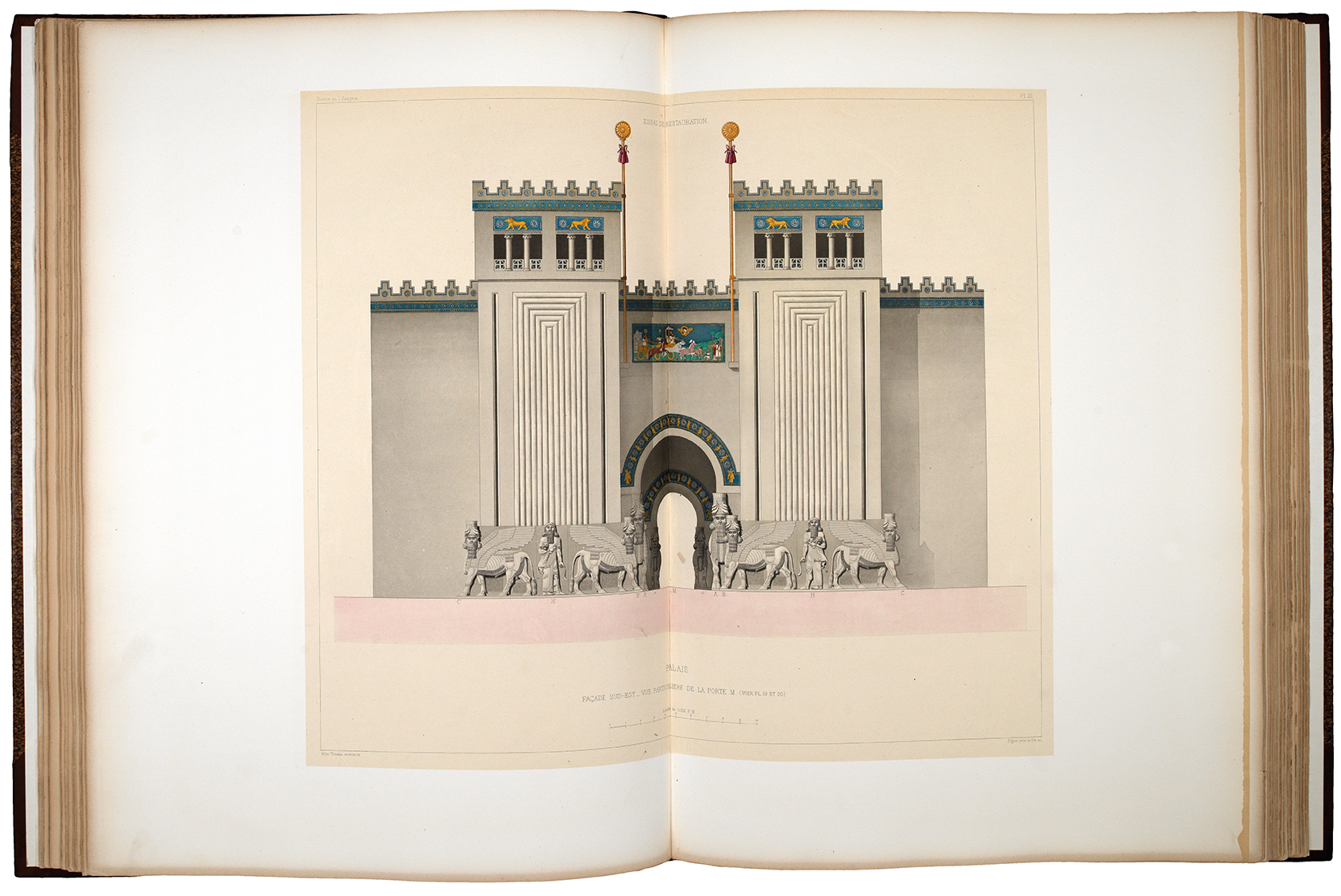
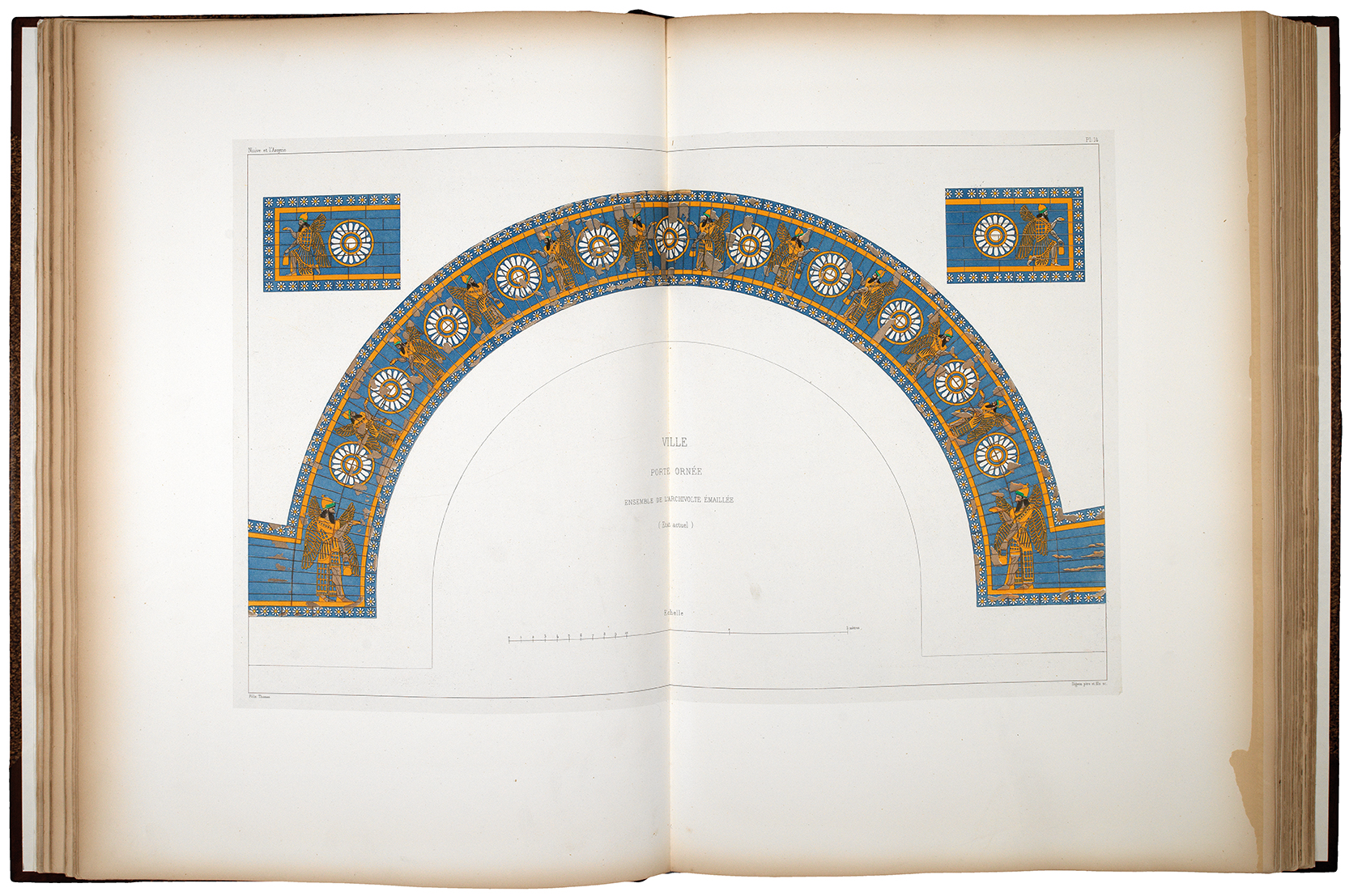
An immense number of statues and bas-reliefs, excavated by Botta, were transported to Paris, and formed the first Assyrian museum to open to the world. The objects excavated by Place, together with the objects found by Fresnel's expedition, from Kish, Dur-Sharrukin, Nimrud and the palace of Assurbanipal at Nineveh, were en route to Basra for shipping to France on a series of rafts and a barge - transport from Baghdad to Basra via the Tigris was considered the safest route for stone sculptures of enormous size - but depredations by tribesmen and 'pirates' caused the loss of many of them. The barge was rammed near Al-Qurna and sank and a raft, presumably overloaded, was lost in the Shatt al-Arab. Fortunately the artist Félix Thomas had made careful drawings of many of the objects and it is these that form the basis for this work.
The whole body of material from all of the sites was published by the French government in two monumental publications, Botta and Flandin's, 'Monument de Ninive' (Paris, 1849 - 1850), and the present work, Victor Place's magnum opus, 'Ninive et l'Assyrie' (Paris, 1867 - 1870). Victor Place's work, given its publication history, scope and limitation, is necessarily scarce and complete copies, as here, are very uncommon.
[Vicaire VI, 698; not in Blackmer].
Vicaire (see below) suggests that 'cent exemplaires seulement ont été mis dans le commerce'.
Paul-Emile Botta, the French consul in Mosul had first discovered the vestiges of the great city of what he considered Nineveh in 1843 and subsequently many of the most important pieces were transported to the Louvre. Victor Place (1819 - 1875) became the new French consul in Mosul in 1851, at the same time succeeding Botta as chief architect of the Nineveh project between 1852 - 1854; together with Jules Oppert and Fulgence Fresnel, Place took part in the excavations which had been started by Botta at Khorsabad. It was in Khorsabad, a Turkish village almost 20 miles north of ancient Nineveh that, in 1843, Botta discovered the remains of an Assyrian palace and town, at which excavations were conducted in 1843 - 1844, and later by Place in 1851 - 1855. The ruins proved to be those of the town of Dur-Sharrukin, built by Sargon II, King of Assyria, as a royal residence.
An immense number of statues and bas-reliefs, excavated by Botta, were transported to Paris, and formed the first Assyrian museum to open to the world. The objects excavated by Place, together with the objects found by Fresnel's expedition, from Kish, Dur-Sharrukin, Nimrud and the palace of Assurbanipal at Nineveh, were en route to Basra for shipping to France on a series of rafts and a barge - transport from Baghdad to Basra via the Tigris was considered the safest route for stone sculptures of enormous size - but depredations by tribesmen and 'pirates' caused the loss of many of them. The barge was rammed near Al-Qurna and sank and a raft, presumably overloaded, was lost in the Shatt al-Arab. Fortunately the artist Félix Thomas had made careful drawings of many of the objects and it is these that form the basis for this work.
The whole body of material from all of the sites was published by the French government in two monumental publications, Botta and Flandin's, 'Monument de Ninive' (Paris, 1849 - 1850), and the present work, Victor Place's magnum opus, 'Ninive et l'Assyrie' (Paris, 1867 - 1870). Victor Place's work, given its publication history, scope and limitation, is necessarily scarce and complete copies, as here, are very uncommon.
[Vicaire VI, 698; not in Blackmer].
pp. viii, 324; 323; viii. 3 vols. Large folio. (636 x 472 mm). Half-title and printed title with Imperial vignette to each vol., vol. I with 'Introduction' and 'Chapitre Préliminaire' and text, Index to each vol., 'Appendice' in vol. II with cuneiform inscriptions, printed text in French with occasional Greek and cuneiform, plate vol. with 'Description des Planches' and 87 plates numbered 1 - 82 including six 'bis' plates (18 bis, 31 bis, 337 bis, 44 bis, 50 bis & 52 bis) and with plate 68 / 69 on a single sheet, 10 double-page, including 2 in colour (1 on Chine), the remainder single-page recto only, including 14 in colour or partial colour, plates mounted on tabs throughout. Later brown calf-backed marbled boards, titles with Assyrian tools and gilt titles, cream endpapers, t.e.g.
#46581