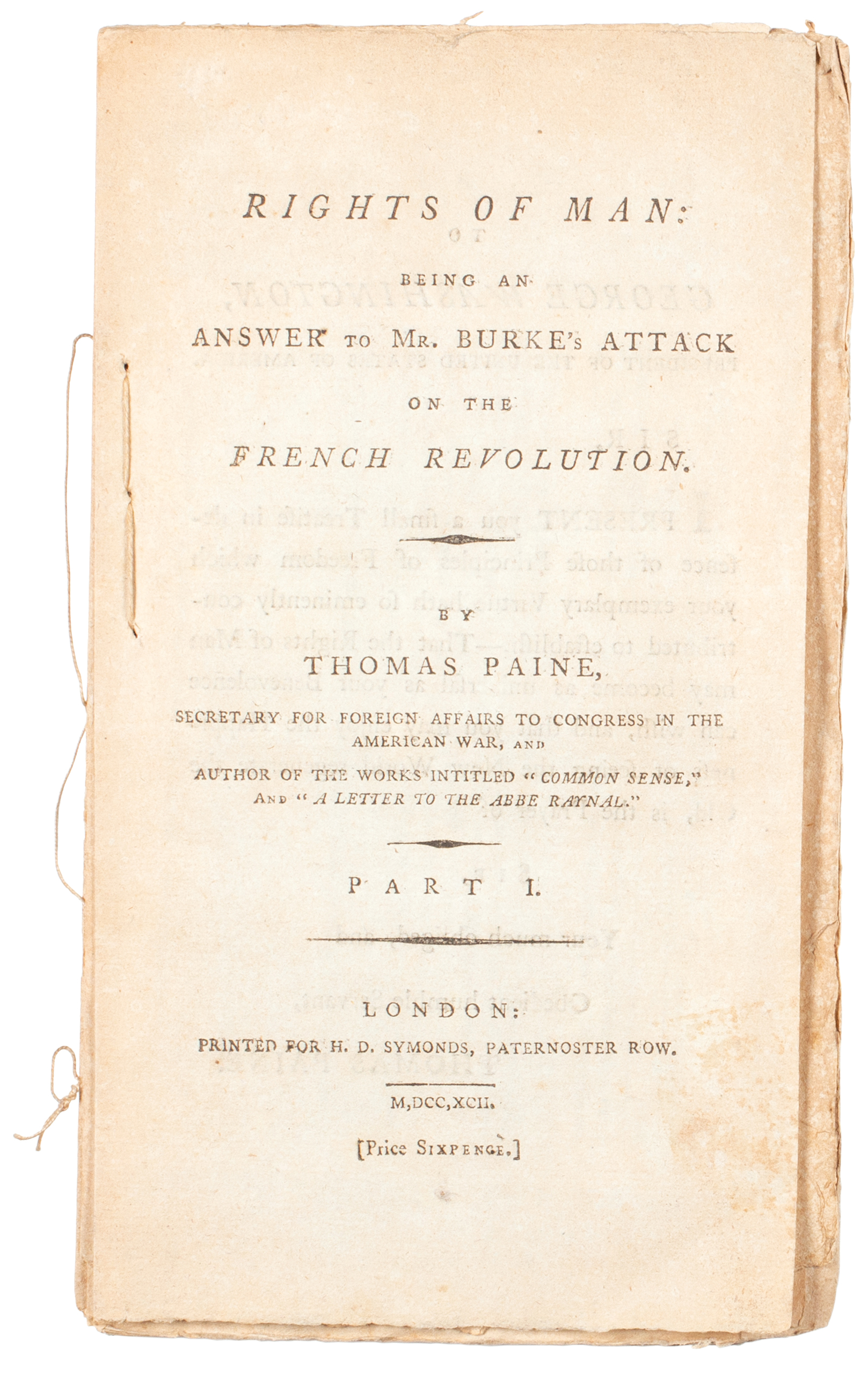
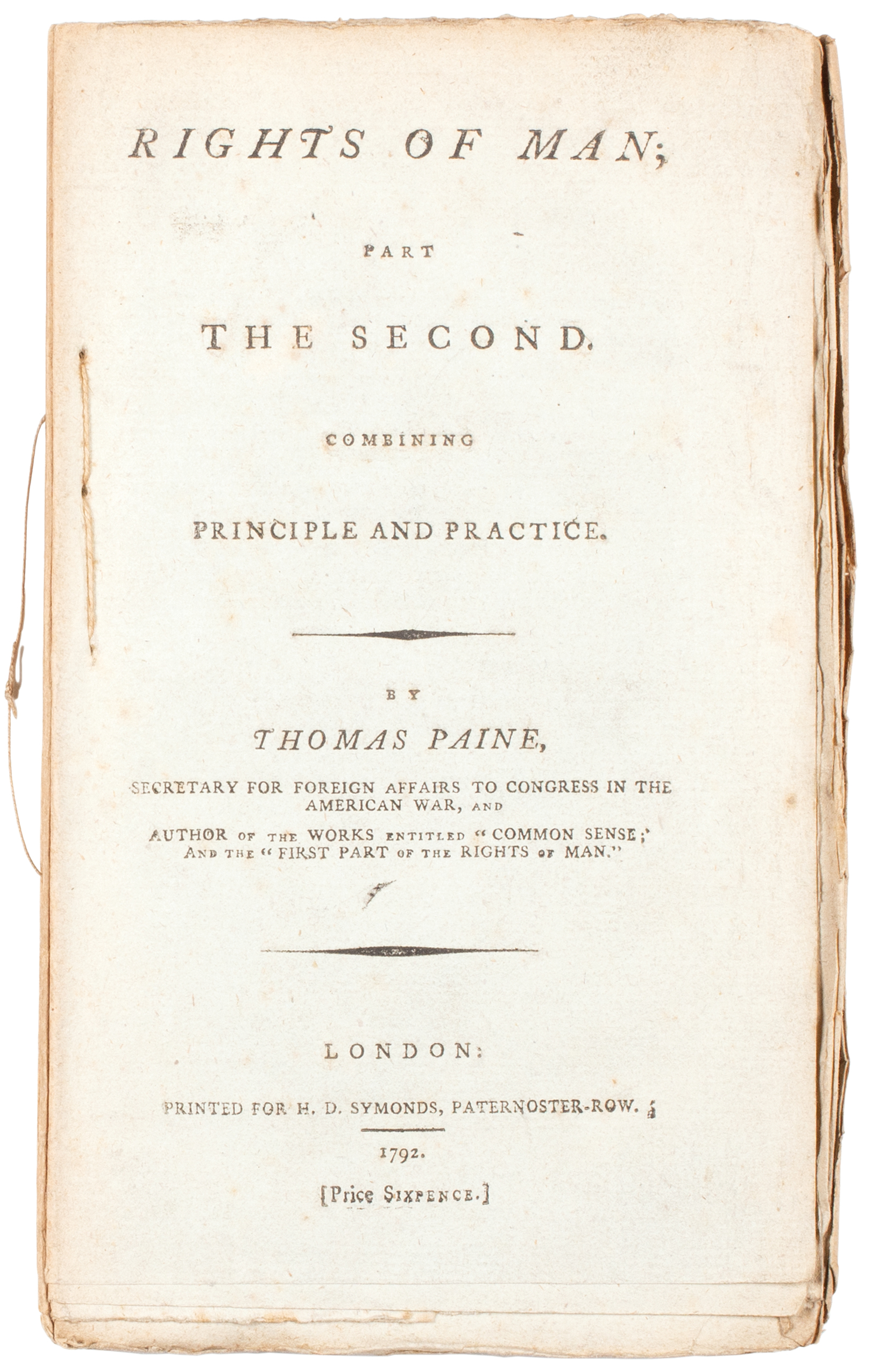
Rights of Man: Being An Answer to Mr. Burke's Attack on the French Revolution. [AND:] Rights of Man. Part the Second. Combining Principle and Practice
Paine, Thomas
London. Printed for H. D. Symonds, Paternoster Row. 1792
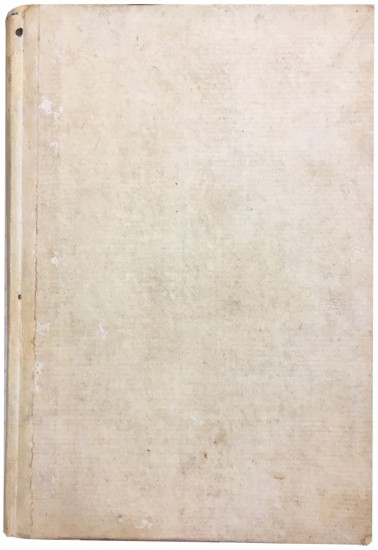
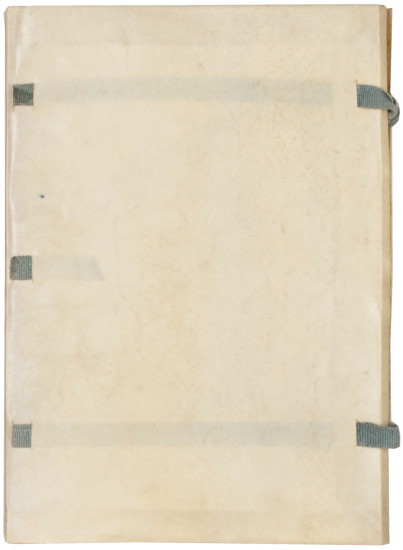
Superb, unsophisticated examples, uncut entirely and stitched as issued in pamphlet form, of the first two parts of Thomas Paine's 'Rights of Man'.
Composed in reaction to Edmund Burke's 1790 'Reflections on the Revolution in France' (and so advertised in Paine's title as 'An Answer to Mr. Burke's Attack ... '), the first part of Paine's response was first published in February 1791 by Joseph Johnson before its withdrawal - Johnson feared prosecution or worse - and its issue with a new imprint by J. S. Jordan in March of the same year. Despite efforts by the government of the day to censor the work - although Pitt feared the effect on the populace he himself (see PMM) thought Paine correct - the analysis of basic democratic rights was so crucial that it proved very popular and was reprinted numerous times. The two parts presented here, each with an individual price, unbound and stab stitched as issued, demonstrate that the 'Rights of Man' was made available as a pamphlet for ease of distribution and concurrent popular influence.
'With a force and clarity unequalled even by Burke, Paine laid down those principles of fundamental human rights which must stand, no matter what excesses are committed to obtain them ... Rights of Man was an immediate success ... The government tried to suppress it, but it circulated the more briskly ... Considered apart from the turmoil which attended its first publication, however, Rights of Man can be seen for what it is: the textbook of radical thought and the clearest of all expositions of the basic principles of democracy.' (Printing and the Mind of Man).
[ESTC: T5878 & T5879; see PMM 241].
Composed in reaction to Edmund Burke's 1790 'Reflections on the Revolution in France' (and so advertised in Paine's title as 'An Answer to Mr. Burke's Attack ... '), the first part of Paine's response was first published in February 1791 by Joseph Johnson before its withdrawal - Johnson feared prosecution or worse - and its issue with a new imprint by J. S. Jordan in March of the same year. Despite efforts by the government of the day to censor the work - although Pitt feared the effect on the populace he himself (see PMM) thought Paine correct - the analysis of basic democratic rights was so crucial that it proved very popular and was reprinted numerous times. The two parts presented here, each with an individual price, unbound and stab stitched as issued, demonstrate that the 'Rights of Man' was made available as a pamphlet for ease of distribution and concurrent popular influence.
'With a force and clarity unequalled even by Burke, Paine laid down those principles of fundamental human rights which must stand, no matter what excesses are committed to obtain them ... Rights of Man was an immediate success ... The government tried to suppress it, but it circulated the more briskly ... Considered apart from the turmoil which attended its first publication, however, Rights of Man can be seen for what it is: the textbook of radical thought and the clearest of all expositions of the basic principles of democracy.' (Printing and the Mind of Man).
[ESTC: T5878 & T5879; see PMM 241].
pp. iv, 78, (i); vii, (i), 9 - 90, (iv), (i). 2 vols. 8vo. (208 x 126 mm). Printed title to part one with Paine's dedication 'To George Washington, President of the United States of America', leaf with 'Preface to the English Edition' and Paine's text including the 'Declaration of the Rights of Man and of Citizens by the National Assembly of France', the 'Observations' on the same, Paine's 'Miscellaneous Chapter' and 'Conclusion', final leaf with advertisement recto for 'Rights of Man Part II'; printed title to part two, leaf with Paine's dedication to 'M. de la Fayette' recto, verso and following leaves with 'Preface' and contents, Paine's text with 'Introduction' and five chapters and 'Appendix', final leaf verso with advertisement for 'Part I' and 'Common Sense'. Unbound gatherings stab stitched in pamphlet form as issued.
#48667