Les Réincarnations du Père Ubu. [Together with:] Manuscrit de G. Rouault - Préface aux 'Réincarnations du Père Ubu'
Rouault, Georges. Vollard, Ambroise
Paris. Ambroise Vollard. 1932
Vollard's Les Réincarnations du Père Ubu illustrated by Rouault together with Rouault's original manuscript for his introduction.
From the edition limited to 335 copies, with this one of 55 édition de tête copies (number 2) on Montval signed by Rouault and Vollard in ink on the justification with two sets of the 22 hors-texte etchings: one on Rives with the watermark 'Ambroise Vollard' and one on Arches.
Also included with this copy is Rouault's original manuscript text for the introduction ('Petit Poème Français en Guise d'Avertissement, Introduction, Préface aux Réincarnations du Père Ubu') on 2 bifolia of large cream paper (with the watermark 'M B M' and 'J. PERRIGOT ARCHES (FRANCE)') and dated '6/8/29' in pencil at the foot of the first sheet. Rouault's manuscript, written in black ink over pencil within ruled pencil frames and on ruled lines is for his first draft for the introduction to the book. Beneath a large wash vignette, largely effaced but matching the size and shape of the final published vignette, Roualt's title and text, including the verse interpolations, follows the contours of the final published version save the vignette illustrations but differs in many respects. The manuscript concludes with Rouault's name beneath and is dated 'Paris, mars 1929'.
The manuscript is also accompanied by a printed proof of the same text on five leaves of thin proofing paper printed recto only. In this version, stamped at the head of the first sheet with 'Imprimerie A. Jourde / 1er Epreuve / le 28/8/29', the text matches that of the manuscript but has been reworked extensively by Rouault in blue ink. The opening paragraph has been rewritten, many passages have been removed entirely, the verse has been edited and the text rearranged. The changes made by Rouault evidenced here go much further towards the final published version than the manuscript version, however, comparison between the final published version and this proof version evince further changes. Both versions provide highly interesting variations to the completed version and demonstrate Rouault's working practise in a literary sense.
'Les gravures sur le thème d'Ubu aux colonies datées de 1918 et 1919 furent tirées à l'initiative d'Ambroise Vollard mais conservées sans être utilisées pour une édition. Les cuivres qui n'avaient pas encore été rayés furent retravaillés par Georges Rouault en 1928. Le premier tirage (1918 - 1919) fut retrouvé après la mort d'Ambroise Vollard.' (Chapon).
'Vollard wrote more than 10 works on the subject of Père Ubu, beginning with Le Grand Almanach du Père Ubu (1900 - 1901) and ending with Les Réincarnations du Père Ubu (1932). The character was based on Allfred Jarry's Ubu Roi, a play first performed in 1896 and marking the beginning of the Théâtre de l'Absurde, which had great vogue in Dada and Surrealist circles. Whereas Jarry's Ubu was a personification of crass malevolence and dictatorial buffoonery, Vollard's character was made into a character that typified political and bureaucratic corruption.' (From Manet to Hockney).
[Chapon 8 - 30; The Artist and the Book 270; From Manet to Hockney 81].
From the edition limited to 335 copies, with this one of 55 édition de tête copies (number 2) on Montval signed by Rouault and Vollard in ink on the justification with two sets of the 22 hors-texte etchings: one on Rives with the watermark 'Ambroise Vollard' and one on Arches.
Also included with this copy is Rouault's original manuscript text for the introduction ('Petit Poème Français en Guise d'Avertissement, Introduction, Préface aux Réincarnations du Père Ubu') on 2 bifolia of large cream paper (with the watermark 'M B M' and 'J. PERRIGOT ARCHES (FRANCE)') and dated '6/8/29' in pencil at the foot of the first sheet. Rouault's manuscript, written in black ink over pencil within ruled pencil frames and on ruled lines is for his first draft for the introduction to the book. Beneath a large wash vignette, largely effaced but matching the size and shape of the final published vignette, Roualt's title and text, including the verse interpolations, follows the contours of the final published version save the vignette illustrations but differs in many respects. The manuscript concludes with Rouault's name beneath and is dated 'Paris, mars 1929'.
The manuscript is also accompanied by a printed proof of the same text on five leaves of thin proofing paper printed recto only. In this version, stamped at the head of the first sheet with 'Imprimerie A. Jourde / 1er Epreuve / le 28/8/29', the text matches that of the manuscript but has been reworked extensively by Rouault in blue ink. The opening paragraph has been rewritten, many passages have been removed entirely, the verse has been edited and the text rearranged. The changes made by Rouault evidenced here go much further towards the final published version than the manuscript version, however, comparison between the final published version and this proof version evince further changes. Both versions provide highly interesting variations to the completed version and demonstrate Rouault's working practise in a literary sense.
'Les gravures sur le thème d'Ubu aux colonies datées de 1918 et 1919 furent tirées à l'initiative d'Ambroise Vollard mais conservées sans être utilisées pour une édition. Les cuivres qui n'avaient pas encore été rayés furent retravaillés par Georges Rouault en 1928. Le premier tirage (1918 - 1919) fut retrouvé après la mort d'Ambroise Vollard.' (Chapon).
'Vollard wrote more than 10 works on the subject of Père Ubu, beginning with Le Grand Almanach du Père Ubu (1900 - 1901) and ending with Les Réincarnations du Père Ubu (1932). The character was based on Allfred Jarry's Ubu Roi, a play first performed in 1896 and marking the beginning of the Théâtre de l'Absurde, which had great vogue in Dada and Surrealist circles. Whereas Jarry's Ubu was a personification of crass malevolence and dictatorial buffoonery, Vollard's character was made into a character that typified political and bureaucratic corruption.' (From Manet to Hockney).
[Chapon 8 - 30; The Artist and the Book 270; From Manet to Hockney 81].
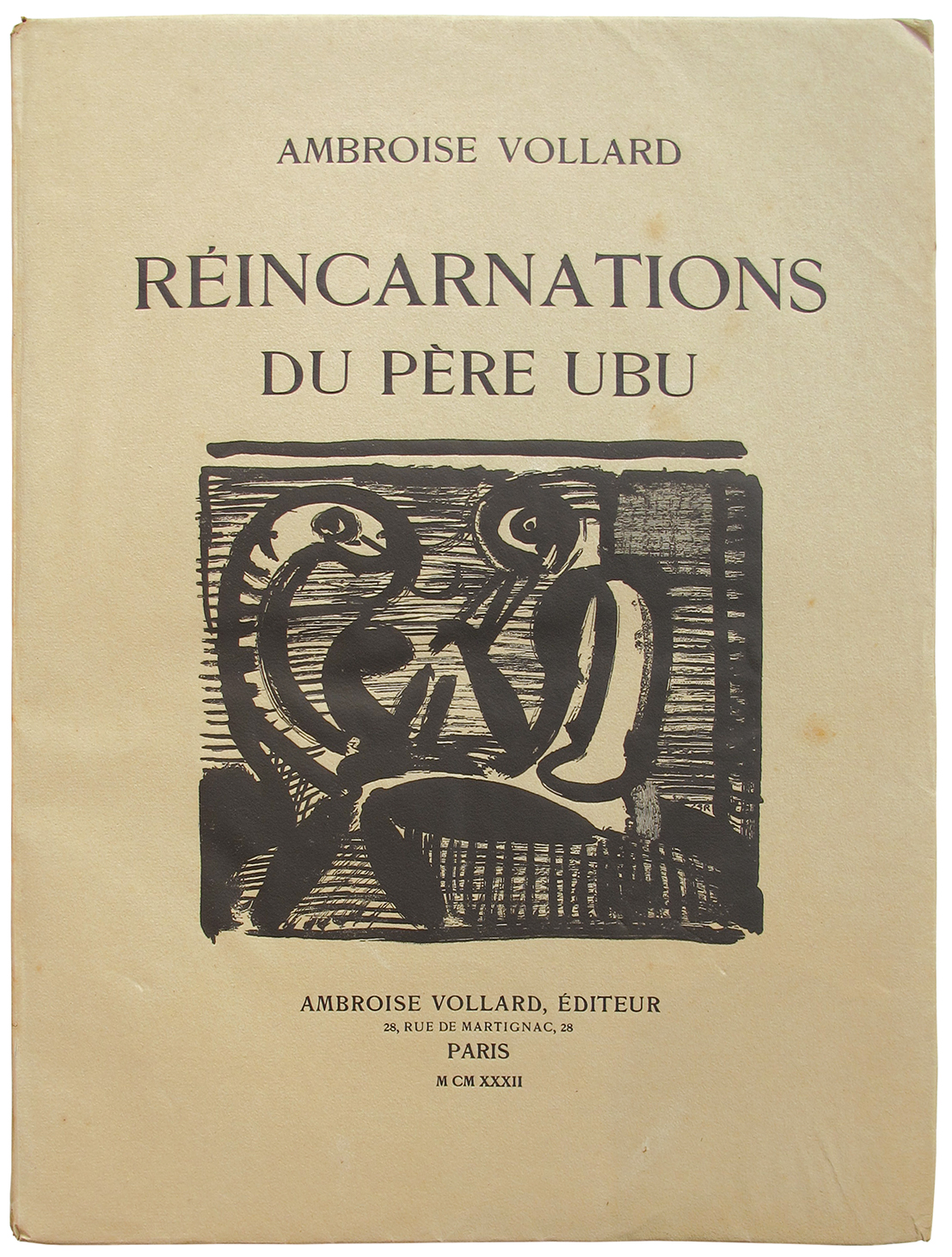
pp. vii, 192. 2 vols. Folio. (450 x 358 / 466 x 350 mm). Illustrated with 104 wood-engraved plates, vignettes and head- and tail-pieces (including the vignettes of the etchings in the 'Tables', the title vignette and that for the wrapper), all by Aubert after Rouault's originals and 22 full-page mixed etchings. Rouault's manuscript (sheet size c.443 x 328 mm) in black ink over pencil on 2 bifolia of thick cream paper forming eight pages recto and verso is accompanied by proof text (sheet size c.384 x 278 mm) of same printed recto only on five leaves of thin proofing paper - see below. Loose as issued in original publisher's wrappers with printed title and wood-engraved vignette after Rouault, later marbled board chemise and slipcase; manuscript loose in coarse weave cloth wrapper with manuscript title to front cover.
#48708