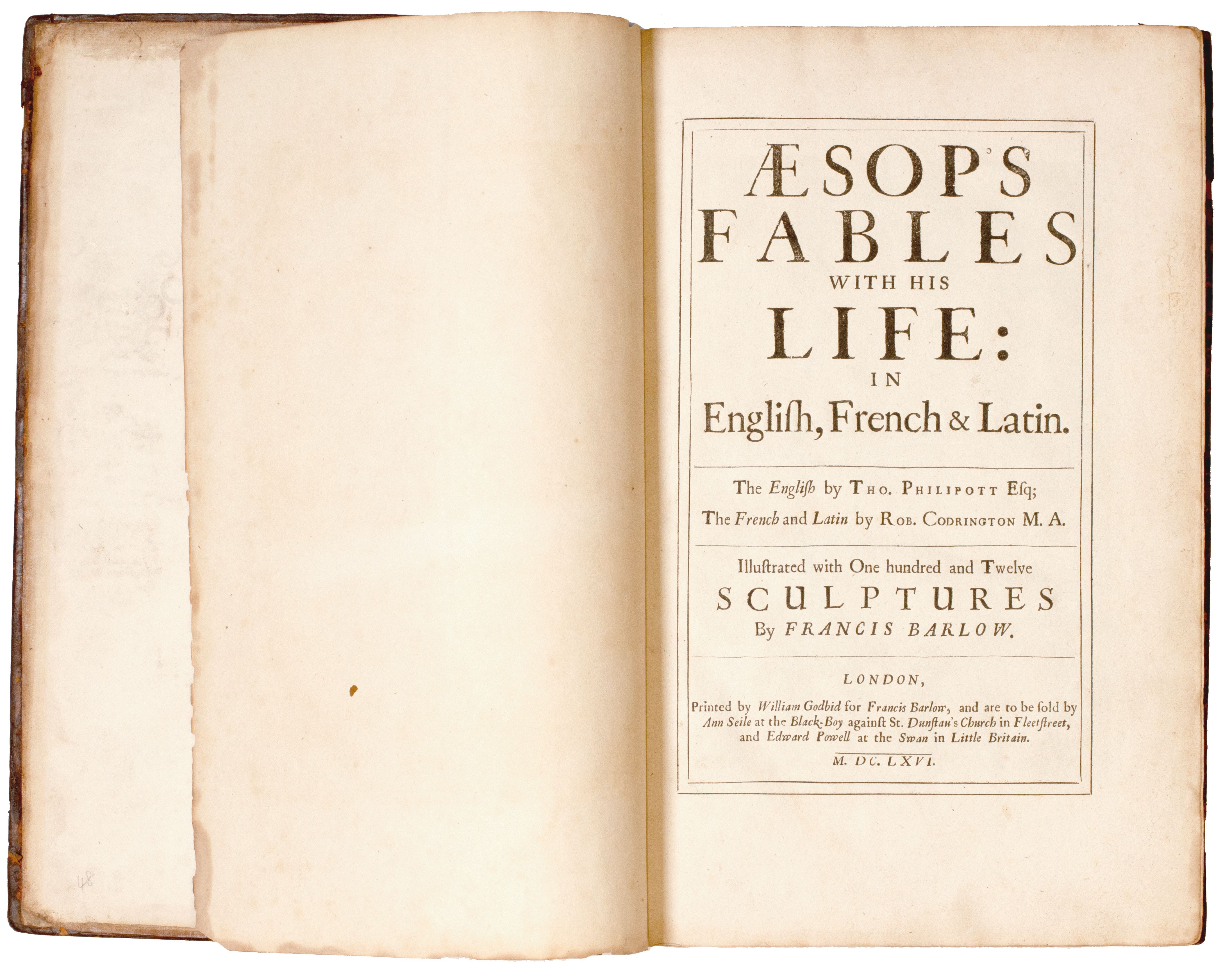
Aesop's Fables WIth His Life: in English, French & Latin
Barlow, Francis. (Aesop). Philipot, Thomas & Robert Codrington
London. Printed by William Godbid for Francis Barlow, and are to be sold by Ann Seile at the Black-Boy against St. Dunstan's Church in Fleetstreet, and Edward Powell at the Swan in Little Britain. 1666
A very rare large paper copy of the scarce first edition of Francis Barlow's undoubted masterpiece of English book illustration.
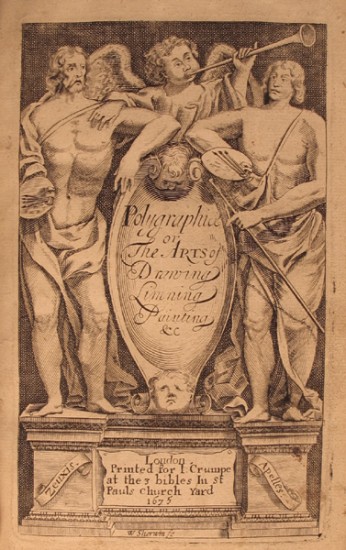
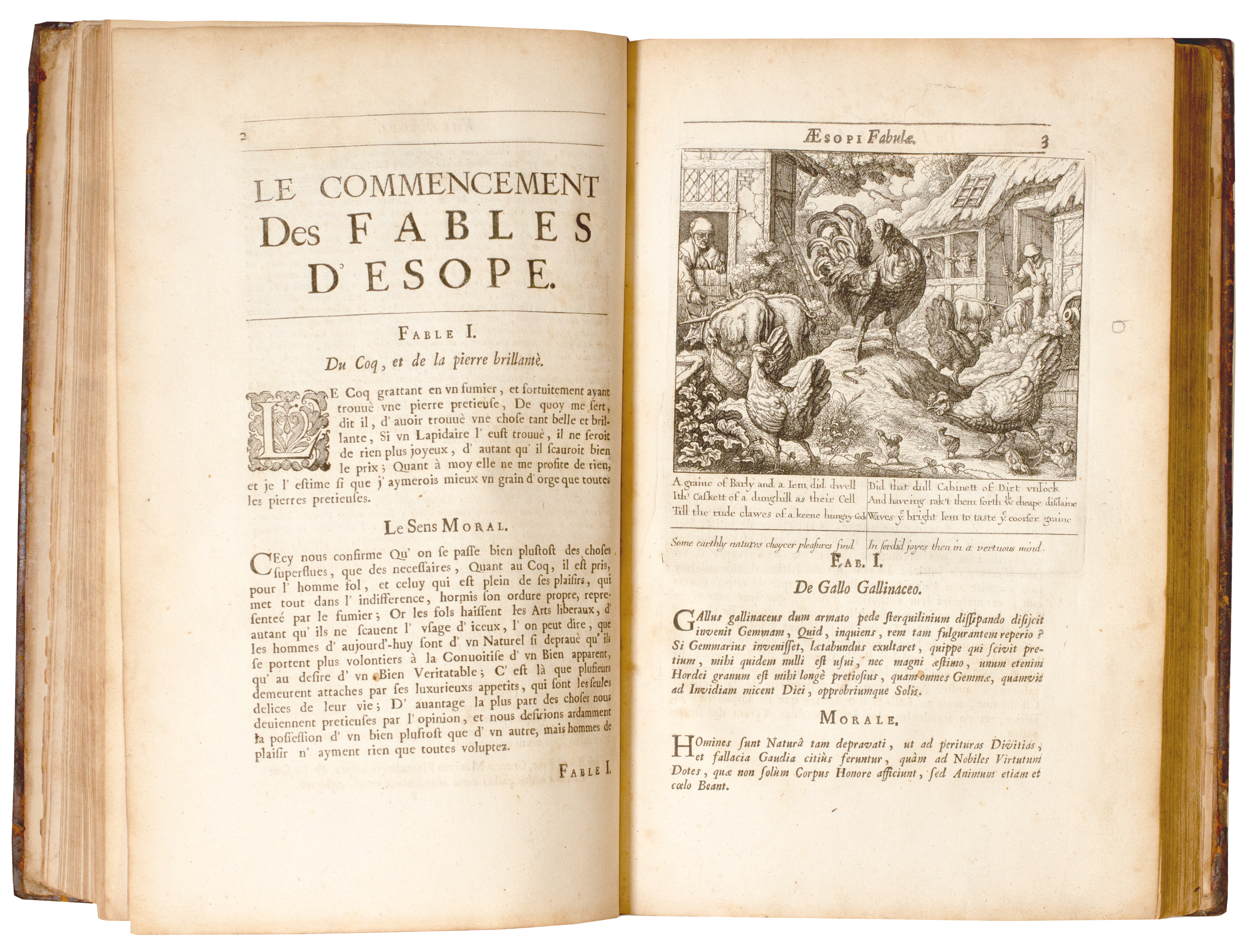
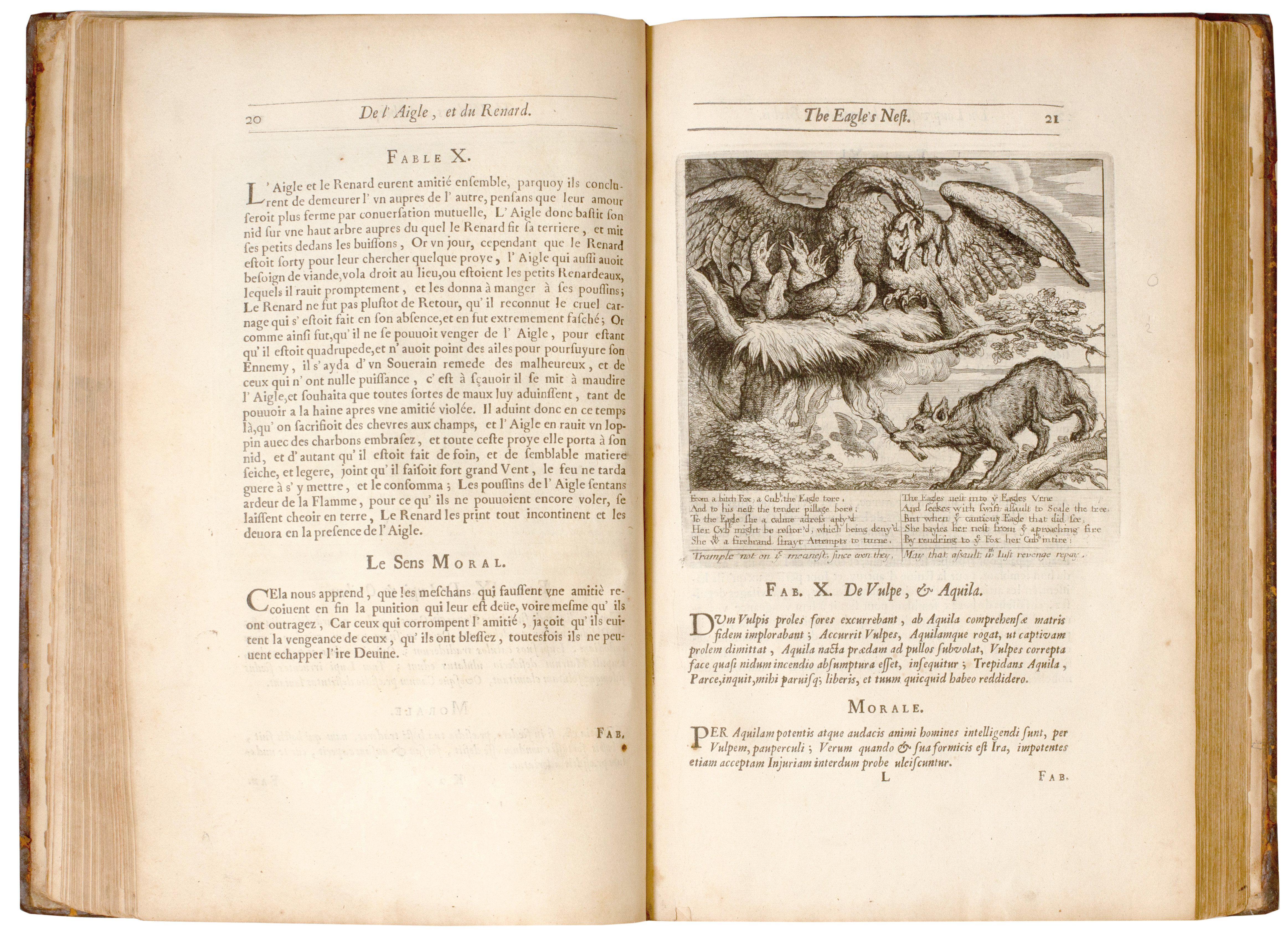
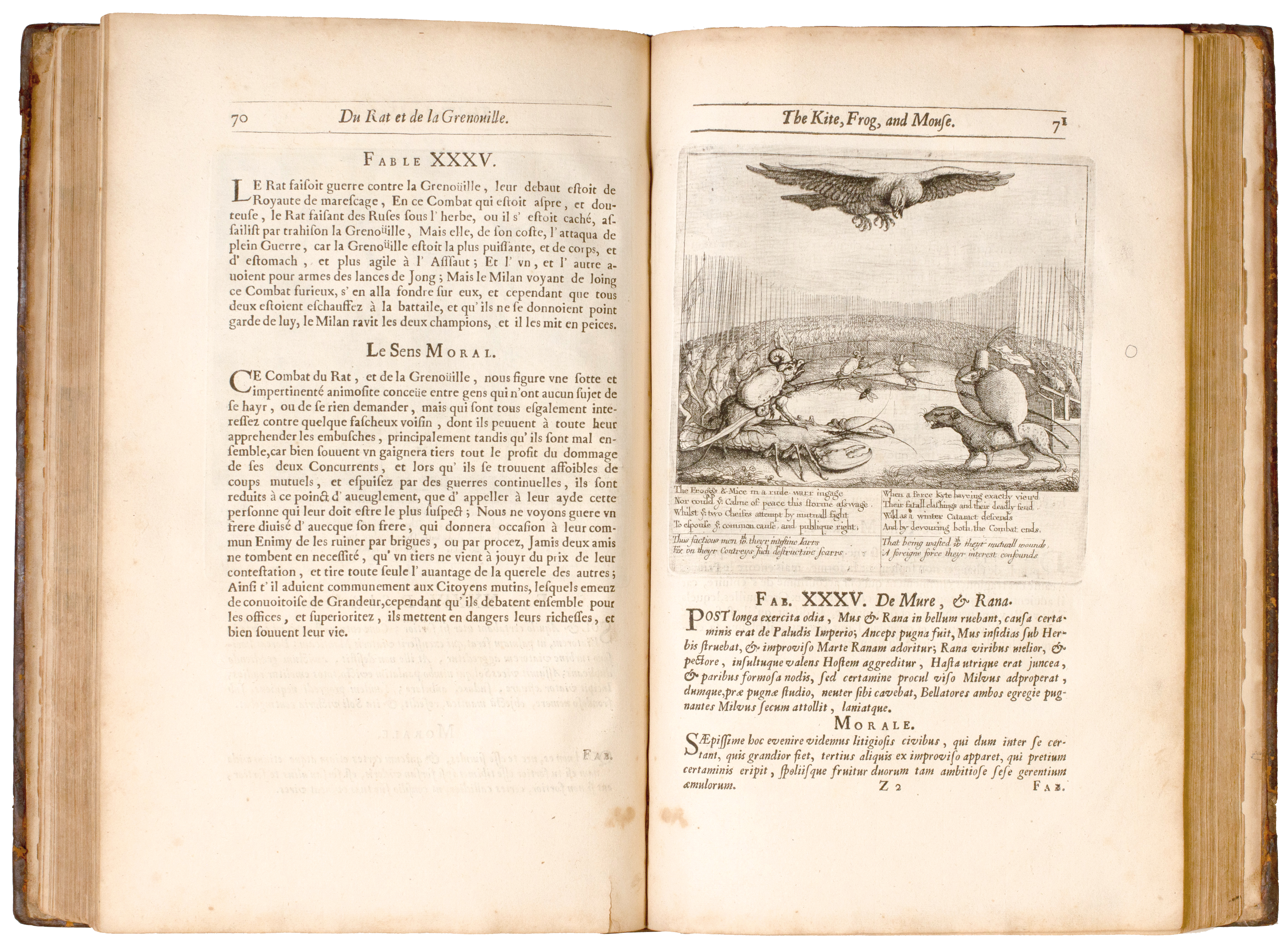
By the time of the Restoration Francis Barlow had achieved a measure of success with his suites of prints of animals - engraved by the best such as Hollar, Griffier and Place - and his decoration of houses and by the mid-1660s had contributed to the Aesop of Ogilby and Hollar. It is not entirely clear why he would wish to issue another edition of the Fables (Hofer suggests a competitive nature and a different projected audience) but by 1665 he had engraved a superb title (it bears that date) and by the time of publication in 1666 (the date to the letterpress title) had engraved a frontispiece of Aesop surrounded by animals and 110 half-page vignettes after his own drawings to illustrate the Fables. Each of the Fable engravings is accompanied by lines of verse by Thomas Philipott; the translations of Aesop's life into French and Latin was by Robert Codrington. Whatever Barlow's motivation, the result is one of the most extensive and beautiful English illustrated books of the seventeenth century, and one of the scarcest, the scarcity often attributed to the loss of the sheets in the Great Fire of London.
Large paper copies of this first edition are identifiable (see ESTC) through various issue points, all present here, but also as per Philip Hofer the transposition of some of Barlow's engravings. In the present copy the engraving for 'Fab. XLVIII' ('The Ant and Fly') is in fact that for 'Fab. XLXIX' ('The Ant and Grasshopper'). Hofer indicates too that the engravings for 'Fab. LXX' ('The Tortoise and Hare') and 'Fab. LXXI' (The Young Man and His Cat') are also transposed, however, in the present copy they are not (the margins, headlines etc. conform to the remaining large paper leaves) although 'The Young Man and His Cat' features the erroneous title 'The Nurse and Her Child' ('Fab. LXIX') albeit with the correct page number. Large paper copies also feature 'FINIS' beneath the signature Ppp at the foot of the leaf with the final engraving (for 'FAB. CX', 'The Tortoise & Eagle'); in addition the spacing of the text in the large paper copy also suggests that the text on this leaf was reset.
A second edition was published in 1687 with additional plates to illustrate the life of Aesop and with Philipott's verse replaced with new verse by Aphra Behn. A third edition was issued in 1703 and a posthumous French edition appeared in 1714, published in Amsterdam; Philip Hofer suggests that the third edition was really made up of unused sheets from the two earlier editions but with a new title and that the edition in French - it makes use of some of Barlow's plates - is not a Barlow edition.
'This seventeenth-century polyglot (English-French-Latin) Aesop is handsomely illustrated with engravings after designs by Francis Barlow (?1626 - 1702), an English painter renowned for his pictures of country life and field sports. (He was perhaps the finest English draughtsman of animal scenes in the seventeenth century.) Barlow, who published the book at his own expense, explains in his preface that he intends the work to contribute to the education of young people. This is the first edition; the relatively few copies known are all survivors of the Great Fire of London, which swept over the printer's premises in 1666.' (Early Children's Books and Their Illustration).
'No artist has responded with more sensitivity and less sentimentality to the gentle grace of deer ... The least of creatures, the frog, the hare, the snake, and the swallow, and the least favoured of them, the ass, the boar and the wolf -- he draws them all with an intimacy, charm, and inviolable integrity never surpassed in an English book ... '. (Edward Hodnett).
'Francis Barlow was the first native English book illustrator - indeed, the leading interpretativeillustrator in England before 1800 ... Otto Benesch of the Albertina Museum, Vienna has called him 'one of the greatest illustrators of all time'.' (Edward Hodnett).
This large paper issue of the 1666 Aesop is very scarce: while ESTC lists 17 copies for the small paper issue (see ESTC R21542) it notes only two of the large: the copy at the Huntington and that at the Morgan Library and Museum, New York; Harvard also holds a copy.
[ESTC R477463; see 'Francis Barlow' by Edward Hodnett, 1978; see #9 in the Morgan Library and Museum's 'Early Children's Books and Their Illustration', 1975; see Philip Hofer's 'Francis Barlow's Aesop' printetd in the Harvard Library Bulletin, Autumn 1948].
By the time of the Restoration Francis Barlow had achieved a measure of success with his suites of prints of animals - engraved by the best such as Hollar, Griffier and Place - and his decoration of houses and by the mid-1660s had contributed to the Aesop of Ogilby and Hollar. It is not entirely clear why he would wish to issue another edition of the Fables (Hofer suggests a competitive nature and a different projected audience) but by 1665 he had engraved a superb title (it bears that date) and by the time of publication in 1666 (the date to the letterpress title) had engraved a frontispiece of Aesop surrounded by animals and 110 half-page vignettes after his own drawings to illustrate the Fables. Each of the Fable engravings is accompanied by lines of verse by Thomas Philipott; the translations of Aesop's life into French and Latin was by Robert Codrington. Whatever Barlow's motivation, the result is one of the most extensive and beautiful English illustrated books of the seventeenth century, and one of the scarcest, the scarcity often attributed to the loss of the sheets in the Great Fire of London.
Large paper copies of this first edition are identifiable (see ESTC) through various issue points, all present here, but also as per Philip Hofer the transposition of some of Barlow's engravings. In the present copy the engraving for 'Fab. XLVIII' ('The Ant and Fly') is in fact that for 'Fab. XLXIX' ('The Ant and Grasshopper'). Hofer indicates too that the engravings for 'Fab. LXX' ('The Tortoise and Hare') and 'Fab. LXXI' (The Young Man and His Cat') are also transposed, however, in the present copy they are not (the margins, headlines etc. conform to the remaining large paper leaves) although 'The Young Man and His Cat' features the erroneous title 'The Nurse and Her Child' ('Fab. LXIX') albeit with the correct page number. Large paper copies also feature 'FINIS' beneath the signature Ppp at the foot of the leaf with the final engraving (for 'FAB. CX', 'The Tortoise & Eagle'); in addition the spacing of the text in the large paper copy also suggests that the text on this leaf was reset.
A second edition was published in 1687 with additional plates to illustrate the life of Aesop and with Philipott's verse replaced with new verse by Aphra Behn. A third edition was issued in 1703 and a posthumous French edition appeared in 1714, published in Amsterdam; Philip Hofer suggests that the third edition was really made up of unused sheets from the two earlier editions but with a new title and that the edition in French - it makes use of some of Barlow's plates - is not a Barlow edition.
'This seventeenth-century polyglot (English-French-Latin) Aesop is handsomely illustrated with engravings after designs by Francis Barlow (?1626 - 1702), an English painter renowned for his pictures of country life and field sports. (He was perhaps the finest English draughtsman of animal scenes in the seventeenth century.) Barlow, who published the book at his own expense, explains in his preface that he intends the work to contribute to the education of young people. This is the first edition; the relatively few copies known are all survivors of the Great Fire of London, which swept over the printer's premises in 1666.' (Early Children's Books and Their Illustration).
'No artist has responded with more sensitivity and less sentimentality to the gentle grace of deer ... The least of creatures, the frog, the hare, the snake, and the swallow, and the least favoured of them, the ass, the boar and the wolf -- he draws them all with an intimacy, charm, and inviolable integrity never surpassed in an English book ... '. (Edward Hodnett).
'Francis Barlow was the first native English book illustrator - indeed, the leading interpretativeillustrator in England before 1800 ... Otto Benesch of the Albertina Museum, Vienna has called him 'one of the greatest illustrators of all time'.' (Edward Hodnett).
This large paper issue of the 1666 Aesop is very scarce: while ESTC lists 17 copies for the small paper issue (see ESTC R21542) it notes only two of the large: the copy at the Huntington and that at the Morgan Library and Museum, New York; Harvard also holds a copy.
[ESTC R477463; see 'Francis Barlow' by Edward Hodnett, 1978; see #9 in the Morgan Library and Museum's 'Early Children's Books and Their Illustration', 1975; see Philip Hofer's 'Francis Barlow's Aesop' printetd in the Harvard Library Bulletin, Autumn 1948].
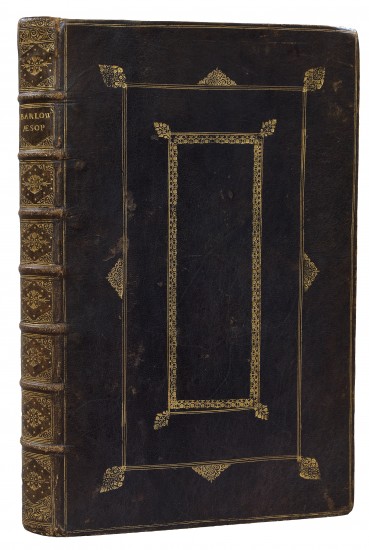
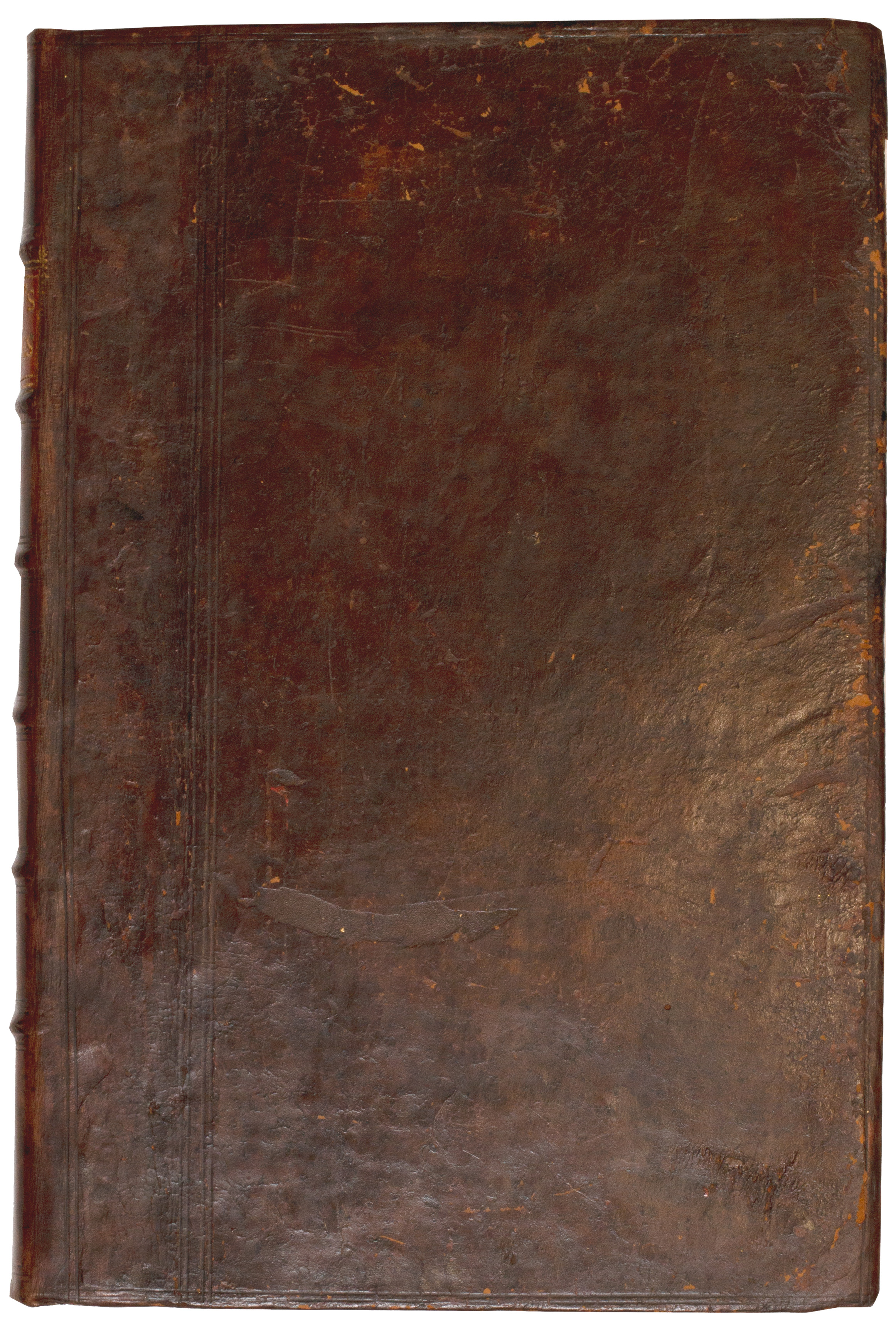
[161 leaves including additional engraved title; pp. (i), (i), (iii), (i), 40, 31, 17, 2 - 221, (ii)]. Folio. (356 x 242 mm). Printed title within double rules, engraved title by Barlow with central title within elaborate cartouche and surrounded by an eagle, leopard, boar, fox, wolf and lion, leaf with large decorative woodcut inhabited ten-line initial and Barlow's dedication to Sir Francis Pruijan (or Prujean), leaf with Barlow's 'To the Reader', leaf with engraved frontispiece of Aesop with animals and additional engraving with text beneath, 20 leaves with 'A Brief Prospect of the Life of Aesop', 16 leaves with 'La Vie d'Esope', 9 leaves with 'Aesopi Philosophice Fabulantis, Vita' and Aesop's 110 fables illustrated with 110 engravings, final leaves with 'La Table' and 'The Table', decorative woodcut initials and tail-pieces throughout; sheet size: 350 x 228 mm. Full contemporary calf, boards ruled in blind, later spine with red morocco label with gilt title and blind rules in seven compartments, marbled edges.
#48718