Poésie de Mots Inconnus
Iliazd
Paris. Le Degré 41. 1949
A very fine copy of Iliazd's typographic masterpiece of visual, phonetic and sound poetry, preserved, as intended, unbound.
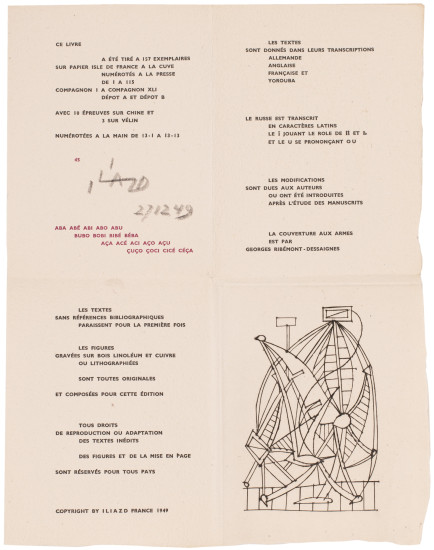
From the edition limited to 158 copies on papier Isle de France à la cuve, with this one of 115 numbered in Arabic numerals in red to the justification (i.e. leaf '3' with Dominguez' engraving) and signed and dated '271249' in black crayon by Iliazd; a further 41 'exemplaires de compagnon' numbered in Roman numerals and two 'dépot' copies all on the same paper and 13 proofs on vellum or chine were also issued.
This anthology of 'forgotten phonetic poetry' by Georgian-born poet-publisher Iliazd was published as his response to an intellectual argument against the Lettrists and Isidore Isou. Iliazd had assembled examples of visual and sound poetry (dada, Futurism, zaum, calligrammatic and so on) to demonstrate a historical context denied by the provocative Isidore Isou and a younger generation of iconoclastic Lettrists. A battle of letters had developed over the previous couple of years and 'Poésie de Mots Inconnus' was to be Iliazd's published riposte after the chaotic mélée that concluded his 1947 lecture 'Après Nous le Lettrisme'. Iliazd's response to the Lettrists was a remarkable interplay of typographic innovation and illustration, a demonstration of the novelties of the pioneers of visual poetry combined with the illustrative printing techniques of the visual avant garde (see below for a complete list of the poets and artists involved). As per Johanna Drucker: 'He [Iliazd] was not so much working at a mimetic redundancy of verbal and graphic qualities as he was demonstrating the theatrical potential of the page.'
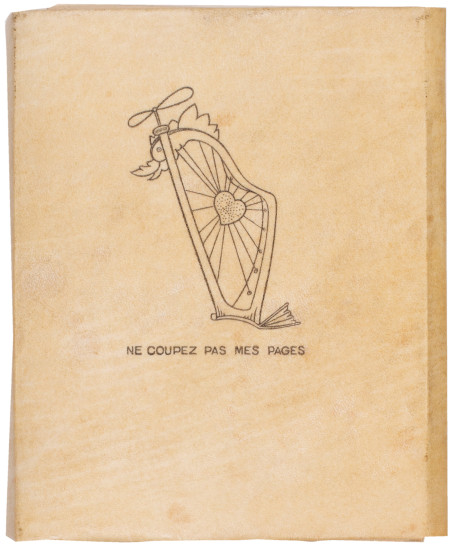
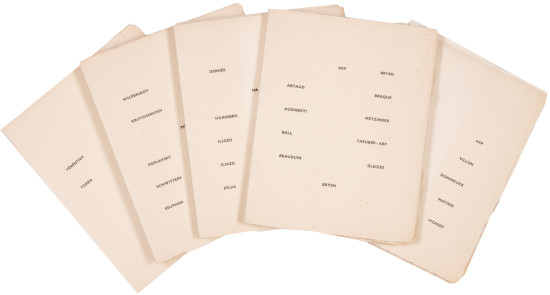
The texts were written between 1910 and 1948, starting with Velimir Khlebnikov and ending with Antonin Artaud, and consist of Russian Futurist texts and Dadaist writings from Paris, Zurich, and Berlin. The book has two formats, folded - as here - and unfolded in sheets and as for all of the books Iliazd published, he did not want the book to be cut or bound (Georges Ribemont-Dessaignes' exhortation 'Ne coupez pas mes pages' is printed in black to the front cover of the volume). For each author, he varies the composition of the page and the book is full of invention typical of this master of mise-en-page. In folded form, the book is solid, compact and almost sculptural, tactile and a beautiful object with a vellum jacket and overjacket with a pleated vellum spine: it is a book that must be handled to be appreciated, explored via manipulation. The importance of the work to Iliazd is clear, even if it brought him much anxiety. After the publication of 'Poésie de Mots Inconnus', Iliazd's oeuvre ceased to be retrospective; the work was the realisation of his highly respected role as editor / publisher / artist and the template for his meticulous future productions. The book was dedicated: 'in recognition of our companions' and the pages were printed by letterpress by Alexander Zasypkine and the Imprimerie Union.
'The simple issue at stake for Iliazd was that the innovative work of the early avant-garde, in which he had personally participated, was being erased. His sense of historical accuracy and his sense of personal pride were both affronted ...One very droll note from Iliazd to the editors of 'Libération' described his presence at a conference where Isou denounced his existence, and then, having denied that he existed, proceeded to describe in detail the various things Iliazd did not do ... Iliazd and the futurists and dadaists, Isou insisted, had copied Lettrism in the past, stealing their ideas from Isou and the future movement.' (Johanna Drucker).
'Ce livre édité par Iliazd vient en réponse aux prétentions novatrices des lettristes. Iliazd y rassemble vingt-et-un poètes et vingt-trois peintres. Poèmes de Akinsemomyin, Albert-Birot, Arp, Artaud, Audiberti, Ball, Beauduin, Bryen, Dermée, Hausmann, Huidobro, Iliazd, Jolas, Khlébnikov, Krutchonykh, Picasso, Poplavsky, Schwitters, Seuphor, Téréntiev, Tzara, ornés de gravures et lithographies par Arp, Braque, Bryen, Chagall, Dominguez, Férat, Giacometti, Gleizes, hausmann, Laurens, Léger, Magnelli, Masson, Matisse, Metzinger, Miro, Picasso, Survage, Taueber-Arp, Tytgat, Villon, Wols, Ribemont-Dessaignes.' (From the catalogue of the Fonds Iliazd in the Bibliothèque Kandinsky, Paris).
[Isselbacher 30 - 32; Chapon 293 / 294; see Cramer Picasso 54 & Miro 19; see Johanna Drucker's 'Iliazd - A Meta-Biography of a Modernist', 2020, pp. 160 - 174].
From the edition limited to 158 copies on papier Isle de France à la cuve, with this one of 115 numbered in Arabic numerals in red to the justification (i.e. leaf '3' with Dominguez' engraving) and signed and dated '271249' in black crayon by Iliazd; a further 41 'exemplaires de compagnon' numbered in Roman numerals and two 'dépot' copies all on the same paper and 13 proofs on vellum or chine were also issued.
This anthology of 'forgotten phonetic poetry' by Georgian-born poet-publisher Iliazd was published as his response to an intellectual argument against the Lettrists and Isidore Isou. Iliazd had assembled examples of visual and sound poetry (dada, Futurism, zaum, calligrammatic and so on) to demonstrate a historical context denied by the provocative Isidore Isou and a younger generation of iconoclastic Lettrists. A battle of letters had developed over the previous couple of years and 'Poésie de Mots Inconnus' was to be Iliazd's published riposte after the chaotic mélée that concluded his 1947 lecture 'Après Nous le Lettrisme'. Iliazd's response to the Lettrists was a remarkable interplay of typographic innovation and illustration, a demonstration of the novelties of the pioneers of visual poetry combined with the illustrative printing techniques of the visual avant garde (see below for a complete list of the poets and artists involved). As per Johanna Drucker: 'He [Iliazd] was not so much working at a mimetic redundancy of verbal and graphic qualities as he was demonstrating the theatrical potential of the page.'
The texts were written between 1910 and 1948, starting with Velimir Khlebnikov and ending with Antonin Artaud, and consist of Russian Futurist texts and Dadaist writings from Paris, Zurich, and Berlin. The book has two formats, folded - as here - and unfolded in sheets and as for all of the books Iliazd published, he did not want the book to be cut or bound (Georges Ribemont-Dessaignes' exhortation 'Ne coupez pas mes pages' is printed in black to the front cover of the volume). For each author, he varies the composition of the page and the book is full of invention typical of this master of mise-en-page. In folded form, the book is solid, compact and almost sculptural, tactile and a beautiful object with a vellum jacket and overjacket with a pleated vellum spine: it is a book that must be handled to be appreciated, explored via manipulation. The importance of the work to Iliazd is clear, even if it brought him much anxiety. After the publication of 'Poésie de Mots Inconnus', Iliazd's oeuvre ceased to be retrospective; the work was the realisation of his highly respected role as editor / publisher / artist and the template for his meticulous future productions. The book was dedicated: 'in recognition of our companions' and the pages were printed by letterpress by Alexander Zasypkine and the Imprimerie Union.
'The simple issue at stake for Iliazd was that the innovative work of the early avant-garde, in which he had personally participated, was being erased. His sense of historical accuracy and his sense of personal pride were both affronted ...One very droll note from Iliazd to the editors of 'Libération' described his presence at a conference where Isou denounced his existence, and then, having denied that he existed, proceeded to describe in detail the various things Iliazd did not do ... Iliazd and the futurists and dadaists, Isou insisted, had copied Lettrism in the past, stealing their ideas from Isou and the future movement.' (Johanna Drucker).
'Ce livre édité par Iliazd vient en réponse aux prétentions novatrices des lettristes. Iliazd y rassemble vingt-et-un poètes et vingt-trois peintres. Poèmes de Akinsemomyin, Albert-Birot, Arp, Artaud, Audiberti, Ball, Beauduin, Bryen, Dermée, Hausmann, Huidobro, Iliazd, Jolas, Khlébnikov, Krutchonykh, Picasso, Poplavsky, Schwitters, Seuphor, Téréntiev, Tzara, ornés de gravures et lithographies par Arp, Braque, Bryen, Chagall, Dominguez, Férat, Giacometti, Gleizes, hausmann, Laurens, Léger, Magnelli, Masson, Matisse, Metzinger, Miro, Picasso, Survage, Taueber-Arp, Tytgat, Villon, Wols, Ribemont-Dessaignes.' (From the catalogue of the Fonds Iliazd in the Bibliothèque Kandinsky, Paris).
[Isselbacher 30 - 32; Chapon 293 / 294; see Cramer Picasso 54 & Miro 19; see Johanna Drucker's 'Iliazd - A Meta-Biography of a Modernist', 2020, pp. 160 - 174].
[29 leaves including terminal blank each folded in 4]. Small 8vo. (175 x 138 mm). Letterpress text by various poets throughout, several leaves with additional overprinting in colour, each illustrated by various artists with linocut, woodcut, lithograph, etching, burin engraving or drypoint, several in colour; sheet size: c.320 x 245 mm. Uncut sheets with deckle edges as issued loose in 5 chemises. Poems and illustration printed recto only with attributions and numbering of leaves (2 - 24) verso, terminal blank and final two sheets with printed title: 'AVIS MUET AU RELIEUR' otherwise blank stitched as issued. Loose as issued in original publisher's printed paper wrappers with contributors to each volume in black to front wrapper, two thick paper jackets, original parchment wrapper with the winged harp vignette by Ribemont-Dessaignes and 'NE COUPEZ PAS MES PAGES' in black to front cover and title stamped in blind to spine, original pleated parchment envelope with title stamped in blind to spine and original two part protective card cartonnage, title in blind to spine with white paper label with printed number in red matching that to the justification.
#48764