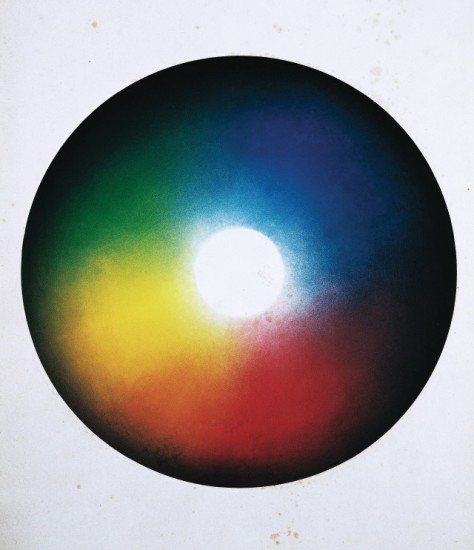
Cercle Chromatique. Presentant tous les complements et toutes les harmonies de couleurs. Avec une introduction sur la theorie generale de la dynamogenie autrement dit du contraste, du rythme et de la mesure
Henry, Charles
Paris. Charles Verdin. 1889
Sold
Rare copy of Henry's rare work on colour.
This copy number 161 of an unspecified edition, signed by the publisher.
For the Neo-Impressionists, pioneered by Seurat, the rational laws governing visual experience were paramount. Seurat took advantage of many of the discoveries made by his contemporaries in the physics of light and colour, visual perception, and the psychology of the affective value of colour, tone, and line. Seurat's new theory of expression was extended by discoveries using geometry and algebra which surfaced through his contact with the mathematician and aesthetician, CharlesHenry, (they first met in 1886).
Charles Henry was gifted with equal talent in the fields of mathematics, physics, aesthetics, and psychology and published prolifically on all of these subjects. Beginning in 1884 he became increasingly interested in art, especially in the problem of formulating a scientifically valid system of aesthetics. Henry prescribed a formulation of theories grounded in mathematical reasoning and in discoveries that related to the physical laws of colour and light. This formula was based in part on the geometry and algebra of the golden section. His theories were to serve as a device that would enable artists to guarantee harmonious results in any given visual configuration.
Much of the text in this present work is related to Henry's device which he called rapporteur esthetique, or aesthetic protractor. His rapporteur esthetique was based on an algebraic formula that would determine which changes in the direction of lines, expressed as radii extending from the centre of a circle to its circumference, would be rhythmical. The intent of which was to arrive at a rational classification of colours and a knowledge of the laws of their harmony. This lead Henry to develop his renowned circular form, the cercle chromatique, where he plotted colours in assignment with variable rhythmical intervals. The angles were studied to have an intrinsic expressive value satisfying harmoniously corresponding colour and direction. Henry, with the circle, developed a new psycho-physical aesthetic, relating lines and colours to emotional expression, and it was this that so fascinated Seurat and the neo-impressionists.
This copy number 161 of an unspecified edition, signed by the publisher.
For the Neo-Impressionists, pioneered by Seurat, the rational laws governing visual experience were paramount. Seurat took advantage of many of the discoveries made by his contemporaries in the physics of light and colour, visual perception, and the psychology of the affective value of colour, tone, and line. Seurat's new theory of expression was extended by discoveries using geometry and algebra which surfaced through his contact with the mathematician and aesthetician, CharlesHenry, (they first met in 1886).
Charles Henry was gifted with equal talent in the fields of mathematics, physics, aesthetics, and psychology and published prolifically on all of these subjects. Beginning in 1884 he became increasingly interested in art, especially in the problem of formulating a scientifically valid system of aesthetics. Henry prescribed a formulation of theories grounded in mathematical reasoning and in discoveries that related to the physical laws of colour and light. This formula was based in part on the geometry and algebra of the golden section. His theories were to serve as a device that would enable artists to guarantee harmonious results in any given visual configuration.
Much of the text in this present work is related to Henry's device which he called rapporteur esthetique, or aesthetic protractor. His rapporteur esthetique was based on an algebraic formula that would determine which changes in the direction of lines, expressed as radii extending from the centre of a circle to its circumference, would be rhythmical. The intent of which was to arrive at a rational classification of colours and a knowledge of the laws of their harmony. This lead Henry to develop his renowned circular form, the cercle chromatique, where he plotted colours in assignment with variable rhythmical intervals. The angles were studied to have an intrinsic expressive value satisfying harmoniously corresponding colour and direction. Henry, with the circle, developed a new psycho-physical aesthetic, relating lines and colours to emotional expression, and it was this that so fascinated Seurat and the neo-impressionists.
pp. (iv), vi, 56. Large folio. With large single colour engraved plate, Henry's chromatic circle. The circle is cut and mounted onto a larger sheet (engraved by Rapine and printed by Ch. Chardon). Bound in original printed boards, later rebacking in red quarter cloth.
#22578