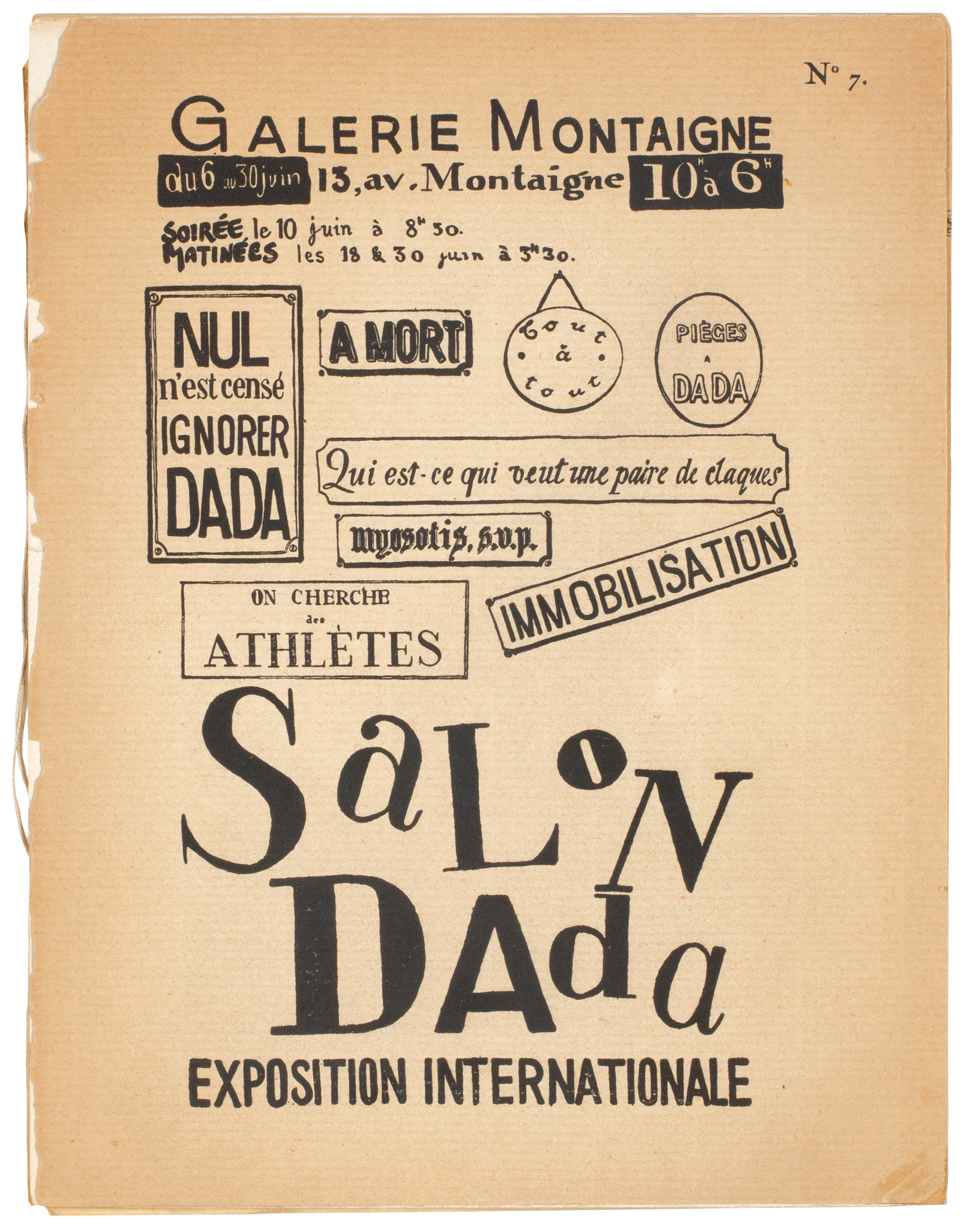
SaLoN DAda. Exposition Internationale
Arp, Hans, Georges Ribemont-Dessaignes, Max Ernst & Marcel Duchamp. Tzara, Tristan, Philippe Soupault, Benjamin Péret, Louis Aragon et al
Paris. (Imprimerie Crémieu). 1921
A presentation copy of the very scarce 'SaLoN DAda' with the rare invitation to the highly controversial 'Soirée dada'.
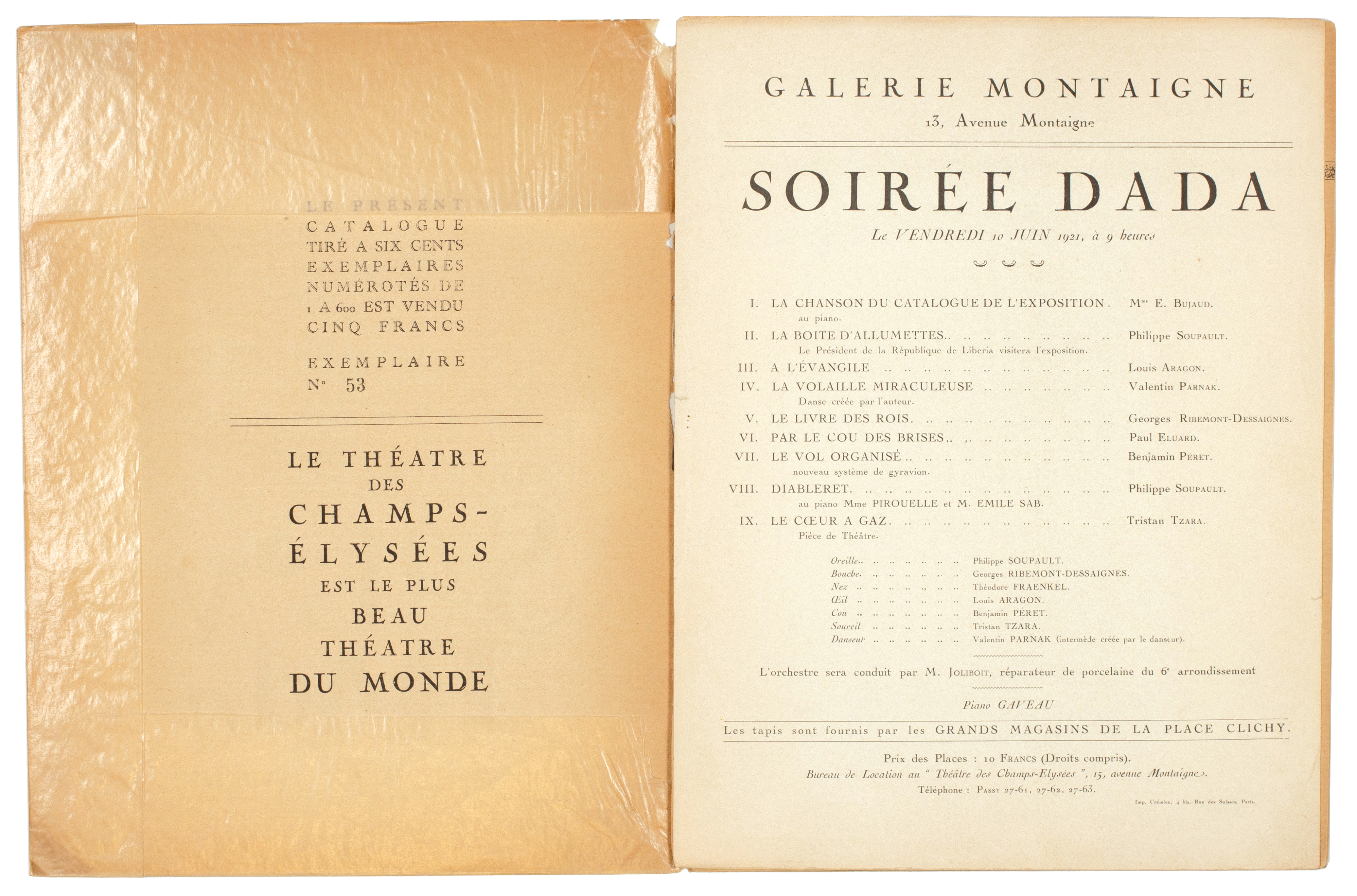
From the edition limited to 600 numbered copies, each stamp-numbered to the justification to front wrapper verso.
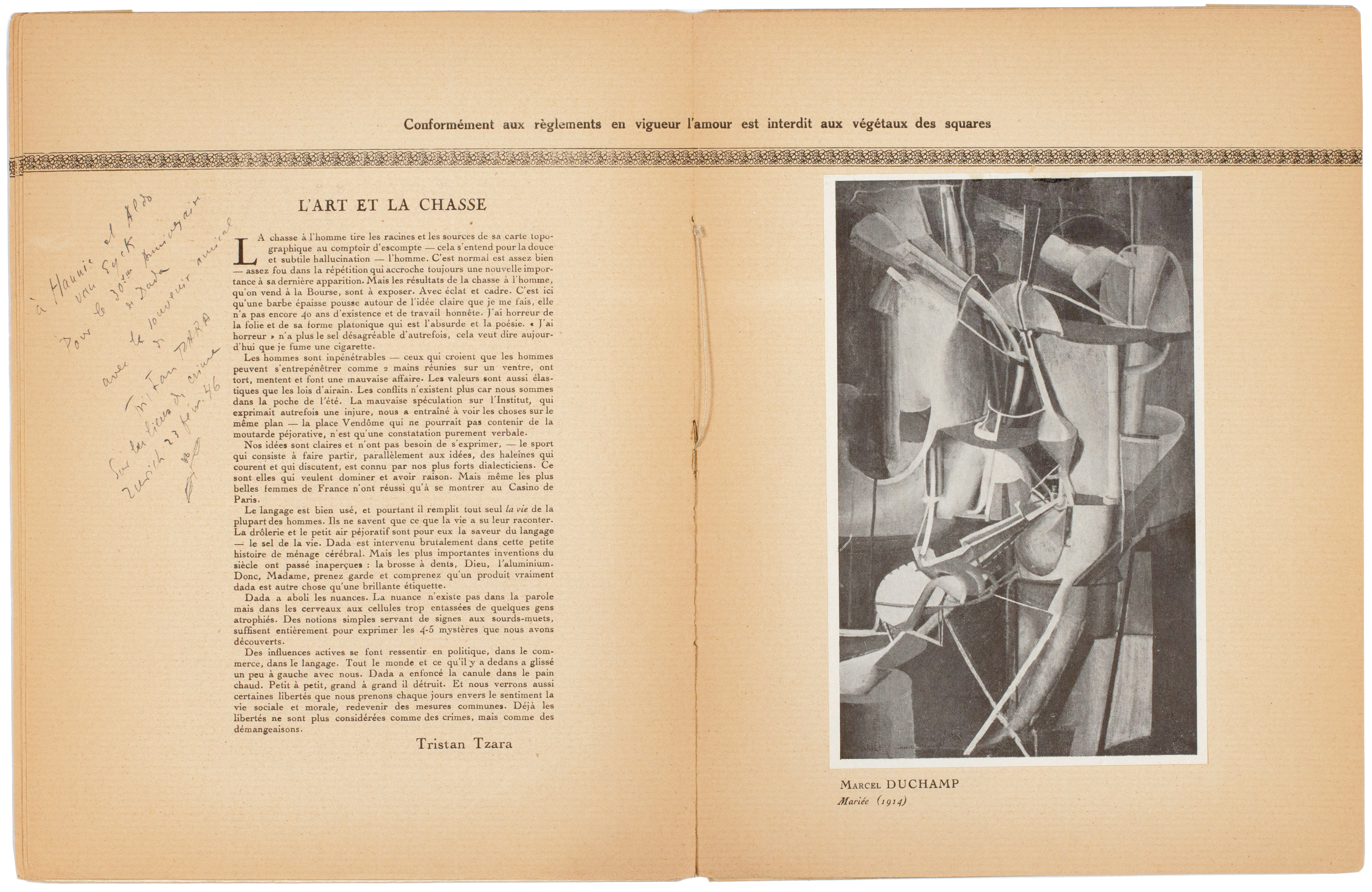
Tristan Tzara's presentation is in black ink to the left-hand margin of the centre spread: 'à Hannie et Aldo / van Eyck / Pour le 30ème Anniversaire / de Dada // avec le souvenir amical / de / Tristan TZARA / Sur les lieux du crime / Zürich 23 févr. 46' and with a typical Tzara sketch of a flower.
The spread includes (above) the legend 'Conformément aux règlements en vigueur l'amour est interdit aux végétaux des squares', (at left) Tzara's 'L'art et la chasse' and (at right) the tipped-in illustration of Duchamp's 'Mariée'.
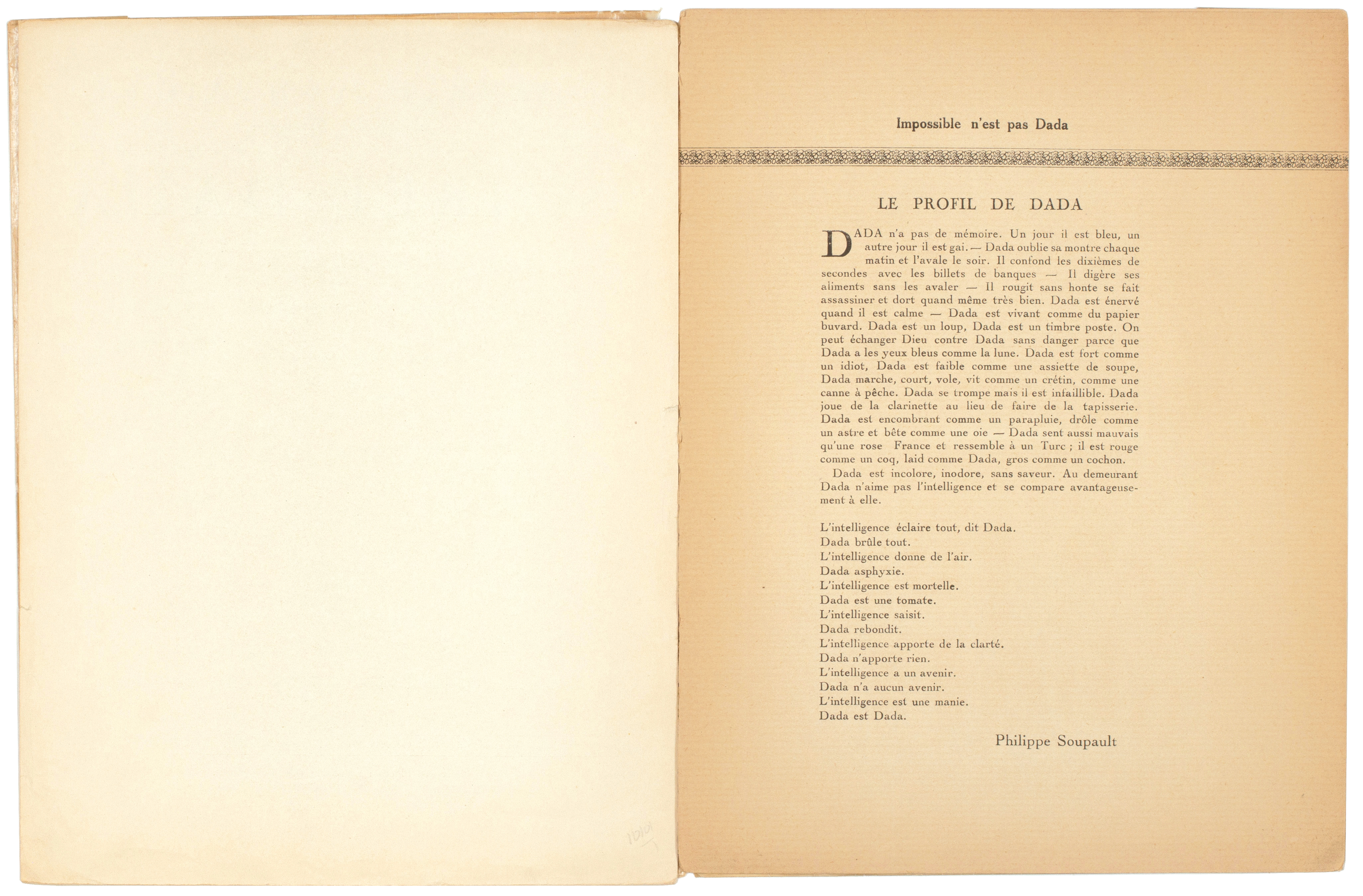
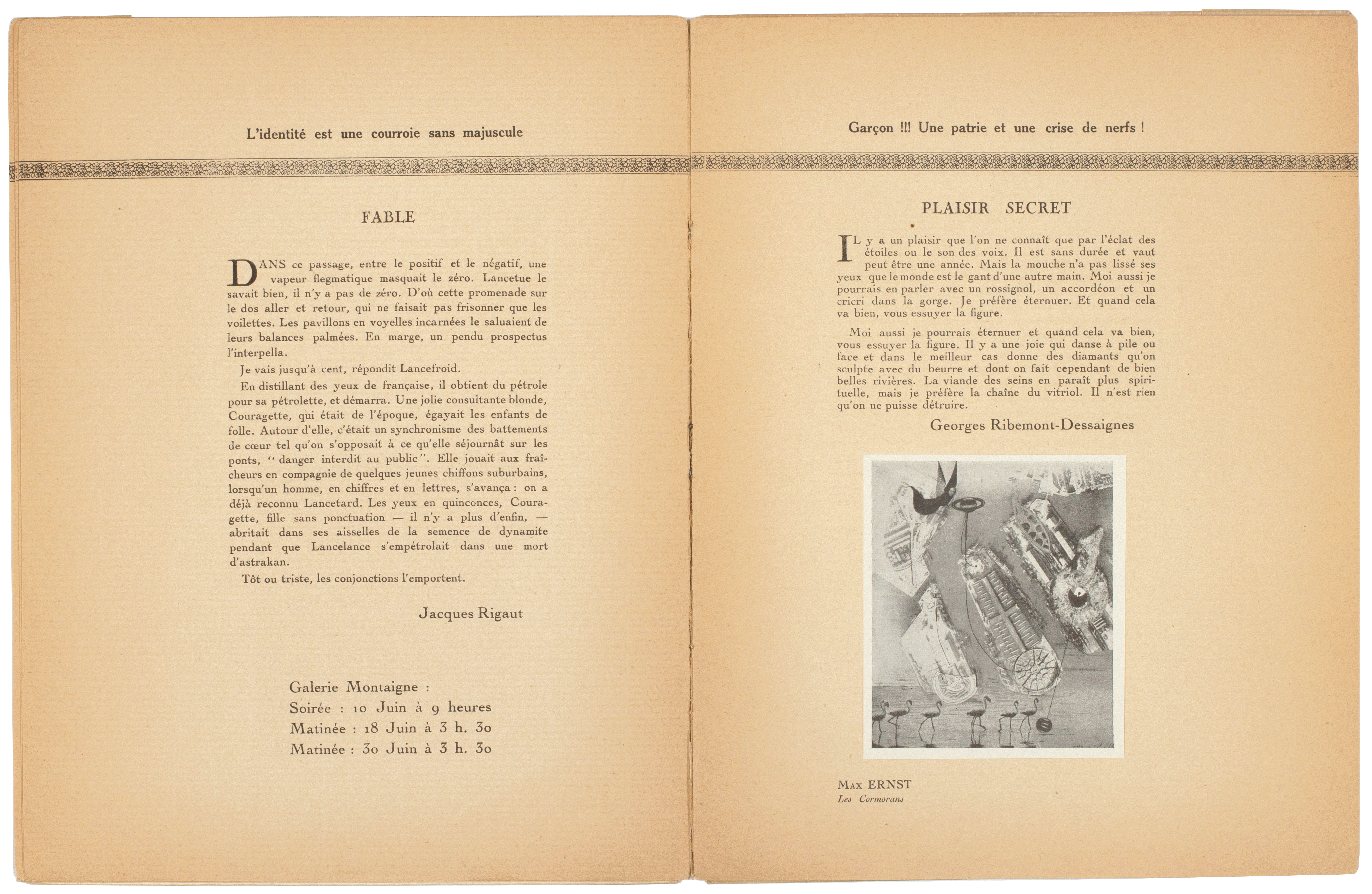
Opening with Philippe Soupault's 'Le Profil de dada', the catalogue 'SaLoN DAda' represents both the highwater mark and the beginning of the end of dada in Paris. 'SaLoN DAda' was convened in June 1921, after Picabia had left the movement (although he was to return) despite all he had done to initiate 'SaLoN DAda', Breton did not participate and Duchamp had departed both physically for New York and metaphorically: although his contribution to the catalogue (the reproduction of his painting 'Mariée') remains, his contributions to the exhibition (nos. '28' to '31' under his name are blank) were removed. 'SaLoN DAda' as an exhibition held at the Galerie Montaigne (within the Théâtre des Champs-Elysées) was largely successful albeit not without controversy, featuring international contributions from Arp, Baargeld, Man Ray, Charchoune, Walther Mehring, J. Evola, Aldo Fiozzi and Joseph Stella, as well as Jacques Rigaut, Jacques Vaché, Gala and Paul Eluard and Théodore Fraenckel among others.
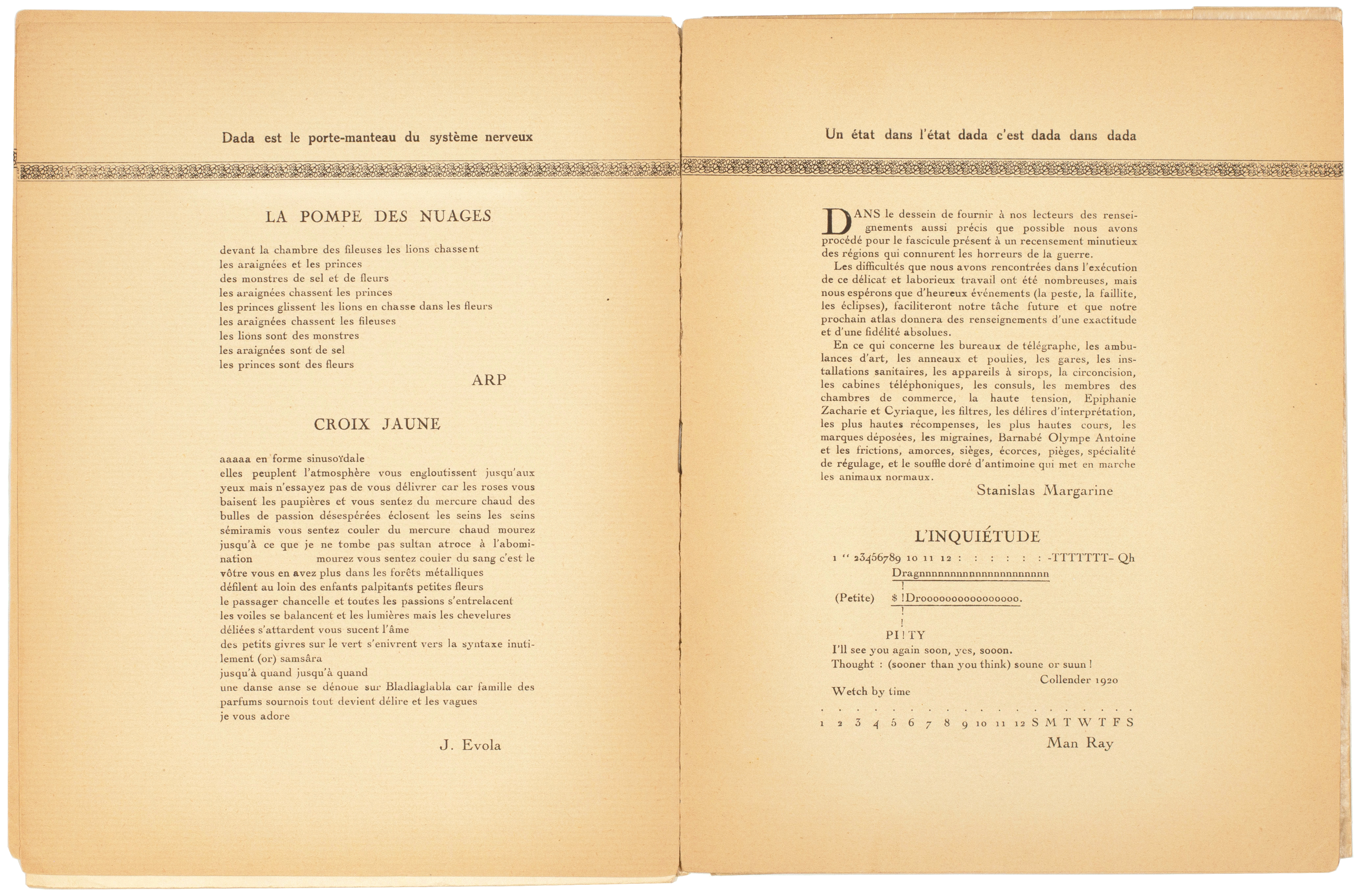
Literary contributors include the aforementioned Soupault ('Le Profil de dada'), Paul Eluard ('L'Ombre aux soupirs'), Arp (as poet: 'Le Pompe des nuages' from the German 'Die Wolkenpumpe'), J. Evola ('Croix jaune'), Stanislas Margarine [sic] (untitled), Man Ray ('L'Inquiétude'), Jacques Rigaut ('Fable'), Georges Ribemont-Dessaignes ('Plaisir secret'), Tzara (as above and 'Epiderme de la nuit croissance'), Benjamin Péret ('Mémoires de Benjamin Péret' and 'Mystère de ma naissance') and Louis Aragon ('Autre procès-verbal').
Also included, inserted loose, is the announcement for 'Soirée dada'. A single sheet of cream glossy paper printed in black recto only (270 x 206 mm), the announcement details the soirée to be held on June 10th, 1921, at 9 o'clock in the Galerie Montaigne with a programme of nine performances. Tickets were available for 10 Francs and for that price one could have seen the following: I. 'La Chanson du catalogue de l'exposition (au piano)' by Mme E. Bujaud; II. 'La Boite d'allumettes (Le Président de la République de Liberia visitera l'exposition)' by Philippe Soupault; III. 'A l'évangile' by Louis Aragon; IV. 'La Volaille miraculeuse (Danse créée par l'auteur)' by Valentin Parnak; V. 'Le livre des rois' by Georges Ribemont-Dessaignes; VI. 'Par le cou des brises' by Paul Eluard; VII. Le vol organisé (nouveau système de gyravion) by Benjamin Péret; VIII. 'Diableret (au piano Mmme. Pirouelle et M. Emile Sab)' by Philippe Soupault; IX. 'Le coeur à gaz (Pièce de Théâtre)' by Tristan Tzara.
The performances were absurd and the reception mixed at best. By the time of the performance of 'Le Coeur à gaz', with a coterie of dadaists taking part, the audience was riotous: 'Après l'entracte, la troupe des dadaïstes représente 'Le Coeur à gaz' de Tzara. La pièce, totalement absurde, est lue avec une accentuation grossière et provoque l'hilarité du public qui exprime son mécontentement en partant massivement et bruyamment. Une fois de plus, Dada réussit à faire scandale ... ' (Xavier Rey). Tzara's drama was performed again - and again aroused a furore - in 1923 at the final rupture of Paris dada; it was not published in book form until Guy Lévis Mano's edition in 1946.
'Ce projet, en germe depuis que le Salon des Indépendants a refusé de l'integrer à son programme, tient autant de Tzara que de Picabia ... La création dada parisienne se présente à son apogée, provocation, humour talentueux et inventions incongrues agrémentant un programme particulièrement riche. L'exposition ouvre le 6 juin dans le hall du studio des Champs-ELysées, au huitième étage du théâtre, baptisé pour l'occasion 'galerie Montaigne' ... Tzara parvient ainsi a réaliser ce qu'il recherche tant: la fusion entre les poètes et les artistes plasticiens dans une exposition inattendue qui abolit la frontière entre les genres ... Ce catalogue, tout comme la plupart des cartons d'invitation et le programme, témoigne d'un certain retour à la rigueur typographique ... La parole dadaïste trouve tout son éclat dans cette mise en page régulière, dotée d'une frise guindée ... '. (Xavier Rey).
Aldo van Eyck (1918 - 1999) and Hannie van Rooijen (1918 - 2018) were influential Dutch architects of international repute. In the 1940s the couple lived in Zurich where through Siegfried Giedion and Carola Giedion-Welcker they met a number of the artists and poets connected to dada: Arp, Tzara, Ernst, Brancusi and others; these friendships led too to a connection with CoBrA and, of course, through the architecture they held in common, Constant. Initially the pair collaborated or worked separately but from 1983 - Aldo's own studio with Theo Bosch was closed - they formed the partnership 'A+H van Eyck Architecten BV'.
'SaLoN DAda' is both rare and fragile and it seems likely that many fewer than the 500 examples listed on the justification were actually printed; certainly fewer survive. We trace only a small number of copies at auction in the last fifty years with even Bolliger describing the catalogue as 'Der seltene Katalog dieser wichtigsten internationalen Dada-Ausstellung'. We trace copies at the Israel Museum, Yale, the New York Public Library and the Bibliothèque Kandinsky in Paris, other examples are held at MoMA, the National Art Library at the V & A in London and the Getty too as part of the Jean Brown collection of dada and Surrealist ephemera. 'Soirée dada' is also rare and is held by MoMA, Iowa, the Ransom Center in Texas, Yale, the Art Institute of Chicago and the New York Public Library in the US, a further example is held by the National Art Library in the UK.
The present copy of 'SaLoN DAda' is, as noted, fragile, but the separation of the wrappers at the spine with some chipping and toning to the leaves aside, represents a remarkable survival: the copy remains complete and retains both the original staple and glassine. The announcement for 'Soirée dada' has only some very small bumps to the head of the leaf and some minor toning to the edges and remains in very good condition.
[see Xavier Rey's 'Paris Manifestations 1921' in 'DADA', Editions du Centre Pompidou, Paris, 2006, pp. 774 - 777; Bolliger II, 95 & III, 28 (SaLoN DAda) and II, 96 (Soirée dada)].
From the edition limited to 600 numbered copies, each stamp-numbered to the justification to front wrapper verso.
Tristan Tzara's presentation is in black ink to the left-hand margin of the centre spread: 'à Hannie et Aldo / van Eyck / Pour le 30ème Anniversaire / de Dada // avec le souvenir amical / de / Tristan TZARA / Sur les lieux du crime / Zürich 23 févr. 46' and with a typical Tzara sketch of a flower.
The spread includes (above) the legend 'Conformément aux règlements en vigueur l'amour est interdit aux végétaux des squares', (at left) Tzara's 'L'art et la chasse' and (at right) the tipped-in illustration of Duchamp's 'Mariée'.
Opening with Philippe Soupault's 'Le Profil de dada', the catalogue 'SaLoN DAda' represents both the highwater mark and the beginning of the end of dada in Paris. 'SaLoN DAda' was convened in June 1921, after Picabia had left the movement (although he was to return) despite all he had done to initiate 'SaLoN DAda', Breton did not participate and Duchamp had departed both physically for New York and metaphorically: although his contribution to the catalogue (the reproduction of his painting 'Mariée') remains, his contributions to the exhibition (nos. '28' to '31' under his name are blank) were removed. 'SaLoN DAda' as an exhibition held at the Galerie Montaigne (within the Théâtre des Champs-Elysées) was largely successful albeit not without controversy, featuring international contributions from Arp, Baargeld, Man Ray, Charchoune, Walther Mehring, J. Evola, Aldo Fiozzi and Joseph Stella, as well as Jacques Rigaut, Jacques Vaché, Gala and Paul Eluard and Théodore Fraenckel among others.
Literary contributors include the aforementioned Soupault ('Le Profil de dada'), Paul Eluard ('L'Ombre aux soupirs'), Arp (as poet: 'Le Pompe des nuages' from the German 'Die Wolkenpumpe'), J. Evola ('Croix jaune'), Stanislas Margarine [sic] (untitled), Man Ray ('L'Inquiétude'), Jacques Rigaut ('Fable'), Georges Ribemont-Dessaignes ('Plaisir secret'), Tzara (as above and 'Epiderme de la nuit croissance'), Benjamin Péret ('Mémoires de Benjamin Péret' and 'Mystère de ma naissance') and Louis Aragon ('Autre procès-verbal').
Also included, inserted loose, is the announcement for 'Soirée dada'. A single sheet of cream glossy paper printed in black recto only (270 x 206 mm), the announcement details the soirée to be held on June 10th, 1921, at 9 o'clock in the Galerie Montaigne with a programme of nine performances. Tickets were available for 10 Francs and for that price one could have seen the following: I. 'La Chanson du catalogue de l'exposition (au piano)' by Mme E. Bujaud; II. 'La Boite d'allumettes (Le Président de la République de Liberia visitera l'exposition)' by Philippe Soupault; III. 'A l'évangile' by Louis Aragon; IV. 'La Volaille miraculeuse (Danse créée par l'auteur)' by Valentin Parnak; V. 'Le livre des rois' by Georges Ribemont-Dessaignes; VI. 'Par le cou des brises' by Paul Eluard; VII. Le vol organisé (nouveau système de gyravion) by Benjamin Péret; VIII. 'Diableret (au piano Mmme. Pirouelle et M. Emile Sab)' by Philippe Soupault; IX. 'Le coeur à gaz (Pièce de Théâtre)' by Tristan Tzara.
The performances were absurd and the reception mixed at best. By the time of the performance of 'Le Coeur à gaz', with a coterie of dadaists taking part, the audience was riotous: 'Après l'entracte, la troupe des dadaïstes représente 'Le Coeur à gaz' de Tzara. La pièce, totalement absurde, est lue avec une accentuation grossière et provoque l'hilarité du public qui exprime son mécontentement en partant massivement et bruyamment. Une fois de plus, Dada réussit à faire scandale ... ' (Xavier Rey). Tzara's drama was performed again - and again aroused a furore - in 1923 at the final rupture of Paris dada; it was not published in book form until Guy Lévis Mano's edition in 1946.
'Ce projet, en germe depuis que le Salon des Indépendants a refusé de l'integrer à son programme, tient autant de Tzara que de Picabia ... La création dada parisienne se présente à son apogée, provocation, humour talentueux et inventions incongrues agrémentant un programme particulièrement riche. L'exposition ouvre le 6 juin dans le hall du studio des Champs-ELysées, au huitième étage du théâtre, baptisé pour l'occasion 'galerie Montaigne' ... Tzara parvient ainsi a réaliser ce qu'il recherche tant: la fusion entre les poètes et les artistes plasticiens dans une exposition inattendue qui abolit la frontière entre les genres ... Ce catalogue, tout comme la plupart des cartons d'invitation et le programme, témoigne d'un certain retour à la rigueur typographique ... La parole dadaïste trouve tout son éclat dans cette mise en page régulière, dotée d'une frise guindée ... '. (Xavier Rey).
Aldo van Eyck (1918 - 1999) and Hannie van Rooijen (1918 - 2018) were influential Dutch architects of international repute. In the 1940s the couple lived in Zurich where through Siegfried Giedion and Carola Giedion-Welcker they met a number of the artists and poets connected to dada: Arp, Tzara, Ernst, Brancusi and others; these friendships led too to a connection with CoBrA and, of course, through the architecture they held in common, Constant. Initially the pair collaborated or worked separately but from 1983 - Aldo's own studio with Theo Bosch was closed - they formed the partnership 'A+H van Eyck Architecten BV'.
'SaLoN DAda' is both rare and fragile and it seems likely that many fewer than the 500 examples listed on the justification were actually printed; certainly fewer survive. We trace only a small number of copies at auction in the last fifty years with even Bolliger describing the catalogue as 'Der seltene Katalog dieser wichtigsten internationalen Dada-Ausstellung'. We trace copies at the Israel Museum, Yale, the New York Public Library and the Bibliothèque Kandinsky in Paris, other examples are held at MoMA, the National Art Library at the V & A in London and the Getty too as part of the Jean Brown collection of dada and Surrealist ephemera. 'Soirée dada' is also rare and is held by MoMA, Iowa, the Ransom Center in Texas, Yale, the Art Institute of Chicago and the New York Public Library in the US, a further example is held by the National Art Library in the UK.
The present copy of 'SaLoN DAda' is, as noted, fragile, but the separation of the wrappers at the spine with some chipping and toning to the leaves aside, represents a remarkable survival: the copy remains complete and retains both the original staple and glassine. The announcement for 'Soirée dada' has only some very small bumps to the head of the leaf and some minor toning to the edges and remains in very good condition.
[see Xavier Rey's 'Paris Manifestations 1921' in 'DADA', Editions du Centre Pompidou, Paris, 2006, pp. 774 - 777; Bolliger II, 95 & III, 28 (SaLoN DAda) and II, 96 (Soirée dada)].
[7 bifolia including wrappers]. Small 4to. (270 x 210 mm). Front wrapper with typographic title, justification verso, text and verse by various dadaists recto and verso illustrated with four tipped-in illustrations on white paper (see below) by Arp, RIbemont-Dessaignes, Ernst and Duchamp, final leaf (rear wrapper) with 'Catalogue' recto and verso; sheet size: 270 x 210 mm. Original publisher's printed wrappers with typographic title to front cover in black, justification verso, catalogue to rear wrapper and interior, staple preserved, later stitching.
#48742