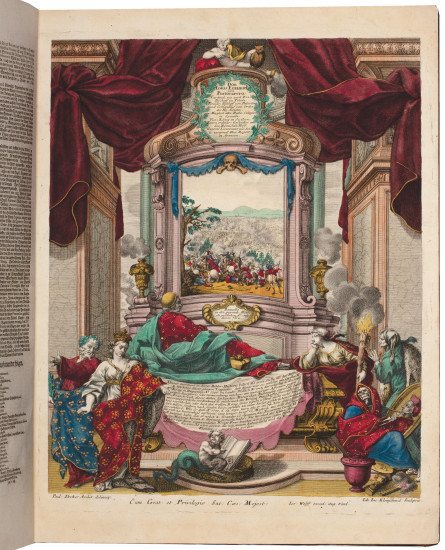
Repraesentatio Belli, ab successionem in Regno Hispanico ... / Der Spanische Successions-Krieg ... &c
Decker, Paul the Elder, Paul Decker the Younger, Abraham Drentwett the Elder et al
Augsburg. Jeremias Wolff. c.1715
An exceptional copy of Decker’s very rare suite of engravings – here in-plano and with exceptional additional colouring and highlighting in gilt by hand – illustrating the battles of the War of the Spanish Succession.
Decker’s suite depicts the battles of the complex series of engagements that became known as the War of the Spanish Succession (1701–1714). Prompted by the death of the last of the Spanish Habsburg Kings, the childless Charles II, and with a shifting group of alliances and a field of warfare that included not only Continental Europe and the Mediterranean, but also the Caribbean and North America, the War of the Spanish Succession has a case to be a true world war. In part an attempt to check French hegemony, the war featured a number of outstanding victories for the Duke of Marlborough and Prince Eugene of Savoy, including Blenheim, although the war was ultimately, at best, indecisive.
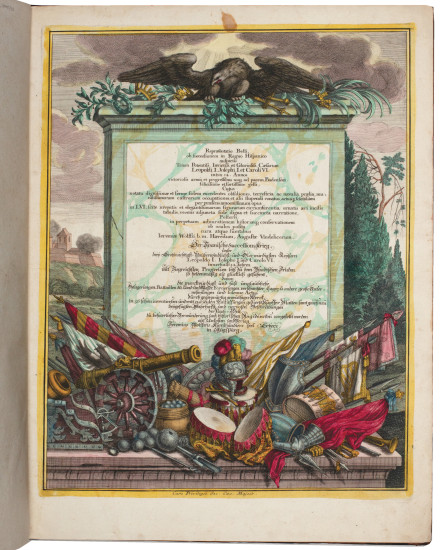
Each of Decker’s magnificent plates features a single engagement, depicted in the central portion of the plate, the whole image surrounded with a decorative border composed of architectural, allegorical and armorial symbols and motifs in the Baroque manner and a descriptive text concerning the battle. Many of the plates feature an additional small vignette of the battlefield keyed to the descriptive text and illustrating the placement of the armies and the most significant figures involved.
The colouring and highlighting by hand of the present copy is remarkable. The painstaking detailing and the additional ornamentation in liquid gold is lavish and in combination with the binding suggests this copy was important and worthy of presentation. The printed text ('Kurze Beschreibung des Spanisch Successions-Krieg ... &c.'), here, and unusually, in German, gives a detailed outline of the origins and history of the conflict and concludes with the list of plates and the engagements they depict. The text appears in other copies in other languages suggesting a commercial flexibility of distribution.
It is a measure of the importance attached to Decker’s suite that the painter Ignaz Preissler used Decker’s plates as the basis for the decoration of an important tea service and garniture now (at least partly) in the collection of the Metropolitan Museum in New York (see ‘Repraesentatio Belli, ob successionem in Regno Hispanico ... A Tea Service and Garniture by the Schwarzlot Decorator Ignaz Preissler’ by Maureen Cassidy-Geiger).
‘Such commemorative series were considered works of art as well as encapsulations of recent events and were highly valued by collectors of the period, who acquired them for their libraries or print cabinets.’ (Maureen Cassidy-Geiger).
Decker’s suite is very rare outside Germany: COPAC lists copies at the British Library and V & A only, while KVK lists copies at the Polish National Library, the Bibliothèque Nationale and the Université de Charles de Gaulle (Lille) in France and the Rijksmuseum Amsterdam; the only traceable copy in North America is at Brown University. We can locate no other copies with contemporary colouring or highlighting by hand,
[Berlin 103 (incomplete); Bobins III, 1165; Brunet V, 626 for the French edition].
Decker’s suite depicts the battles of the complex series of engagements that became known as the War of the Spanish Succession (1701–1714). Prompted by the death of the last of the Spanish Habsburg Kings, the childless Charles II, and with a shifting group of alliances and a field of warfare that included not only Continental Europe and the Mediterranean, but also the Caribbean and North America, the War of the Spanish Succession has a case to be a true world war. In part an attempt to check French hegemony, the war featured a number of outstanding victories for the Duke of Marlborough and Prince Eugene of Savoy, including Blenheim, although the war was ultimately, at best, indecisive.
Each of Decker’s magnificent plates features a single engagement, depicted in the central portion of the plate, the whole image surrounded with a decorative border composed of architectural, allegorical and armorial symbols and motifs in the Baroque manner and a descriptive text concerning the battle. Many of the plates feature an additional small vignette of the battlefield keyed to the descriptive text and illustrating the placement of the armies and the most significant figures involved.
The colouring and highlighting by hand of the present copy is remarkable. The painstaking detailing and the additional ornamentation in liquid gold is lavish and in combination with the binding suggests this copy was important and worthy of presentation. The printed text ('Kurze Beschreibung des Spanisch Successions-Krieg ... &c.'), here, and unusually, in German, gives a detailed outline of the origins and history of the conflict and concludes with the list of plates and the engagements they depict. The text appears in other copies in other languages suggesting a commercial flexibility of distribution.
It is a measure of the importance attached to Decker’s suite that the painter Ignaz Preissler used Decker’s plates as the basis for the decoration of an important tea service and garniture now (at least partly) in the collection of the Metropolitan Museum in New York (see ‘Repraesentatio Belli, ob successionem in Regno Hispanico ... A Tea Service and Garniture by the Schwarzlot Decorator Ignaz Preissler’ by Maureen Cassidy-Geiger).
‘Such commemorative series were considered works of art as well as encapsulations of recent events and were highly valued by collectors of the period, who acquired them for their libraries or print cabinets.’ (Maureen Cassidy-Geiger).
Decker’s suite is very rare outside Germany: COPAC lists copies at the British Library and V & A only, while KVK lists copies at the Polish National Library, the Bibliothèque Nationale and the Université de Charles de Gaulle (Lille) in France and the Rijksmuseum Amsterdam; the only traceable copy in North America is at Brown University. We can locate no other copies with contemporary colouring or highlighting by hand,
[Berlin 103 (incomplete); Bobins III, 1165; Brunet V, 626 for the French edition].
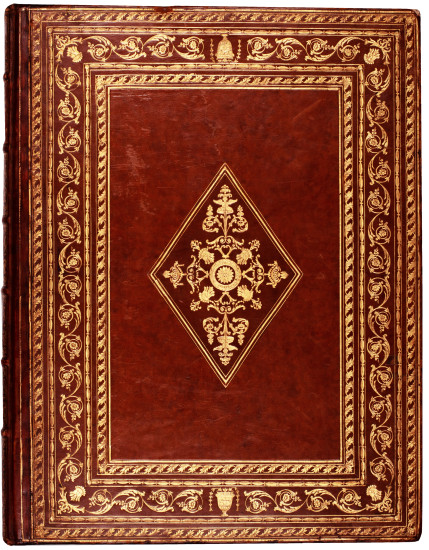
[58 unnumbered leaves]. Folio. (554 x 423 mm). Engraved allegorical title with Latin and German text, leaf with letterpress text in German in double columns and 56 engraved allegorical plates all after the Deckers by various engravers (see below). (Sheet size: 435 x 560 mm). Full contemporary blond calf, boards with elaborate neo-classical decorative borders composed of rules, foliate, floral and rope-work tools, vase tools at head and foot and mask corner tools all to surround a central lozenge with a decorative composition of floral, foliate and mask tools, later banded spine with elaborate decorative tooling in gilt in seven compartments, turn-ins tooled in gilt, red speckled edges.
#48763