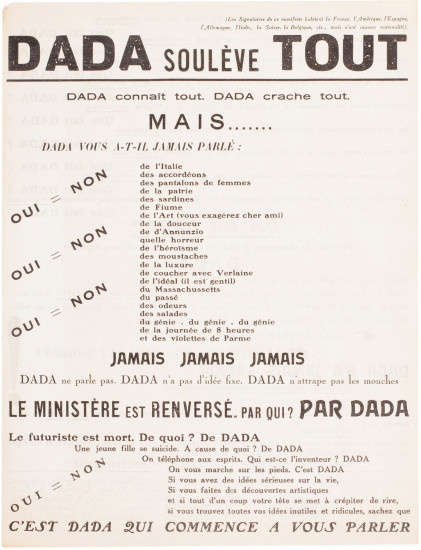
DADA SOULÈVE TOUT.DADA connaît tout. DADA crache tout. MAIS ......
Dada. Tzara, Tristan, Edgar Varèse, Philippe Soupault, Georges Ribemont-Dessaignes, Man Ray, Max Ernst et al
Paris. Au Sans Pareil. 1921, 12 janvier
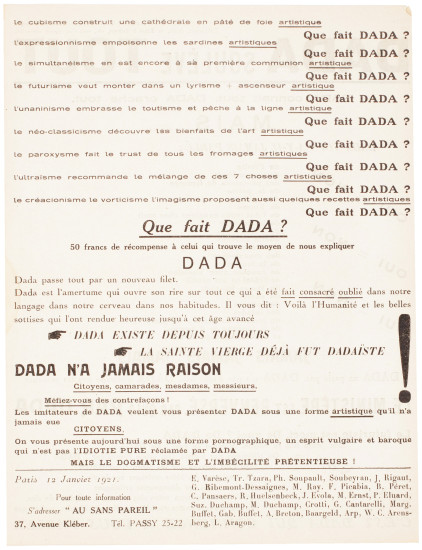
A very fine example, never folded, of this scarce, iconoclastic and blasphemous dada manifesto,an excellent specimen of dada typography.
Tzara's 1921 restatement of dada had a very serious purpose: to reinvigorate and revitalise dada. Tzara was to some extent successful and dada continued albeit with the same troubles that prompted the issue of this manifesto. The document is an outstanding example of the typographical caprice and linguistic inventiveness that made dada so intriguing and appealing. The use of various other schools of art (Cubism, Expressionism, Simultaneism, Futurism, Unanism, Neo-Claissicism, Ultraism, Creationism, Vorticism and Imagism) to underline dada's point, or rather its lack thereof, is classic. Tzara's most iconoclastic and blasphemous slogans, were taken up by Van Doesburg for his own later dada poster produced in conjunction with Schwitters, 'kleine dada soirée': 'DADA EXISTE DEPUIS TOUJOURS / LA SAINTE VUERGE DÉJÀ FUT DADAÎSTE!'
This manifesto was truly international, as noted at the head of the sheet: '(Les Signataires de ce manifeste habitent la France, l'Amérique, l'Espagne, l'Allemagne, l'Italie, la Suisse, la Belgique, etc., mais n'ont aucune nationalité).'
The signatories, as listed, were: 'E. Varèse, Tr. Tzara, Ph. Soupault, Soubeyran, J. Rigaut, G. Ribemont-Dessaignes, M. Ray [sic], F. Picabia, B. Péret, C. Pansaers, R. Huelsenbeck, J. Evola, M. Ernst, P. Eluard, Suz. Duchamp, M. Duchamp, Crotti, G. Cantarelli, Marg. Buffet, Gab. Buffet, A. Breton, Baargeld, Arp, W. C. Aresnberg, L. Aragon.'
'In 1921, Tristan Tzara found himself battling to sustain Dada's declining popularity. Aesthetic, political, and social differences among the movement's most prominenet members shook Dada at the doundation. In line with Dada's emphasis on easy distribution, Tzara created this one-page flyer presenting a condensed, more direct iteration of the Dada Manifesto ... The text's inconsistent typefaces, orientation, and size embody the disorientation and randomness at the heart of the Dadaist philosophy.' (From the catalogue of the Art Institute of Chicago).
'Dada fait ici le choix d'une composition graphique et d'une typographie affranchies des traditions, use de termes saugrenus n'ayant aucun lien logique entre eux, recourt aux antonymes («oui = non»), aux répétitions («jamais jamais jamais»), s'autointerroge («Que fait DADA?»), affirme et se contredit dans le même temps ... La mise en page, les différentes tailles de caractères et les polices d'écriture confèrent à l'ensemble un rythme singulier, fait d'accélérations, de ralentissements, de pauses, autant d'éléments qui construisent un parcours de lecture heurté, discontinu, à l'issue duquel renaîtra peut-être un «homme nouveau», purgé de tout espèce de culture.' (Anne Delebaree writing in 'Petits Papiers des Avant-Gardes: La Collection Paul Desrtribats').
[Destribats Tracts 132 / 133; Ades 8.45; Pompidou 326 / 327].
Tzara's 1921 restatement of dada had a very serious purpose: to reinvigorate and revitalise dada. Tzara was to some extent successful and dada continued albeit with the same troubles that prompted the issue of this manifesto. The document is an outstanding example of the typographical caprice and linguistic inventiveness that made dada so intriguing and appealing. The use of various other schools of art (Cubism, Expressionism, Simultaneism, Futurism, Unanism, Neo-Claissicism, Ultraism, Creationism, Vorticism and Imagism) to underline dada's point, or rather its lack thereof, is classic. Tzara's most iconoclastic and blasphemous slogans, were taken up by Van Doesburg for his own later dada poster produced in conjunction with Schwitters, 'kleine dada soirée': 'DADA EXISTE DEPUIS TOUJOURS / LA SAINTE VUERGE DÉJÀ FUT DADAÎSTE!'
This manifesto was truly international, as noted at the head of the sheet: '(Les Signataires de ce manifeste habitent la France, l'Amérique, l'Espagne, l'Allemagne, l'Italie, la Suisse, la Belgique, etc., mais n'ont aucune nationalité).'
The signatories, as listed, were: 'E. Varèse, Tr. Tzara, Ph. Soupault, Soubeyran, J. Rigaut, G. Ribemont-Dessaignes, M. Ray [sic], F. Picabia, B. Péret, C. Pansaers, R. Huelsenbeck, J. Evola, M. Ernst, P. Eluard, Suz. Duchamp, M. Duchamp, Crotti, G. Cantarelli, Marg. Buffet, Gab. Buffet, A. Breton, Baargeld, Arp, W. C. Aresnberg, L. Aragon.'
'In 1921, Tristan Tzara found himself battling to sustain Dada's declining popularity. Aesthetic, political, and social differences among the movement's most prominenet members shook Dada at the doundation. In line with Dada's emphasis on easy distribution, Tzara created this one-page flyer presenting a condensed, more direct iteration of the Dada Manifesto ... The text's inconsistent typefaces, orientation, and size embody the disorientation and randomness at the heart of the Dadaist philosophy.' (From the catalogue of the Art Institute of Chicago).
'Dada fait ici le choix d'une composition graphique et d'une typographie affranchies des traditions, use de termes saugrenus n'ayant aucun lien logique entre eux, recourt aux antonymes («oui = non»), aux répétitions («jamais jamais jamais»), s'autointerroge («Que fait DADA?»), affirme et se contredit dans le même temps ... La mise en page, les différentes tailles de caractères et les polices d'écriture confèrent à l'ensemble un rythme singulier, fait d'accélérations, de ralentissements, de pauses, autant d'éléments qui construisent un parcours de lecture heurté, discontinu, à l'issue duquel renaîtra peut-être un «homme nouveau», purgé de tout espèce de culture.' (Anne Delebaree writing in 'Petits Papiers des Avant-Gardes: La Collection Paul Desrtribats').
[Destribats Tracts 132 / 133; Ades 8.45; Pompidou 326 / 327].
[Single sheet of cream paper]. Folio. (277 x 212 mm). Drop-head title and printed text recto and verso in French with typical dada typography, manicules and type variation, imprint and list of signatories at foot of verso.
#48774