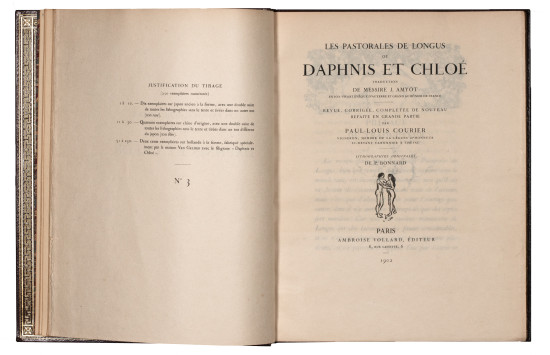
Les Pastorales de Longus ou Daphnis et Chloé
Bonnard, Pierre. Longus
Paris. Ambroise Vollard, Editeur. 1902
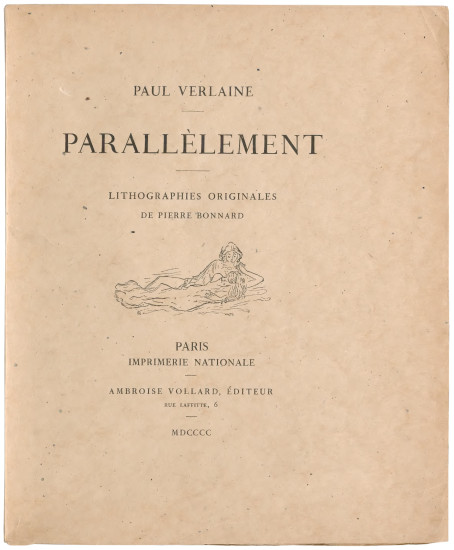
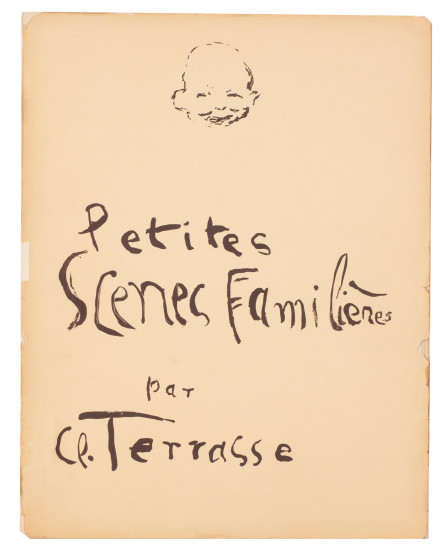
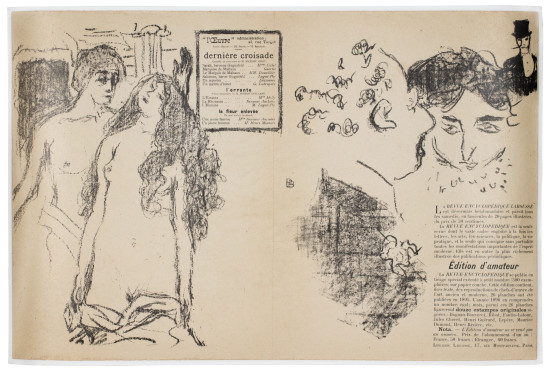
A very rare example of Bonnard's superb second book with Vollard, one of ten from the édition de tête on Japon ancien, with the additional suite and in a contemporary binding by Noulhac.
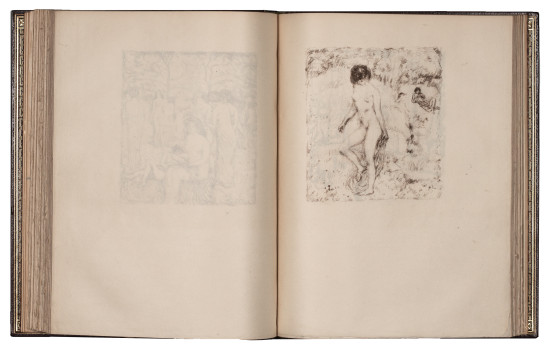
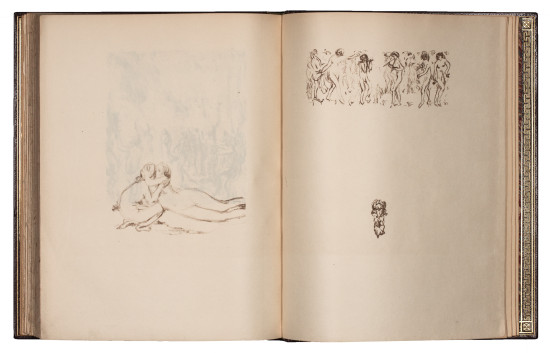
From the edition limited to 250 numbered copies, with this one of 10 copies on japon ancien à la forme from the édition de tête with the additional suite of the lithographs printed without text in 'ton rose'.
The édition de tête of ten copies of 'Daphnis et Chloé' is extremely rare: we know only of one other copy, that formerly in a Swiss private collection cited in 'De Parallèlement à Chanson Complète'. That catalogue cites a further copy: 'Un autre exemplaire du rarissime tirage sur japon était le livre le plus précieux du célèbre catalogue de Nicolas Rauch sur les livres de peintres en 1957'. We locate no other examples at auction or in public or private collections.
The only known work of the Greek Longus, Daphnis and Chloe, has appealed to numerous artists and illustrators: Pierre Bonnard (1902), Sylvain Sauvage (1925), Aristide Maillol (1937) and Marc Chagall (1961) all produced illustrated editions. The tale - one of the least tragic of the Greek canon - tells of the love of two foundlings raised together, the eponymous hero and heroine, who each harbour an unsuspected love for the other, suffer various reverses of fortune (including Chloe's kidnap by pirates) before a happy resolution for all parties.
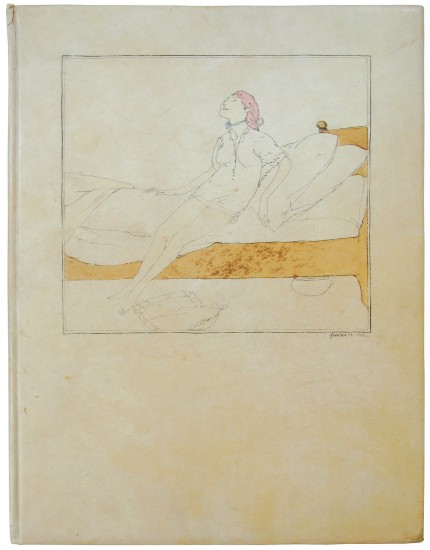
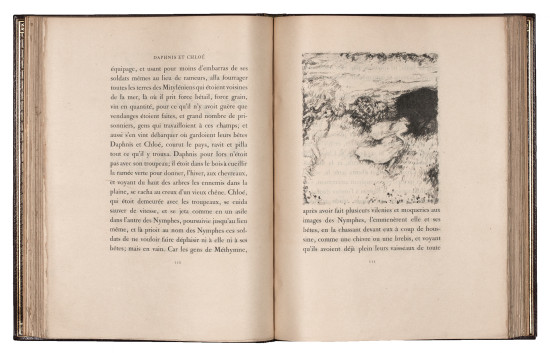
'The lithographs, of an unprecedented lightness of touch, have been printed with such subtlety and skill that you seem to see the original crayon, and they, like the text, have that marvellous spontaneity that will remain forever one of Bonnard's greatest gifts.' (J. Guignard, Le Livre, 1942).
'Chaque composition de Bonnard sur 'belle page' tient dans un rectangle vertical de proportion quasi identique, 'soulignée' de quelques lignes de texte, donnant au livre une homogénéité de présentation fascinante. La typographie de l'Imprimerie nationale fut entièrement réalisée en fonte neuve de 'Grandjean du Roi'. La traduction du texte de Longus (sophiste de Lesbos, au IIe siècel) fut effectuée par Amyot vers 1558, et révisée par P.-L. Courier au XIXe siècle. Deux ans après 'Parallèlement' cette nouvelle collaboration Vollard-Bonnard n'eut pas non plus grand succès à sa parution, avant de devenir un des symboles du 'livre de peintre' au XXe siècle.' (de Parallèlement à Chanson Complète).
[see Guignard's 'Le Livre', Paris, 1942; see 'de Parallèlement à Chanson Complète' pp. 23 - 26].
From the edition limited to 250 numbered copies, with this one of 10 copies on japon ancien à la forme from the édition de tête with the additional suite of the lithographs printed without text in 'ton rose'.
The édition de tête of ten copies of 'Daphnis et Chloé' is extremely rare: we know only of one other copy, that formerly in a Swiss private collection cited in 'De Parallèlement à Chanson Complète'. That catalogue cites a further copy: 'Un autre exemplaire du rarissime tirage sur japon était le livre le plus précieux du célèbre catalogue de Nicolas Rauch sur les livres de peintres en 1957'. We locate no other examples at auction or in public or private collections.
The only known work of the Greek Longus, Daphnis and Chloe, has appealed to numerous artists and illustrators: Pierre Bonnard (1902), Sylvain Sauvage (1925), Aristide Maillol (1937) and Marc Chagall (1961) all produced illustrated editions. The tale - one of the least tragic of the Greek canon - tells of the love of two foundlings raised together, the eponymous hero and heroine, who each harbour an unsuspected love for the other, suffer various reverses of fortune (including Chloe's kidnap by pirates) before a happy resolution for all parties.
'The lithographs, of an unprecedented lightness of touch, have been printed with such subtlety and skill that you seem to see the original crayon, and they, like the text, have that marvellous spontaneity that will remain forever one of Bonnard's greatest gifts.' (J. Guignard, Le Livre, 1942).
'Chaque composition de Bonnard sur 'belle page' tient dans un rectangle vertical de proportion quasi identique, 'soulignée' de quelques lignes de texte, donnant au livre une homogénéité de présentation fascinante. La typographie de l'Imprimerie nationale fut entièrement réalisée en fonte neuve de 'Grandjean du Roi'. La traduction du texte de Longus (sophiste de Lesbos, au IIe siècel) fut effectuée par Amyot vers 1558, et révisée par P.-L. Courier au XIXe siècle. Deux ans après 'Parallèlement' cette nouvelle collaboration Vollard-Bonnard n'eut pas non plus grand succès à sa parution, avant de devenir un des symboles du 'livre de peintre' au XXe siècle.' (de Parallèlement à Chanson Complète).
[see Guignard's 'Le Livre', Paris, 1942; see 'de Parallèlement à Chanson Complète' pp. 23 - 26].
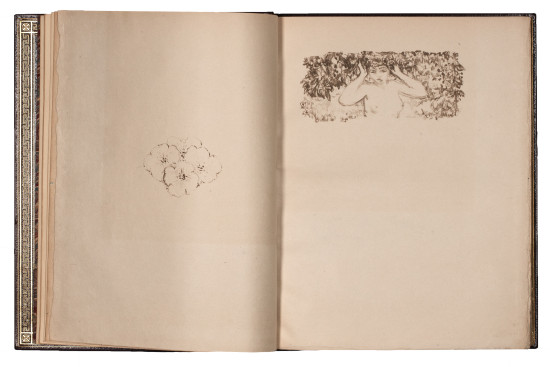
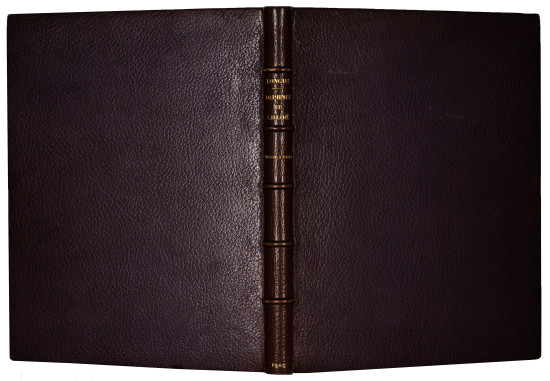
[156 leaves; 151 leaves (suite); pp. x, 294, (i), (i)]. Small folio. (334 x 268 mm). Half-title with justification verso, printed title with vignette by Bonnard, 3 leaves with 'Préface du Traducteur' and Longus' text illustrated with 156 original lithographs by Bonnard printed in black, leaf with 'Table des Matières', final leaf with achevé d'imprimer; also included in a separate volume with a separate wrapper is the complete series - three leaves with a lithograph recto and verso and one leaf with the two final lithographs recto - of lithographs printed in 'ton rose'. Full aubergine crushed morocco by Noulhac with his signature gilt for each vol., banded spines with gilt titles in six compartments, turn-ins ruled in gilt with decorative Greek key roll-tool border and floral ornaments at corners, green silk doublures and endleaves, marbled endpapers, original publisher's printed wrappers with titles and Bonnard's vignette in black to front cover and and backstrip for each vol. preserved, a.e.g.
#48813