Herodias
Seligmann, Kurt. Mallarmé, Stéphane & Clark Mills. (Trans.)
Prairie City, Illinois. The Press of James A. Decker. 1942
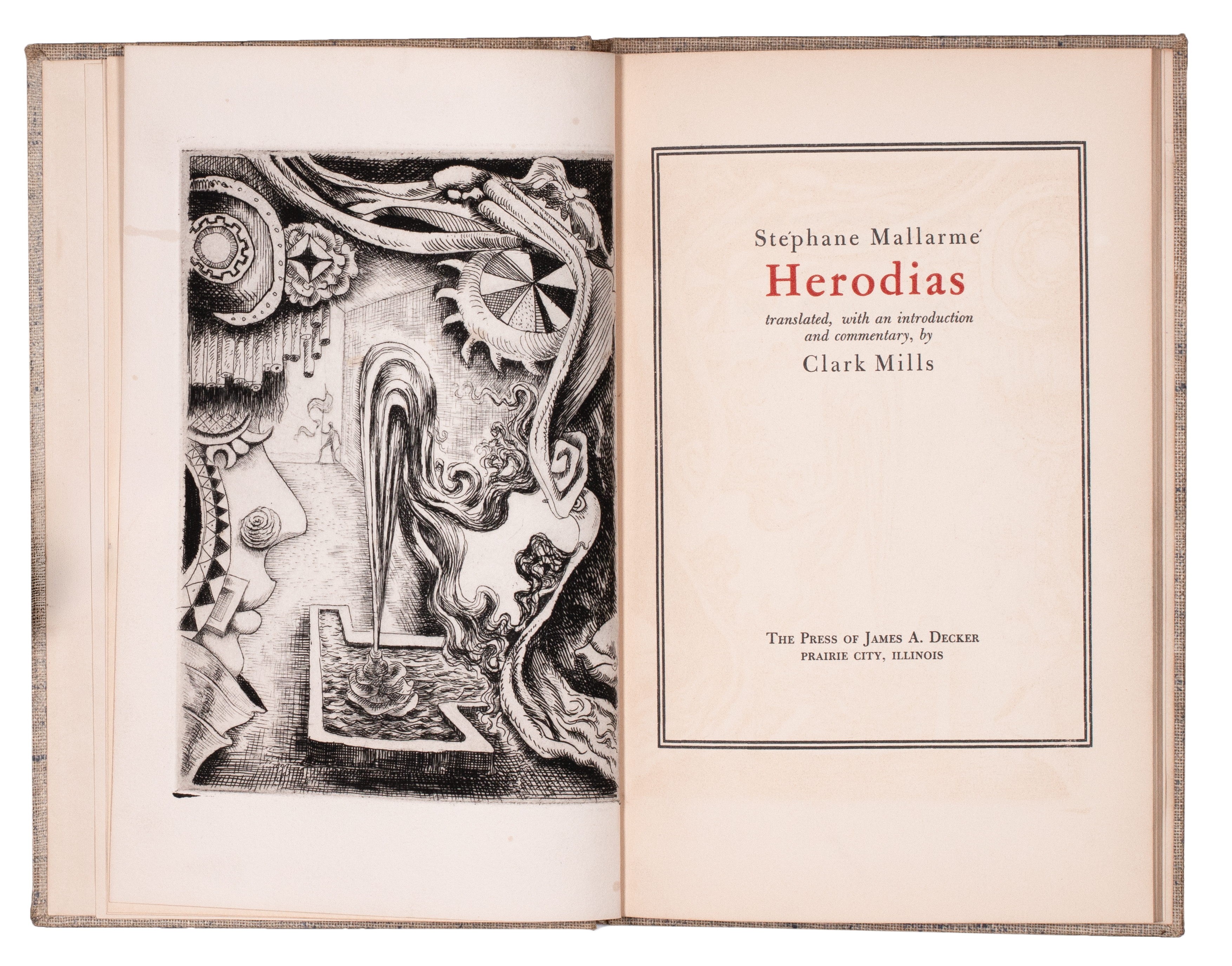
The rare édition de tête, with Kurt Seligmann's original etching, of Clark Mills' English translation of Stéphane Mallarmé's 'Hérodiade'.
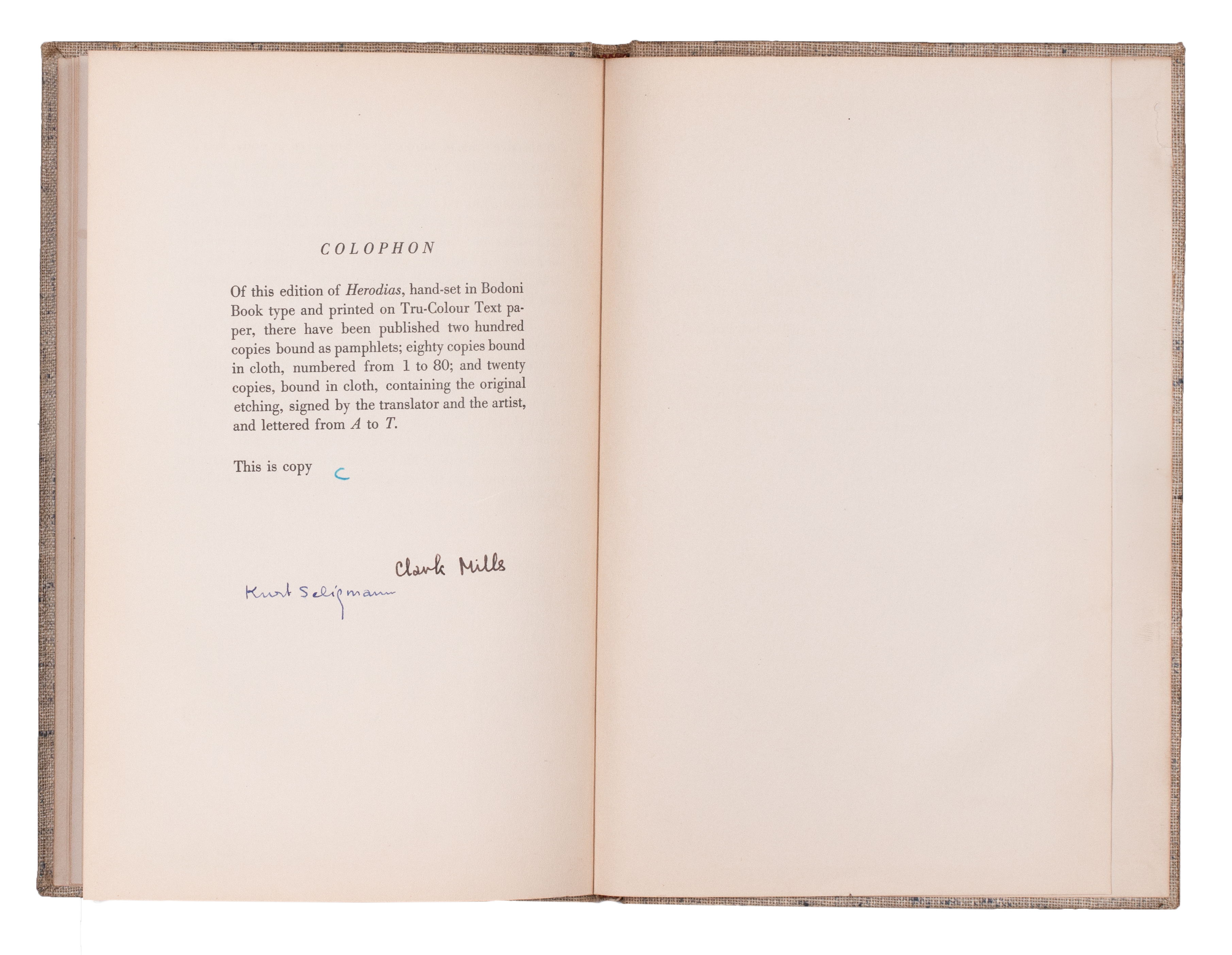
From the edition limited to 300 copies on Tru-Color Text paper, with this one of 20 lettered édition de tête examples ('C') signed by the translator and the artist to the justification and including Kurt Seligmann's original etching as frontispiece; the 200 copies issued in wrappers and the 80 issued in cloth were not signed and did not include the original etching.
Clark Mills (1913 - 1986), was a poet, translator, spy (he worked as a government intelligence officer) and academic (he taught at Hunter College and Fairleigh Dickinson University) and a friend of Tennessee Williams. In the present volume, Mills aimed to produce a verse version of Mallarmé's original: 'As equivalent to the rhymed alexandrine couplets of Mallarmé, unrhymed iambic pentameter was chosen as being best suited in English to dramatic dialogue ... '. Mills thus aimed to reproduce the structure and the quality of the original French (both are printed together on facing pages) as opposed to the earlier efforts of Roger Fry who aimed for 'an exact equivalence of the original'.
'In 'Herodias' itself he created not only a surface finish which in brilliance of color and hardness of syntax was comparable to a Byzantine mosaic, but an atmospheric effect, an intuitive uncovering of secret psychological processes which was unique for its time as it is today ... '. (From Clark Mills' 'Commentary').
'Another master of the engraver's art who emerged in Paris in the 1930s was Kurt Seligmann, originally from Basel. Born (like an astounding number of the surrealists) in the year 1900 ... He did not enter the domain of surrealist prints until the late 1920s, when he arrived in Paris ... When World War II broke out, Seligmann moved to the United States. He set up his presses first in New York City and then on his farm in Sugar Loaf, New York ... '. (see Surrealist Prints, pg. 90).
'There can be no doubt that he [Mallarmé] sought deliberately, through suggestion rather than explicitness, and the oblique rather than the direct statement, to erect obstacles between his work and the reader. From his earliest, relatively accessible poems to his final experimental sketch, 'Un coup de dés jamais n'abolira le hasard', his evolution was away from the simple, transparent, towards the complex and the indirect ... Though 'Herodias' belongs to his earlier period, it contains numerous obstacles, some accidental and others perhaps intentional. Most of these, as in all his work, lie in his syntax, which at times reaches such complexity that neither French nor English readers agree as to the exact prose meanings of his words ... Mallarmé himself admitted that numerous explanations, present or possible, existed ... so that if the reader is allowed to provide his own interpretations, these do not exclude the possibility of others diametrically opposed.' (From Clark Mills' 'Commentary').
The édition de tête with Seligmann's etching is rare and we locate no other examples at auction or in institutional collections.
[see Timothy Baum's 'The Surrealist as Printmaker' in 'Surrealist Prints', New York, 1997].
From the edition limited to 300 copies on Tru-Color Text paper, with this one of 20 lettered édition de tête examples ('C') signed by the translator and the artist to the justification and including Kurt Seligmann's original etching as frontispiece; the 200 copies issued in wrappers and the 80 issued in cloth were not signed and did not include the original etching.
Clark Mills (1913 - 1986), was a poet, translator, spy (he worked as a government intelligence officer) and academic (he taught at Hunter College and Fairleigh Dickinson University) and a friend of Tennessee Williams. In the present volume, Mills aimed to produce a verse version of Mallarmé's original: 'As equivalent to the rhymed alexandrine couplets of Mallarmé, unrhymed iambic pentameter was chosen as being best suited in English to dramatic dialogue ... '. Mills thus aimed to reproduce the structure and the quality of the original French (both are printed together on facing pages) as opposed to the earlier efforts of Roger Fry who aimed for 'an exact equivalence of the original'.
'In 'Herodias' itself he created not only a surface finish which in brilliance of color and hardness of syntax was comparable to a Byzantine mosaic, but an atmospheric effect, an intuitive uncovering of secret psychological processes which was unique for its time as it is today ... '. (From Clark Mills' 'Commentary').
'Another master of the engraver's art who emerged in Paris in the 1930s was Kurt Seligmann, originally from Basel. Born (like an astounding number of the surrealists) in the year 1900 ... He did not enter the domain of surrealist prints until the late 1920s, when he arrived in Paris ... When World War II broke out, Seligmann moved to the United States. He set up his presses first in New York City and then on his farm in Sugar Loaf, New York ... '. (see Surrealist Prints, pg. 90).
'There can be no doubt that he [Mallarmé] sought deliberately, through suggestion rather than explicitness, and the oblique rather than the direct statement, to erect obstacles between his work and the reader. From his earliest, relatively accessible poems to his final experimental sketch, 'Un coup de dés jamais n'abolira le hasard', his evolution was away from the simple, transparent, towards the complex and the indirect ... Though 'Herodias' belongs to his earlier period, it contains numerous obstacles, some accidental and others perhaps intentional. Most of these, as in all his work, lie in his syntax, which at times reaches such complexity that neither French nor English readers agree as to the exact prose meanings of his words ... Mallarmé himself admitted that numerous explanations, present or possible, existed ... so that if the reader is allowed to provide his own interpretations, these do not exclude the possibility of others diametrically opposed.' (From Clark Mills' 'Commentary').
The édition de tête with Seligmann's etching is rare and we locate no other examples at auction or in institutional collections.
[see Timothy Baum's 'The Surrealist as Printmaker' in 'Surrealist Prints', New York, 1997].
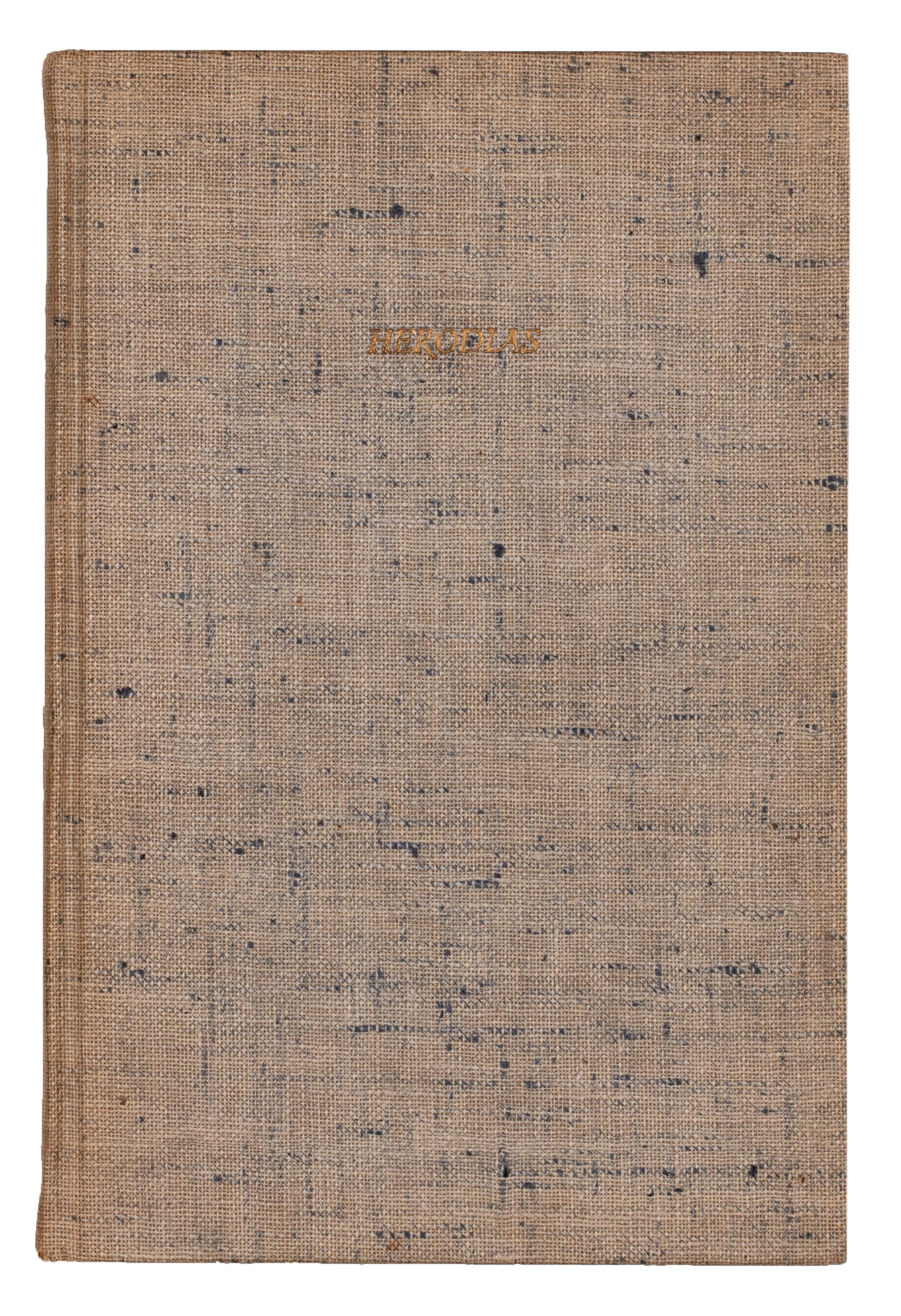
[21 leaves including inserted leaf with Seligmann's original etching; pp. (i), (i), 37, (i)]. 8vo. (227 x 151 mm). Leaf with tipped-in monochrome reproduction and the note 'Etching by Kurt Seligmann' verso, leaf with original monochrome etching by Seligmann verso as frontispiece, printed title in red and black with copyright verso, leaf with dedication 'For H. V. H.', leaf with Mills' 'Note', Mallarmé's 'Hérodiade' to versos with Mills' English translation to facing rectos, final leaves with Mills' 'Commentary' and final verso with colophon (justification). Original publisher's coarse-weave mottled cloth, title gilt to front board, title and credits gilt to spine.
#49021