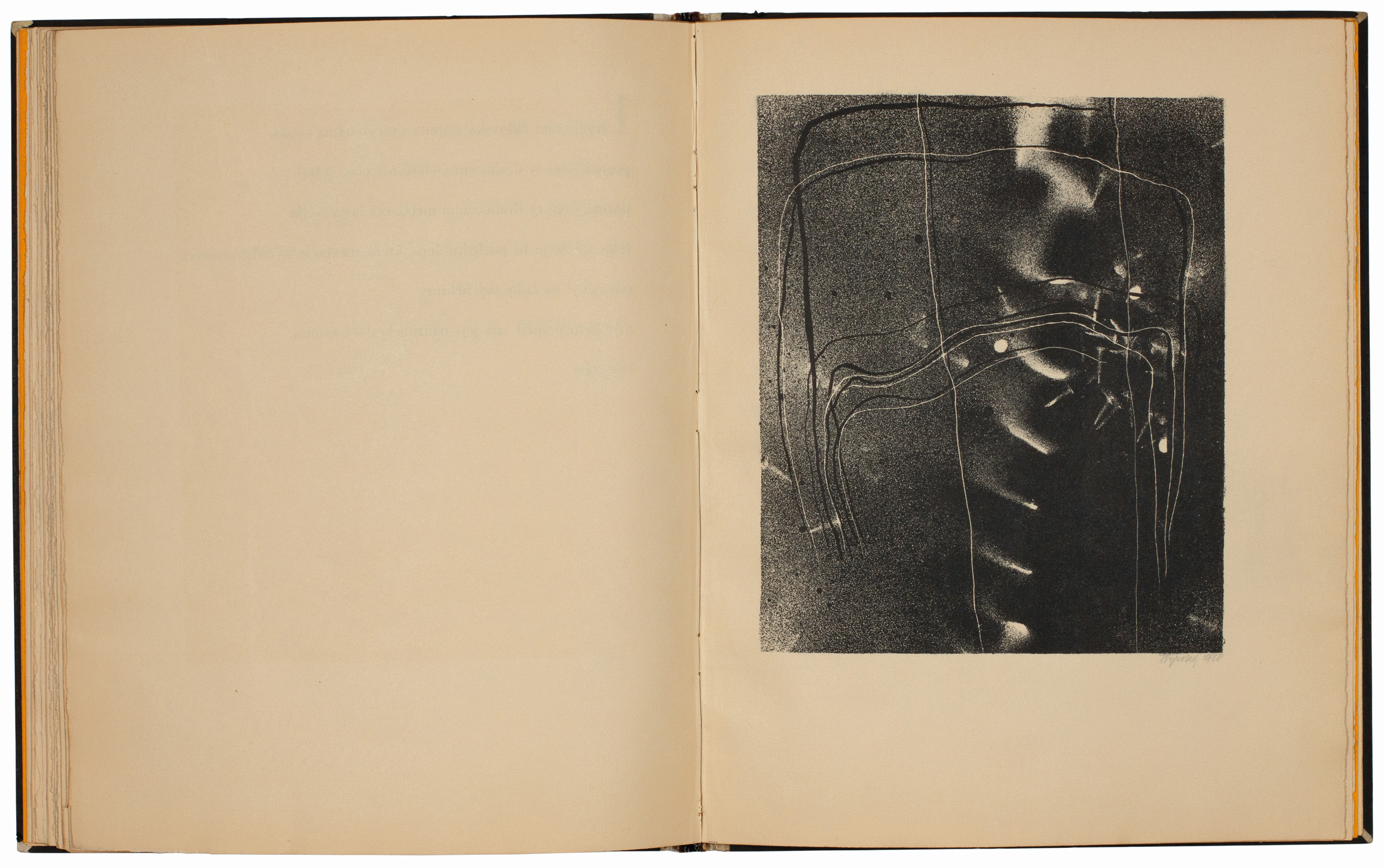
Zidovsky Hrbitov. (The Jewish Cemetery)
(toyen). Styrsky, Jindrich. Nezval, Vitezslav, Karel Teige (Typ.)
Prague. Odeon / Jan Fromek. 1928
Toyen's presentation copy of her friend Vitezlav Nezval's verse illustrated by Jindrich Styrsky and designed by Karel Teige, a highly important, significant and deeply resonant association.
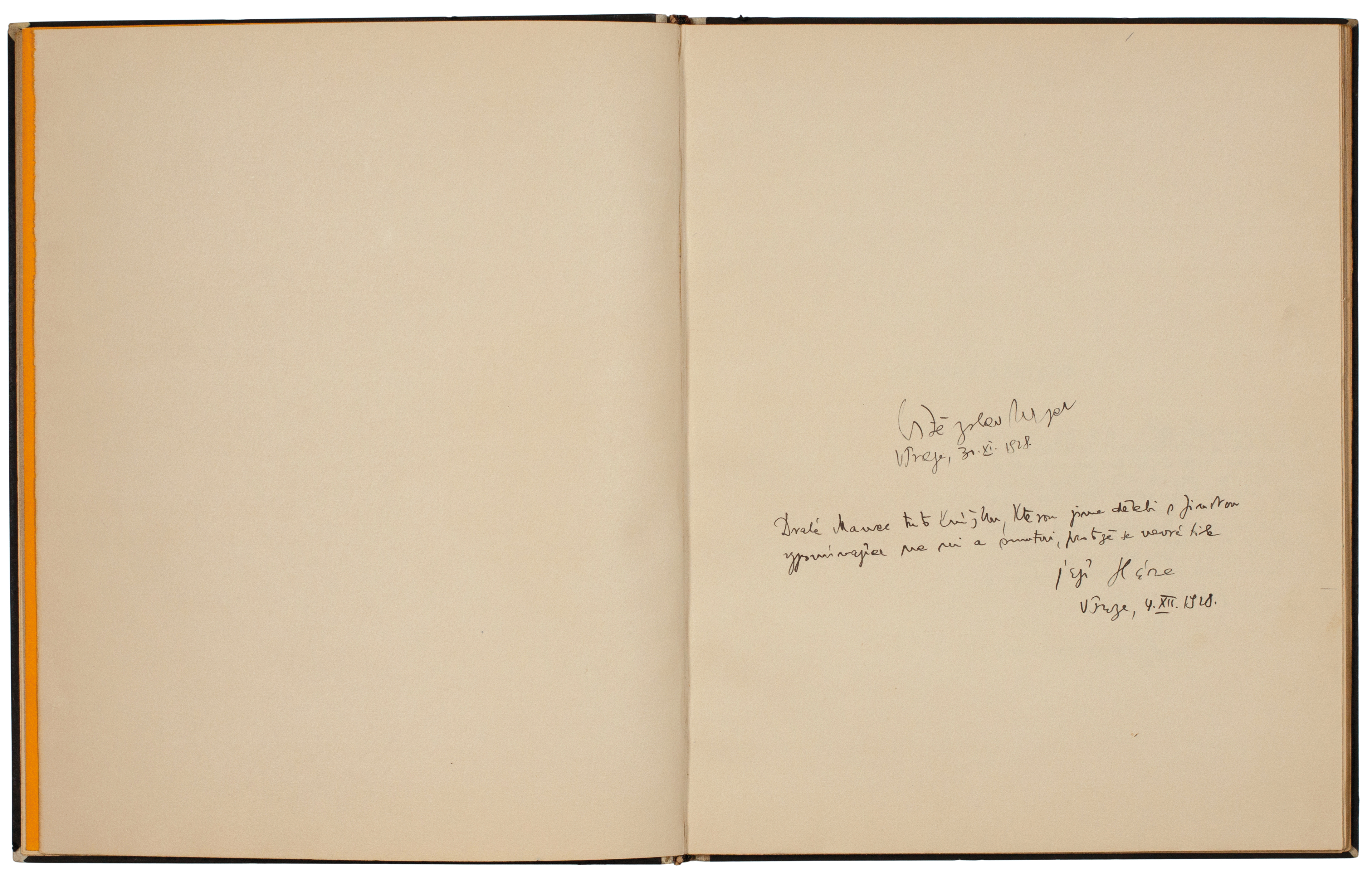
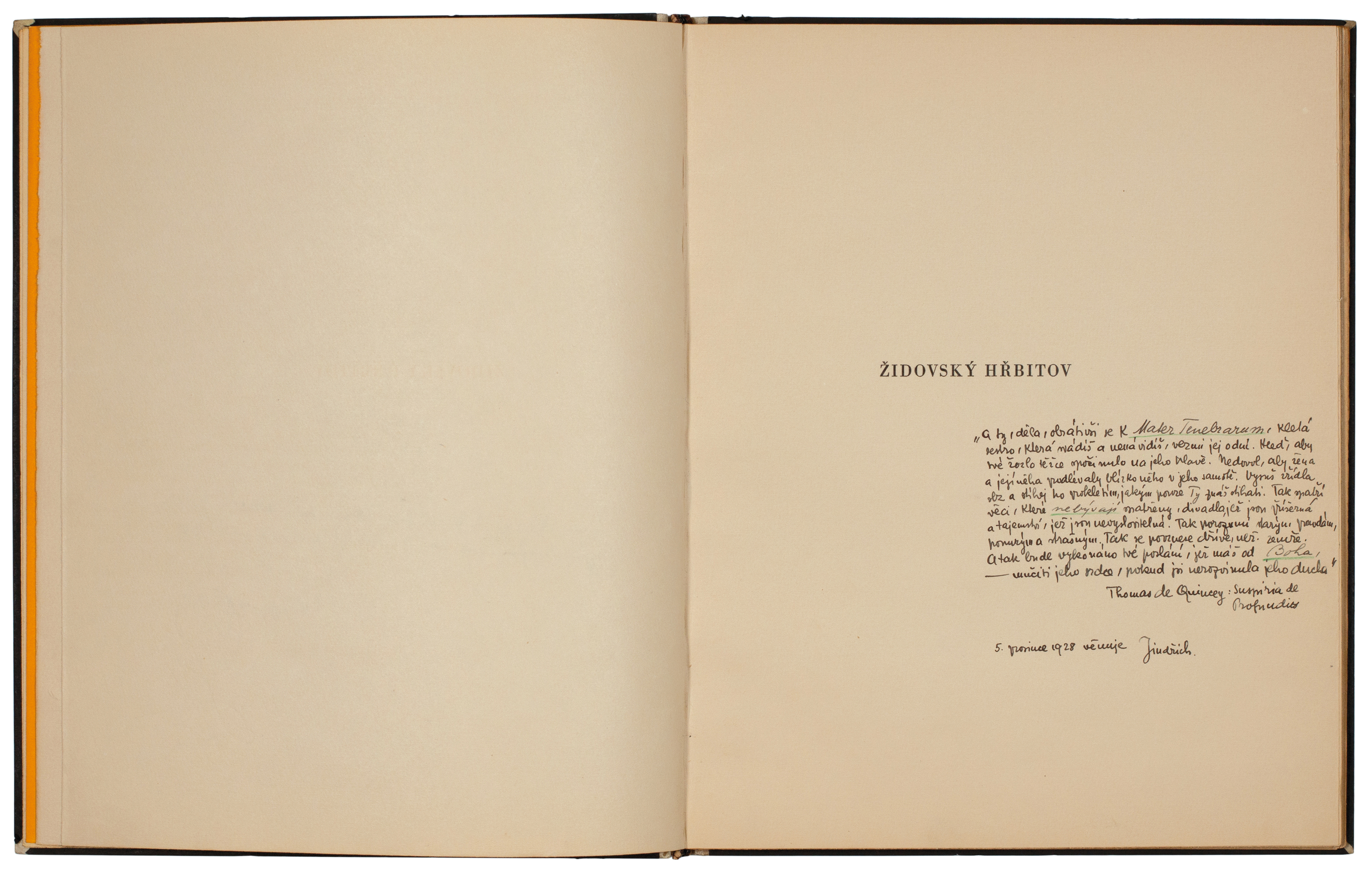
This extraordinary copy of 'Židovský Hřbitov' unites the leading lights of the Czech artistic avant-garde: the poet Nezval with his signed presentation, the artist Styrsky to whom Nezval dedicated the book and who has signed all of the original lithographs and inscribed the book with a long quote from de Quincey, the designer and theorist Teige who was responsible for the typography and mise en page and, of course, Toyen herself, to whom the work is presented. All were members of the group 'Devětsil' and Toyen and Styrsky had developed the credo of 'Artificialism' in Paris in 1927, their response to Surrealism; the illustrations by Styrsky for 'Židovský Hřbitov' belong to his pre-Surrealist Artificialist oeuvre. The timing of the presentation is significant as Toyen was in Paris at the time - Nezval references this in his presentation - in addition to which Sttyrsky's manuscript quotation is the only surviving semantic link between the pair (no letter or other presentation is known) as they were never apart, physically or creatively. That Styrsky's choice of de Quincey is of the utmost importance hardly needs stating, that he wrote the quotation with blank spaces that Toyen herself later filled in highlights this significance further and suggests that this passage taken from 'Levana and Our Ladies of Sorrow' had a deerp and resonant meaning for them both.
From the edition limited to 220 numbered copies on Hollande Van Gelder; this copy signed by Nezval to initial blank and numbered to the justification in ink; also with Nezval's presentation to the initial blank beneath his signature, Styrsky's extensive and allusive manuscript quotation from de Quincey to the half-title and with all the original lithographs signed and dated '1928' in pencil by Styrsky.
Nezval's presentation is in black ink to the initial blank beneath his signature: 'Drahé Mance tuto knížku, kterou jsme dělali s Jindrou / vzpomínajíce na ni a smutni, protože se nevrátila / Její Sláva / V Praze 4. XII. 1928' (Precious Mance [a dimnutive of Marie, i.e. Toyen] this book, that we made with Jindrou [a diminutive of Jindricj=h, i.e. Styrsky] remembering her and miserable, because she has not returned, Her Slava [a diminutive of Vitezlav, e.e. Nezval] / 4.XII.1929.).
Styrsky's extensive quotation in Czech - taken from Thomas de Quincey's 'Levana and Our Ladies of Sorrow' in 'Suspiria De Profundis: Being a Sequel to the 'Confessions of an Engllsh Opium-Eater''' - is in black ink to the half-title. A transcription of the manuscript is available on request.
All of the manuscript in the present copy is dated from within a very few days: Nezval's signature to an initial blank features the date '30.XI.1928' (presumably close to the date of publication / issue) while his presentation to Toyen is dated '4.XII.1928'; Styrsky's quotation is dated '5. prosince 1928'. In June 1928, Toyen travelled to Paris alone (her only separation from Styrsky until his death) and only returned to Prague in January 1929; Nezval's presentation refers to this absence directly.
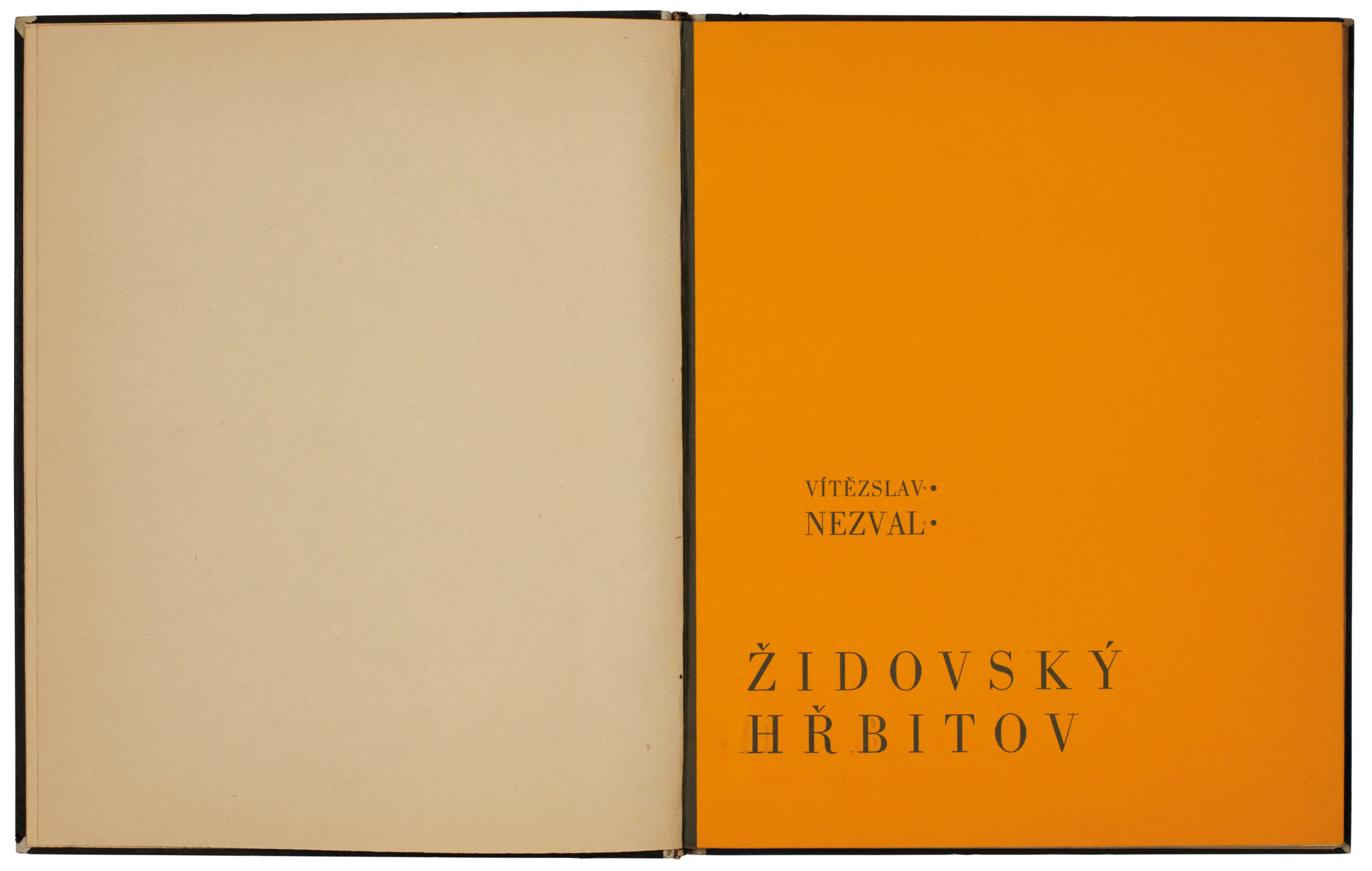
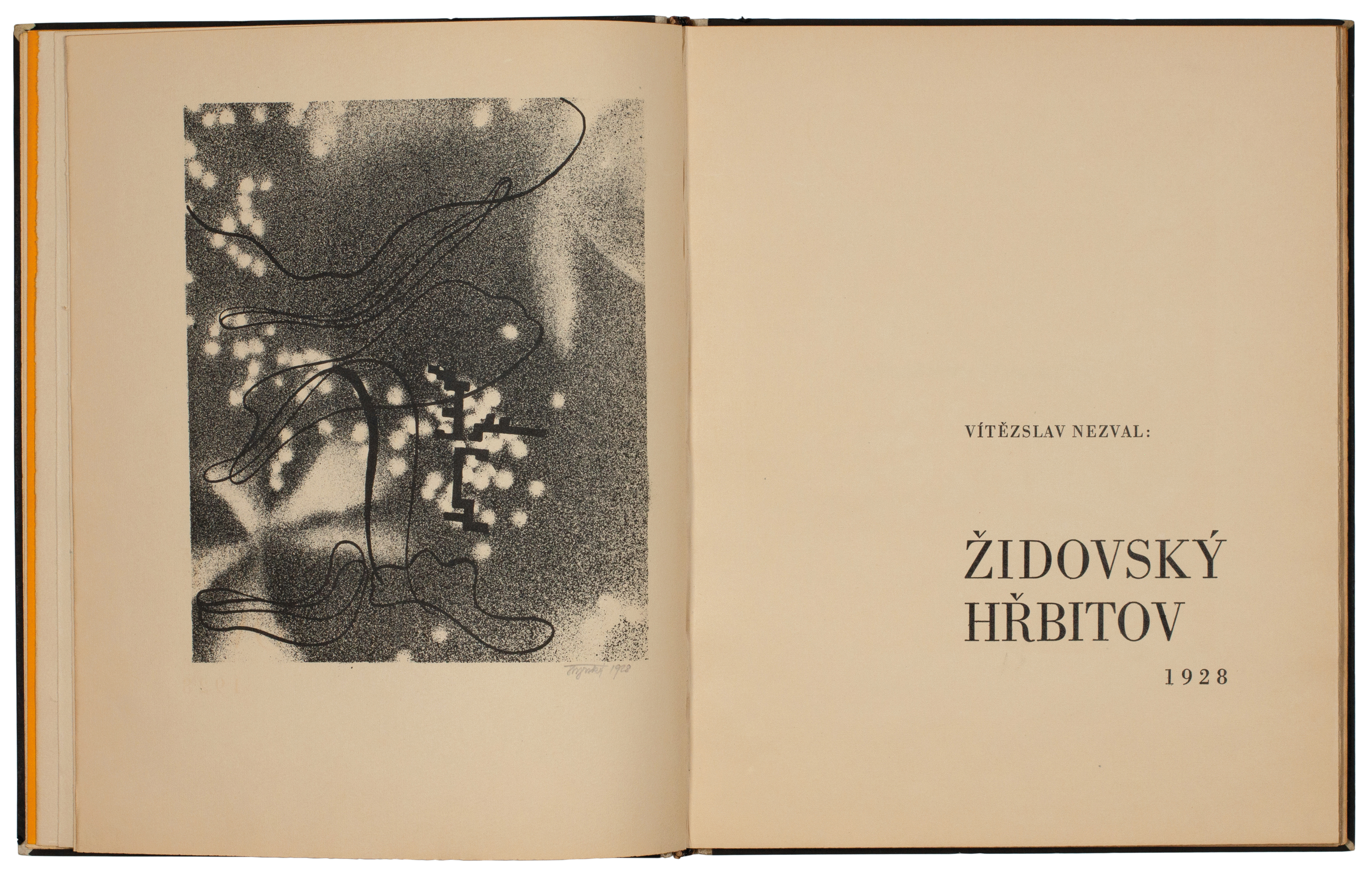
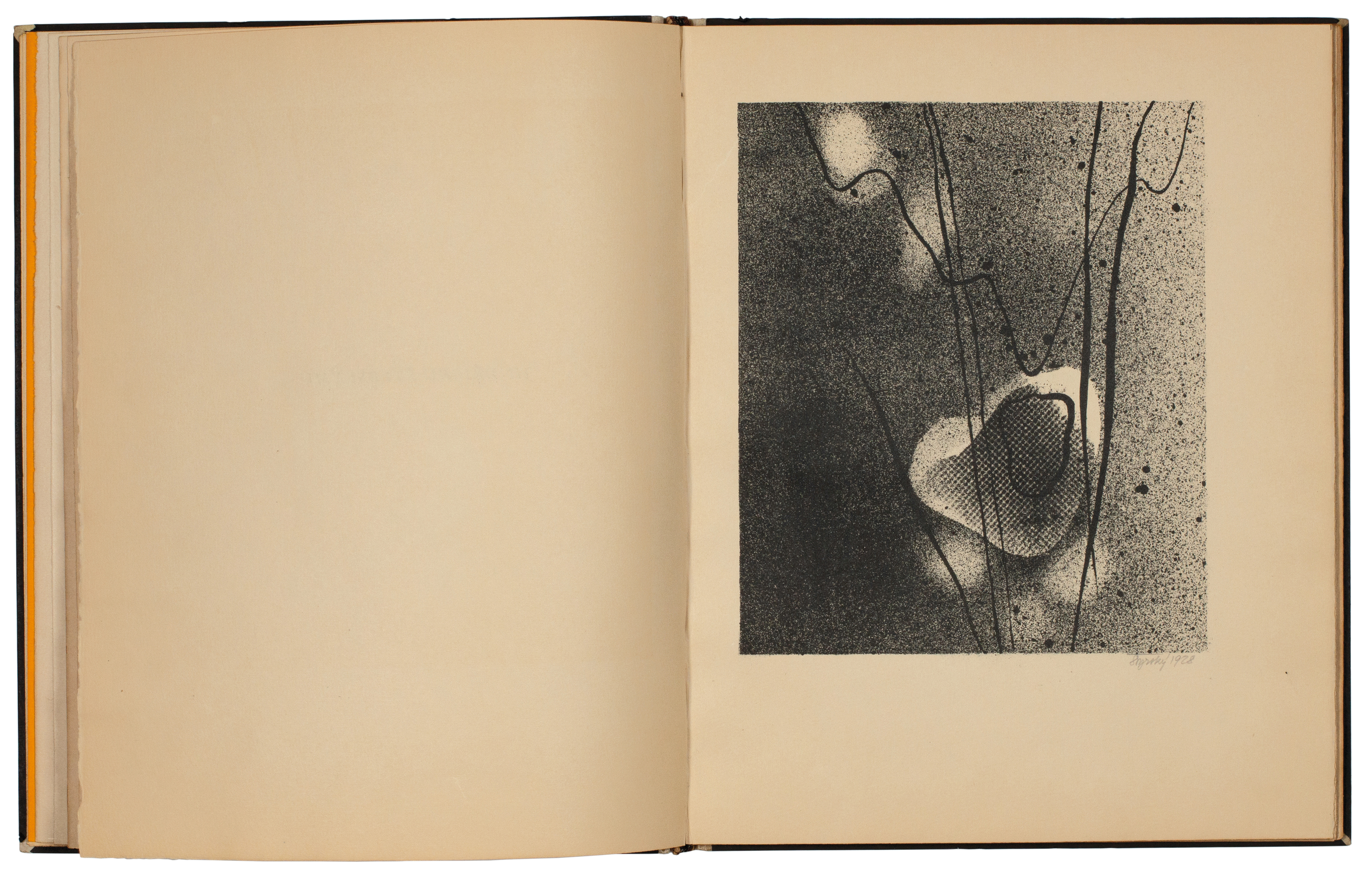
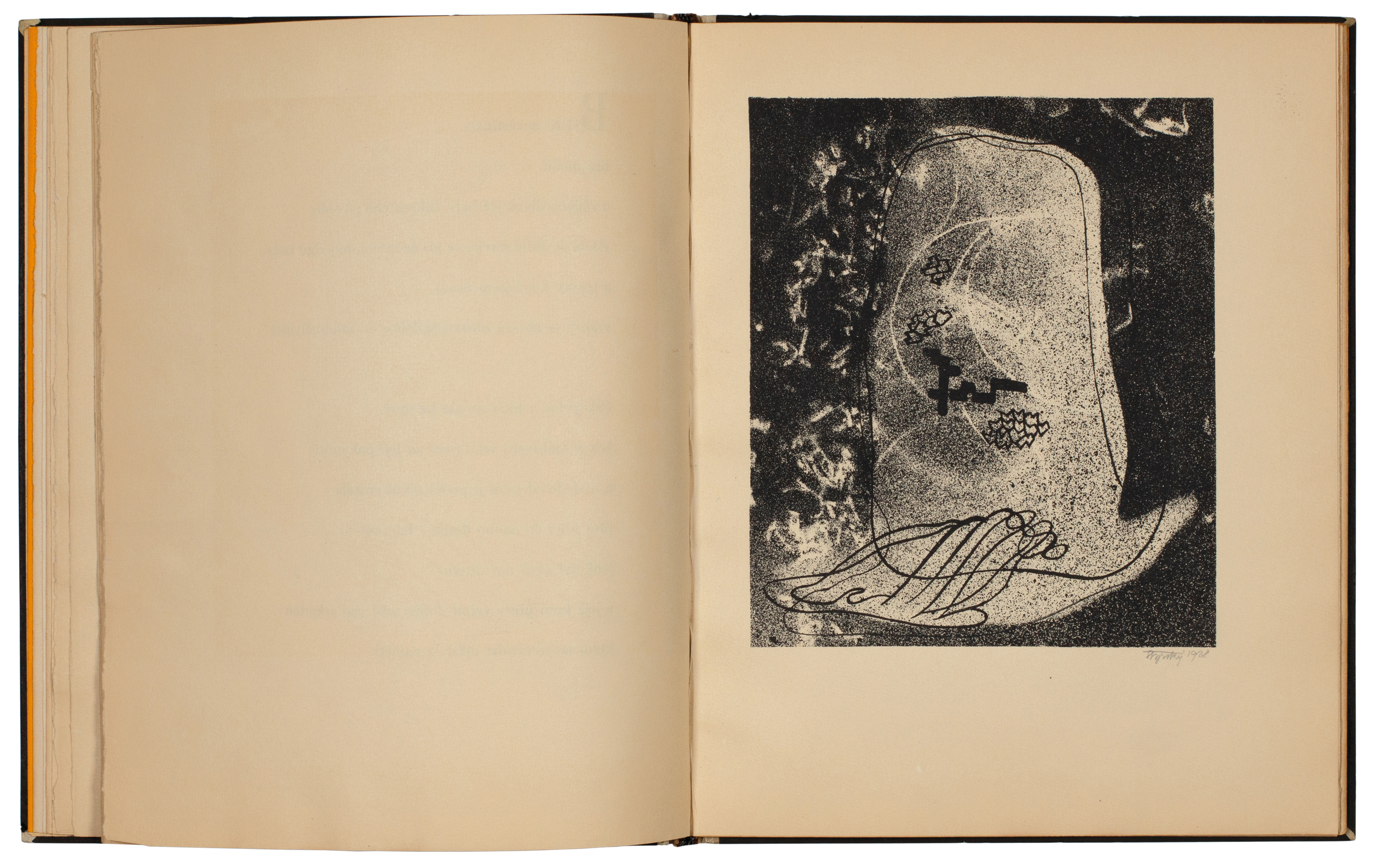
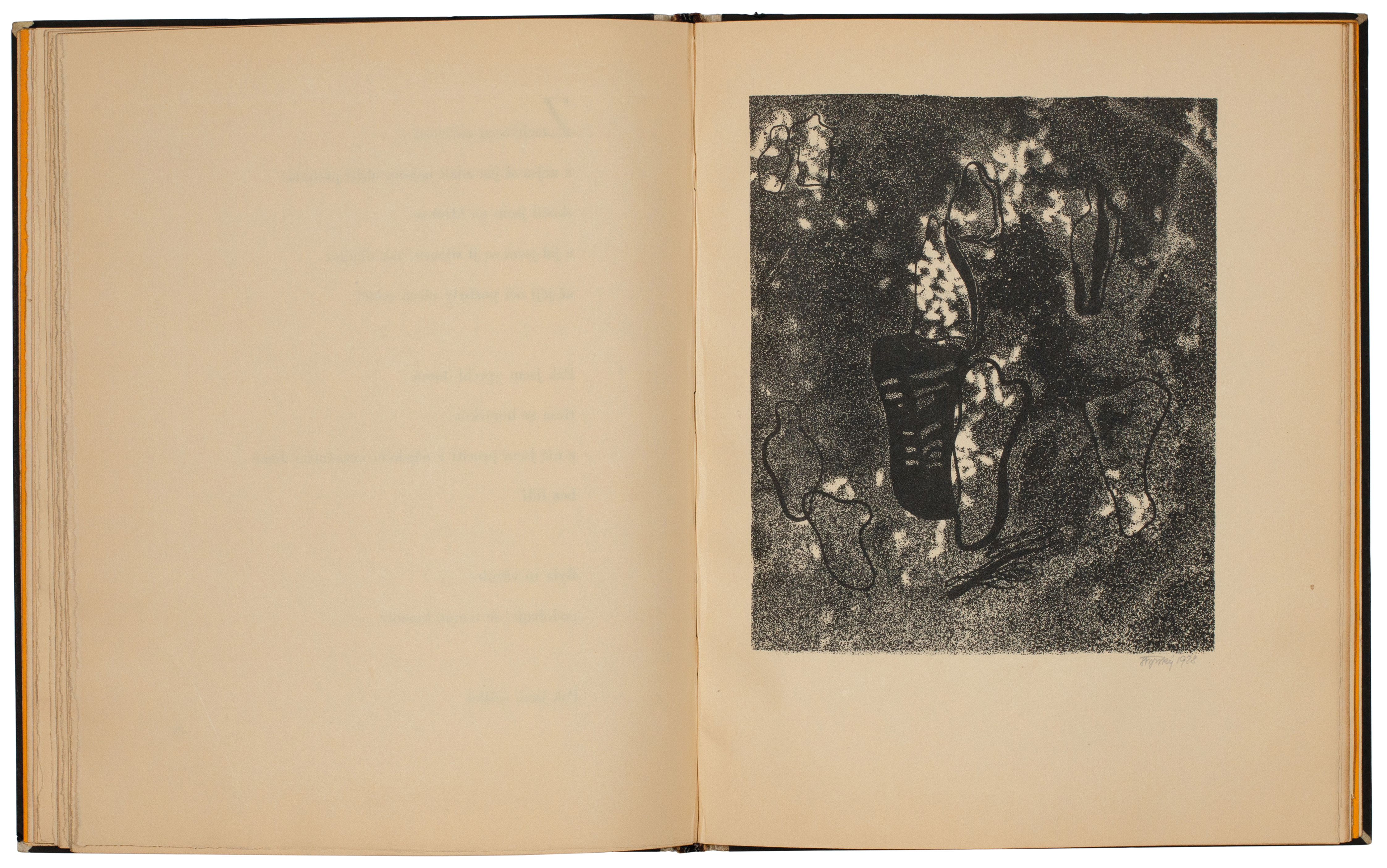
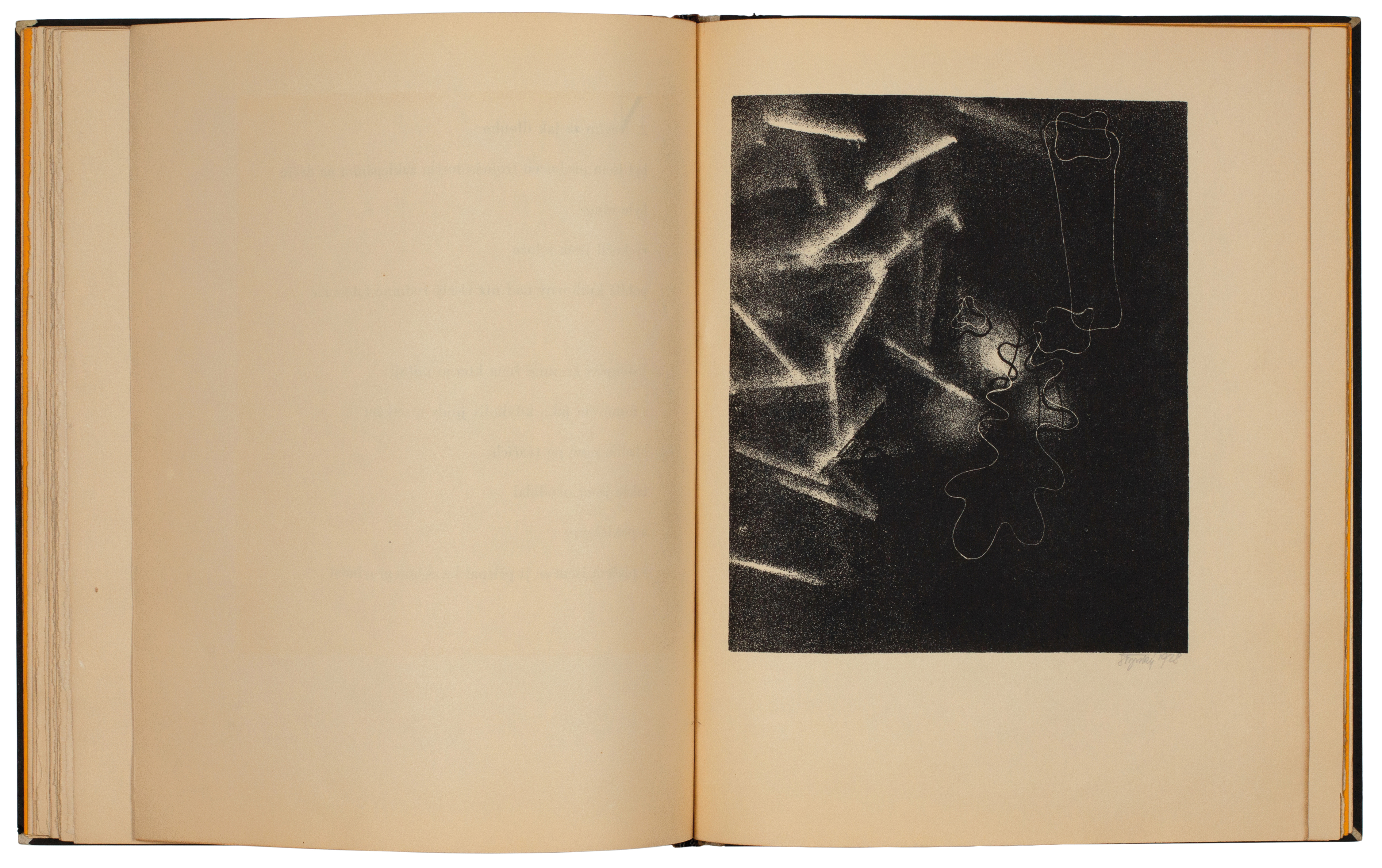
Toyen (1903 - 1980) was born Marie Čerminovà before adopting the androgynous mononym Toyen in 1923. Before the Czech Surrealist group (founded in 1934) which included Toyen, Styrsky, Teige and Nezval, there was 'Devětsil'. Founded in the early 1920s, 'Devětsil' was a major force of the European avant-garde and included among many others the quartet exemplified in this copy of 'Židovský Hřbitov'. Composed of Nezval's epic eponymous poem, itself a forerunner of the poet's Surrealist phase - it was included in his second Surrealist collection 'Praha s prsty deště' (Prague with Fingers of Rain) of 1936 - and Styrsky's six superbly evocative original lithographs. Here Styrsky's lithographs, almost photographic in effect and evoking rayograms or rayographs, are all signed and dated in pencil. Styrsky's original lithographs prefigure his illustrations for 'Les Chants de Maldoror' of 1929 and the Surrealist work of the 1930's. Undertaken after he and Toyen had spent time in Paris in the mid-1920s, these extraordinary abstractions and the verse they accompany underscore the 'Artificialist' credo the pair espoused: 'Artificialism is the assimilation of the painter and the poet' (Styrsky / Toyen, 1926). The typography and mise en page by Karel Teige bring unity to the text and illustration: the unpunctuated lines of verse and the interspersed lithographs are all printed recto only, giving both the attention of the reader that they deserve and underlining their interplay. The inscribed leaves - with Nezval's and Styrsky's contributions discrete - also conform to this system and all are enclosed within the vivid orange wrappers with Teige's beautiful lettering.
'We should not forget that Man Ray's rayograms were a vital source of inspiration for Artificialism's 'imprinting' technques ... '. (Brandon Taylor).
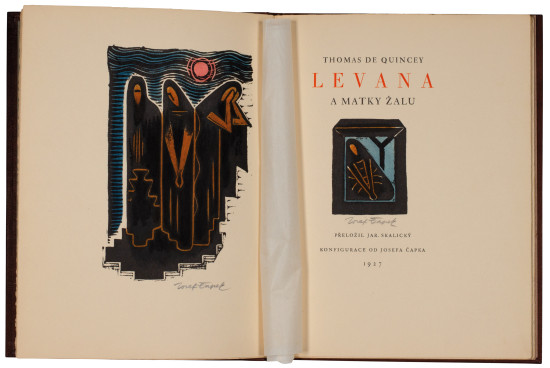
'Levana and Our Ladies of Sorrow' forms a part - as noted by Styrsky in his manuscript quotation - of Thomas de Quincey's extraordinary 'Suspirira de Produndis', itself considered by de Quincey to be the sequel to his 'Confessions of an English Opium-Eater'. Portions of 'Suspiria de Profundis' (including 'Levana and Our Ladies of Sorrow' were published in Blackwood's Magazine in 1845 but a larger part was not published until after de Quincey's death. Lauded by Baudelaire who translated 'Suspiria de Profundis' into French, de Quincey's prose poem was admired too by the Surrealists and Breton included him in his 'Anthologie de l'Humour Noir' (1940). 'Suspiria de Profundis' was first translated into Czech in the early twentieth century but we have been unable to trace the source for Styrsky's quotation. The most likely edition would be the 1927 edition featuring illustration by Josef Capek, a fellow member of 'Devětsil' but differences make it clear that this was not the source used by Styrsky. Indeed, cafreful comparison of Styrsky's Czech version with de Quincey's English version suggest that Styrsky has added a sentence of his own: 'Tak porozumi darýu pravdám, ponurýin a strasuým.' (And so understand the gift of truths, gloomy and haunting), or at least has adjusted de Quincey's syntax. Intriguingly too, Styrsky's quotation features three blank spaces, as if for a Surrealist game, each with a green crayon line inviting the reader to fill in the blanks. The blanks have been duly filled, appropriately with 'Mater Tenebrarum', 'nebývají' and 'Boha' in another hand and with a different ink; it seems likely given the presentation that the additions are by Toyen herself.
Given the very specific nature of Styrsky's quotation - its tone of portentousness ensures it is hard to overlook - that there is a strong significance for both Styrsky and Toyen is a conclusion that is inescapable. One may surmise a number of intentions on the part of Styrsky (that the passage is self-referential and is an allusion to him in the absence of Toyen, that Toyen is herself the 'Mater Tenebrarum' with concurrent effect, that the prose is an artistic aspiration, a wishful manifesto of oneiric sight) but all remain conjecture without further evidence. It can however be stated that Styrsky's quotation is of a profound resonance, and given all that Toyen and Styrsky were to achieve, singly and together, for the remaining time of their creative partnership, a quotation that is startlingly suggestive and of a deep and submerged power.
'Nezval dedicated his text, in which an impression of the 'profound connection between eroticism and death' evokes a 'dreamy, lyrical ecstacy', to Styrsky, for whom the theme had a special, personal resonance. (For his entire life, Styrsky was obsessed with eros and thanatos.) The poems, in turn, inspired STyrsky's favorite technique of these years, which he applied to both printmaking and painting. Using a spray gun, he was able to silhouette disparate objects against a neutral ground, achieving an unusual and tenebrous luminosity. The black-and-white lithographs ... have a peculiar graininess and suggest a tremulous nighttime space, with scattered matches, nails, and otherr small items transformed into out-of-focus nebulous shapes. A game of free-flowing lines is played out in this setting as well. In the fifth and sixth prints in particular, one sees a disturbing relationship between the white lines, created by the negative imprint of threads, and their black shadows, which start to follow their own course. Additionally, among the abstract shapes that appear in the chiaroscuro illustrations for 'The Jewish Cemetery', one can identify the outlines of standing tombstones.' (Karel Srp and Lenka Bydzovska).
'Vitezslav Nezval, one of the greatest (but also most controversial) Czech poets, lived in a country whose history was rich in reversals and paradoxical changes, but also a country where poetry enjoyed extraordinary interest ... Nezval was one of those exceptional creative persons for whom everything they encounter turns into poetry ... That period [the end of the 1920s and beginning of the 1930s] (from which his poems about Prague date) may be regarded as the peak period of his creativity. Nezval had in him that which characterises a genius - the need to forever seek and find something new, a need further enhanced by the atmosphere of his day, which regarded novelty, freshness and rebellion against any tradition as its highest value ... '. (Ivan Klima).
[see Karel Srp and Lenka Bydzovska's 'Mirrors without Images' in 'New Formations: Czech Avant-Garde Art and Modern Glass from the Roy and Mary Cullen Collection', Houston, 2011; see 'Prague with Fingers of Rain', Ewald Oser's translation of Nezval's 'Praha s prs
This extraordinary copy of 'Židovský Hřbitov' unites the leading lights of the Czech artistic avant-garde: the poet Nezval with his signed presentation, the artist Styrsky to whom Nezval dedicated the book and who has signed all of the original lithographs and inscribed the book with a long quote from de Quincey, the designer and theorist Teige who was responsible for the typography and mise en page and, of course, Toyen herself, to whom the work is presented. All were members of the group 'Devětsil' and Toyen and Styrsky had developed the credo of 'Artificialism' in Paris in 1927, their response to Surrealism; the illustrations by Styrsky for 'Židovský Hřbitov' belong to his pre-Surrealist Artificialist oeuvre. The timing of the presentation is significant as Toyen was in Paris at the time - Nezval references this in his presentation - in addition to which Sttyrsky's manuscript quotation is the only surviving semantic link between the pair (no letter or other presentation is known) as they were never apart, physically or creatively. That Styrsky's choice of de Quincey is of the utmost importance hardly needs stating, that he wrote the quotation with blank spaces that Toyen herself later filled in highlights this significance further and suggests that this passage taken from 'Levana and Our Ladies of Sorrow' had a deerp and resonant meaning for them both.
From the edition limited to 220 numbered copies on Hollande Van Gelder; this copy signed by Nezval to initial blank and numbered to the justification in ink; also with Nezval's presentation to the initial blank beneath his signature, Styrsky's extensive and allusive manuscript quotation from de Quincey to the half-title and with all the original lithographs signed and dated '1928' in pencil by Styrsky.
Nezval's presentation is in black ink to the initial blank beneath his signature: 'Drahé Mance tuto knížku, kterou jsme dělali s Jindrou / vzpomínajíce na ni a smutni, protože se nevrátila / Její Sláva / V Praze 4. XII. 1928' (Precious Mance [a dimnutive of Marie, i.e. Toyen] this book, that we made with Jindrou [a diminutive of Jindricj=h, i.e. Styrsky] remembering her and miserable, because she has not returned, Her Slava [a diminutive of Vitezlav, e.e. Nezval] / 4.XII.1929.).
Styrsky's extensive quotation in Czech - taken from Thomas de Quincey's 'Levana and Our Ladies of Sorrow' in 'Suspiria De Profundis: Being a Sequel to the 'Confessions of an Engllsh Opium-Eater''' - is in black ink to the half-title. A transcription of the manuscript is available on request.
All of the manuscript in the present copy is dated from within a very few days: Nezval's signature to an initial blank features the date '30.XI.1928' (presumably close to the date of publication / issue) while his presentation to Toyen is dated '4.XII.1928'; Styrsky's quotation is dated '5. prosince 1928'. In June 1928, Toyen travelled to Paris alone (her only separation from Styrsky until his death) and only returned to Prague in January 1929; Nezval's presentation refers to this absence directly.
Toyen (1903 - 1980) was born Marie Čerminovà before adopting the androgynous mononym Toyen in 1923. Before the Czech Surrealist group (founded in 1934) which included Toyen, Styrsky, Teige and Nezval, there was 'Devětsil'. Founded in the early 1920s, 'Devětsil' was a major force of the European avant-garde and included among many others the quartet exemplified in this copy of 'Židovský Hřbitov'. Composed of Nezval's epic eponymous poem, itself a forerunner of the poet's Surrealist phase - it was included in his second Surrealist collection 'Praha s prsty deště' (Prague with Fingers of Rain) of 1936 - and Styrsky's six superbly evocative original lithographs. Here Styrsky's lithographs, almost photographic in effect and evoking rayograms or rayographs, are all signed and dated in pencil. Styrsky's original lithographs prefigure his illustrations for 'Les Chants de Maldoror' of 1929 and the Surrealist work of the 1930's. Undertaken after he and Toyen had spent time in Paris in the mid-1920s, these extraordinary abstractions and the verse they accompany underscore the 'Artificialist' credo the pair espoused: 'Artificialism is the assimilation of the painter and the poet' (Styrsky / Toyen, 1926). The typography and mise en page by Karel Teige bring unity to the text and illustration: the unpunctuated lines of verse and the interspersed lithographs are all printed recto only, giving both the attention of the reader that they deserve and underlining their interplay. The inscribed leaves - with Nezval's and Styrsky's contributions discrete - also conform to this system and all are enclosed within the vivid orange wrappers with Teige's beautiful lettering.
'We should not forget that Man Ray's rayograms were a vital source of inspiration for Artificialism's 'imprinting' technques ... '. (Brandon Taylor).
'Levana and Our Ladies of Sorrow' forms a part - as noted by Styrsky in his manuscript quotation - of Thomas de Quincey's extraordinary 'Suspirira de Produndis', itself considered by de Quincey to be the sequel to his 'Confessions of an English Opium-Eater'. Portions of 'Suspiria de Profundis' (including 'Levana and Our Ladies of Sorrow' were published in Blackwood's Magazine in 1845 but a larger part was not published until after de Quincey's death. Lauded by Baudelaire who translated 'Suspiria de Profundis' into French, de Quincey's prose poem was admired too by the Surrealists and Breton included him in his 'Anthologie de l'Humour Noir' (1940). 'Suspiria de Profundis' was first translated into Czech in the early twentieth century but we have been unable to trace the source for Styrsky's quotation. The most likely edition would be the 1927 edition featuring illustration by Josef Capek, a fellow member of 'Devětsil' but differences make it clear that this was not the source used by Styrsky. Indeed, cafreful comparison of Styrsky's Czech version with de Quincey's English version suggest that Styrsky has added a sentence of his own: 'Tak porozumi darýu pravdám, ponurýin a strasuým.' (And so understand the gift of truths, gloomy and haunting), or at least has adjusted de Quincey's syntax. Intriguingly too, Styrsky's quotation features three blank spaces, as if for a Surrealist game, each with a green crayon line inviting the reader to fill in the blanks. The blanks have been duly filled, appropriately with 'Mater Tenebrarum', 'nebývají' and 'Boha' in another hand and with a different ink; it seems likely given the presentation that the additions are by Toyen herself.
Given the very specific nature of Styrsky's quotation - its tone of portentousness ensures it is hard to overlook - that there is a strong significance for both Styrsky and Toyen is a conclusion that is inescapable. One may surmise a number of intentions on the part of Styrsky (that the passage is self-referential and is an allusion to him in the absence of Toyen, that Toyen is herself the 'Mater Tenebrarum' with concurrent effect, that the prose is an artistic aspiration, a wishful manifesto of oneiric sight) but all remain conjecture without further evidence. It can however be stated that Styrsky's quotation is of a profound resonance, and given all that Toyen and Styrsky were to achieve, singly and together, for the remaining time of their creative partnership, a quotation that is startlingly suggestive and of a deep and submerged power.
'Nezval dedicated his text, in which an impression of the 'profound connection between eroticism and death' evokes a 'dreamy, lyrical ecstacy', to Styrsky, for whom the theme had a special, personal resonance. (For his entire life, Styrsky was obsessed with eros and thanatos.) The poems, in turn, inspired STyrsky's favorite technique of these years, which he applied to both printmaking and painting. Using a spray gun, he was able to silhouette disparate objects against a neutral ground, achieving an unusual and tenebrous luminosity. The black-and-white lithographs ... have a peculiar graininess and suggest a tremulous nighttime space, with scattered matches, nails, and otherr small items transformed into out-of-focus nebulous shapes. A game of free-flowing lines is played out in this setting as well. In the fifth and sixth prints in particular, one sees a disturbing relationship between the white lines, created by the negative imprint of threads, and their black shadows, which start to follow their own course. Additionally, among the abstract shapes that appear in the chiaroscuro illustrations for 'The Jewish Cemetery', one can identify the outlines of standing tombstones.' (Karel Srp and Lenka Bydzovska).
'Vitezslav Nezval, one of the greatest (but also most controversial) Czech poets, lived in a country whose history was rich in reversals and paradoxical changes, but also a country where poetry enjoyed extraordinary interest ... Nezval was one of those exceptional creative persons for whom everything they encounter turns into poetry ... That period [the end of the 1920s and beginning of the 1930s] (from which his poems about Prague date) may be regarded as the peak period of his creativity. Nezval had in him that which characterises a genius - the need to forever seek and find something new, a need further enhanced by the atmosphere of his day, which regarded novelty, freshness and rebellion against any tradition as its highest value ... '. (Ivan Klima).
[see Karel Srp and Lenka Bydzovska's 'Mirrors without Images' in 'New Formations: Czech Avant-Garde Art and Modern Glass from the Roy and Mary Cullen Collection', Houston, 2011; see 'Prague with Fingers of Rain', Ewald Oser's translation of Nezval's 'Praha s prs
[24 leaves; pp. 31]. Small folio. (303 x 244 mm). Initial blank with Nezval's signature and Nezval's signed presentation, half-title with extensive signed manuscript quotation by Styrsky, leaf with original lithograph by Styrsky as frontispiece verso, printed title, leaf with dedication to Styrsky and Nezval's verse illustrated with five further original full-page lithographs by Styrsky, final leaf with justification, all of the original lithographs are signed and dated '1928' by Styrsky in pencil; printed text and illustration recto only throu Contemporary Czech vellum-backed stiff black card boards, gilt tile to spine, t.e.g., original publisher's orange printed paper wrappers with titles to front cover and spine in grey / green by Karel Teige preserved.
#48695