Le Corbeau. The Raven. Poème par Edgar Poe. Traduction française de Stéphane Mallarmé. Avec Illustrations par Edouard Manet
Manet, Edouard. Poe, Edgar Allan
Paris. Richard Lesclide. 1875
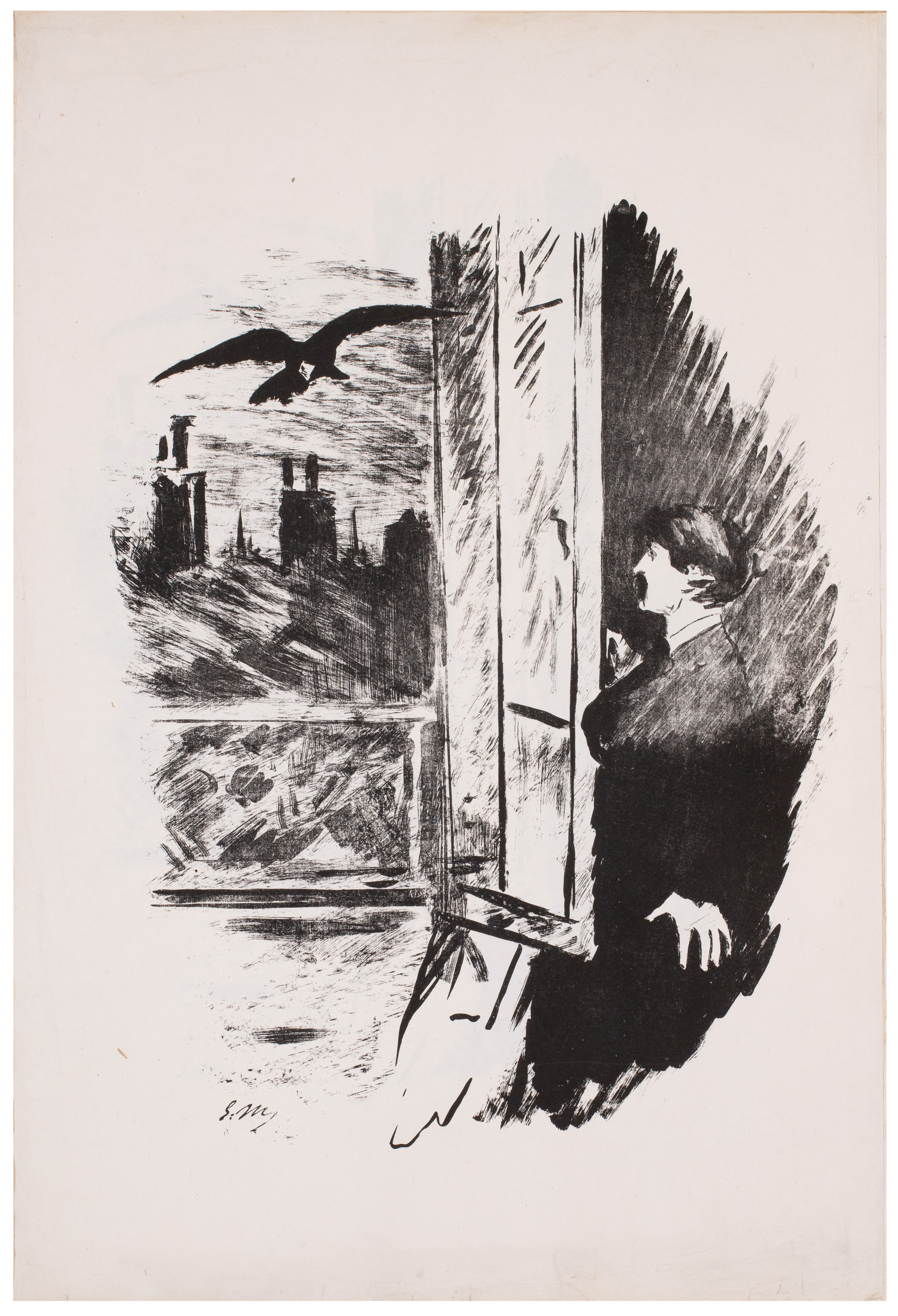
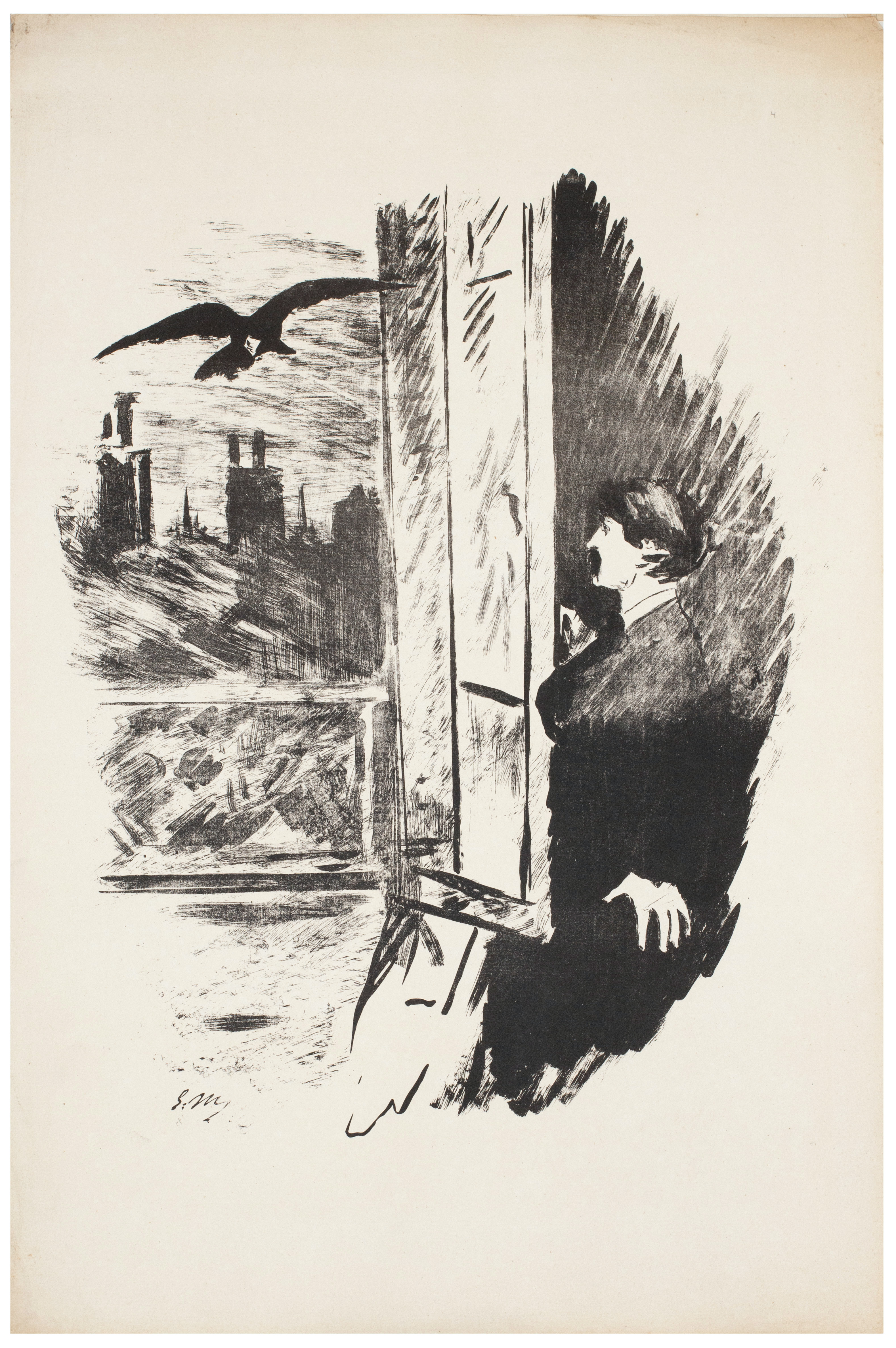
Manet's illustrations for Mallarmé's translation of Edgar Allen Poe's 'The Raven', a stunning copy of 'Le Corbeau' in the original portfolio, with a suite of Manet's illustrations on Chine and with the very rare 'affiche de librairie'.
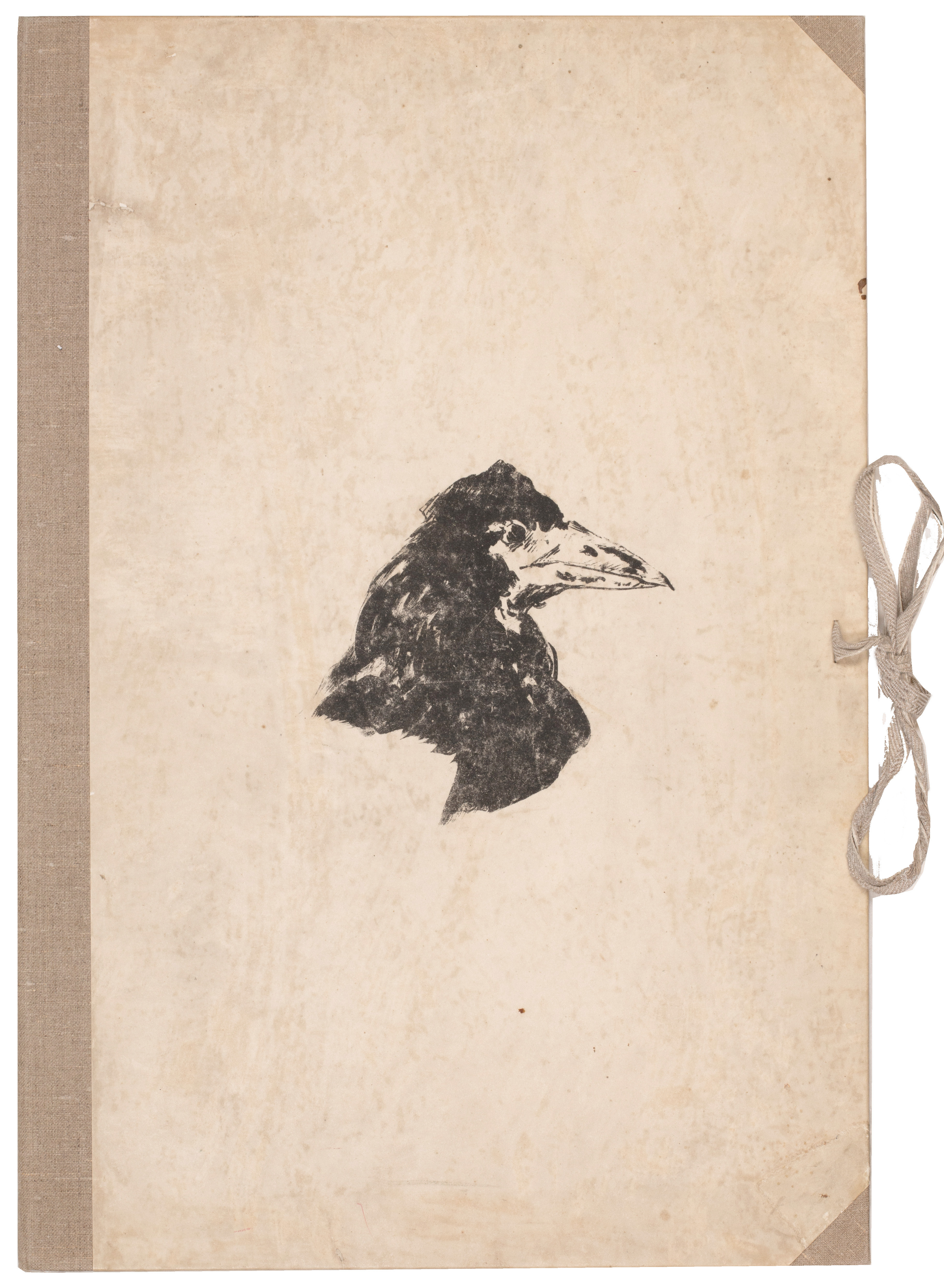
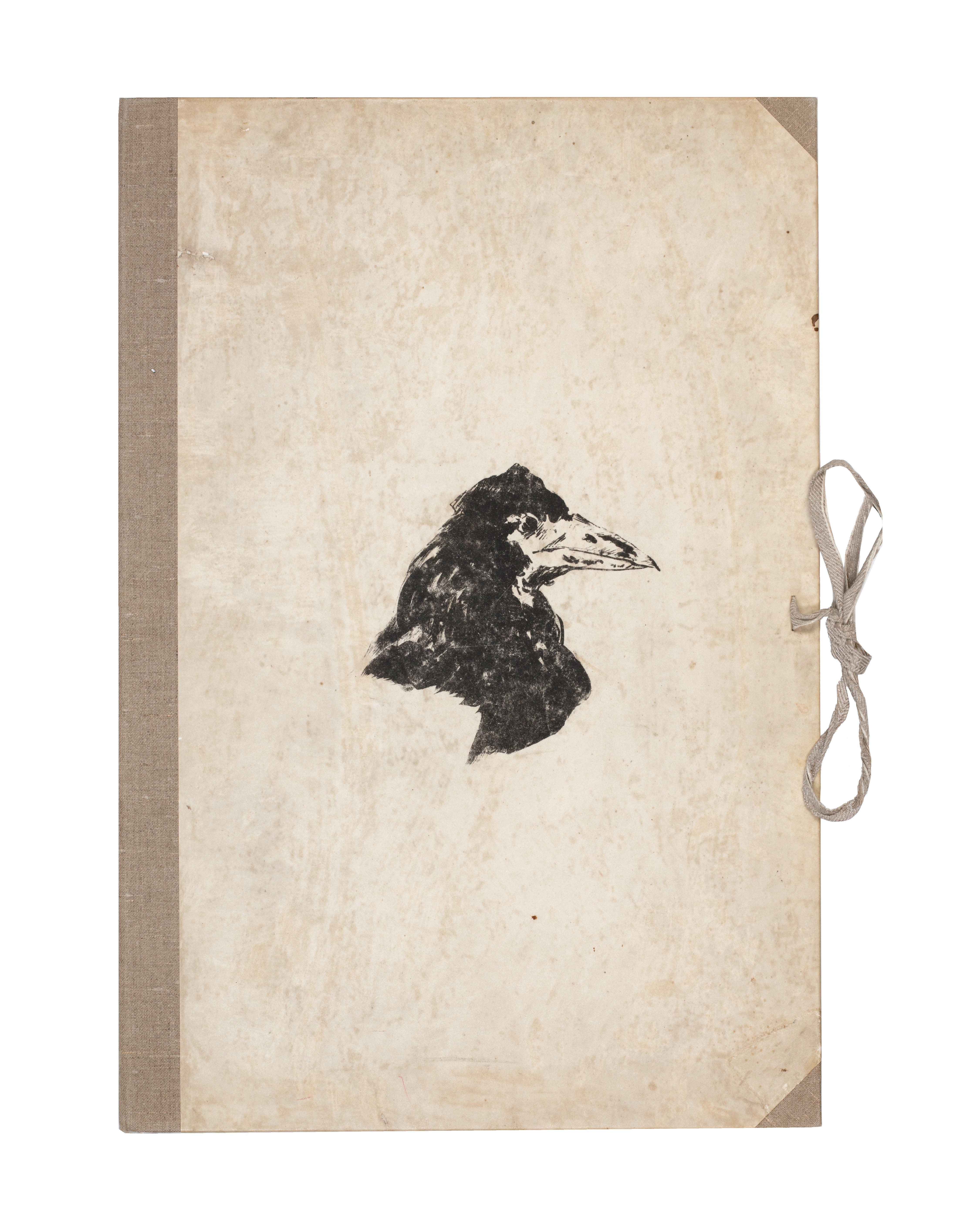
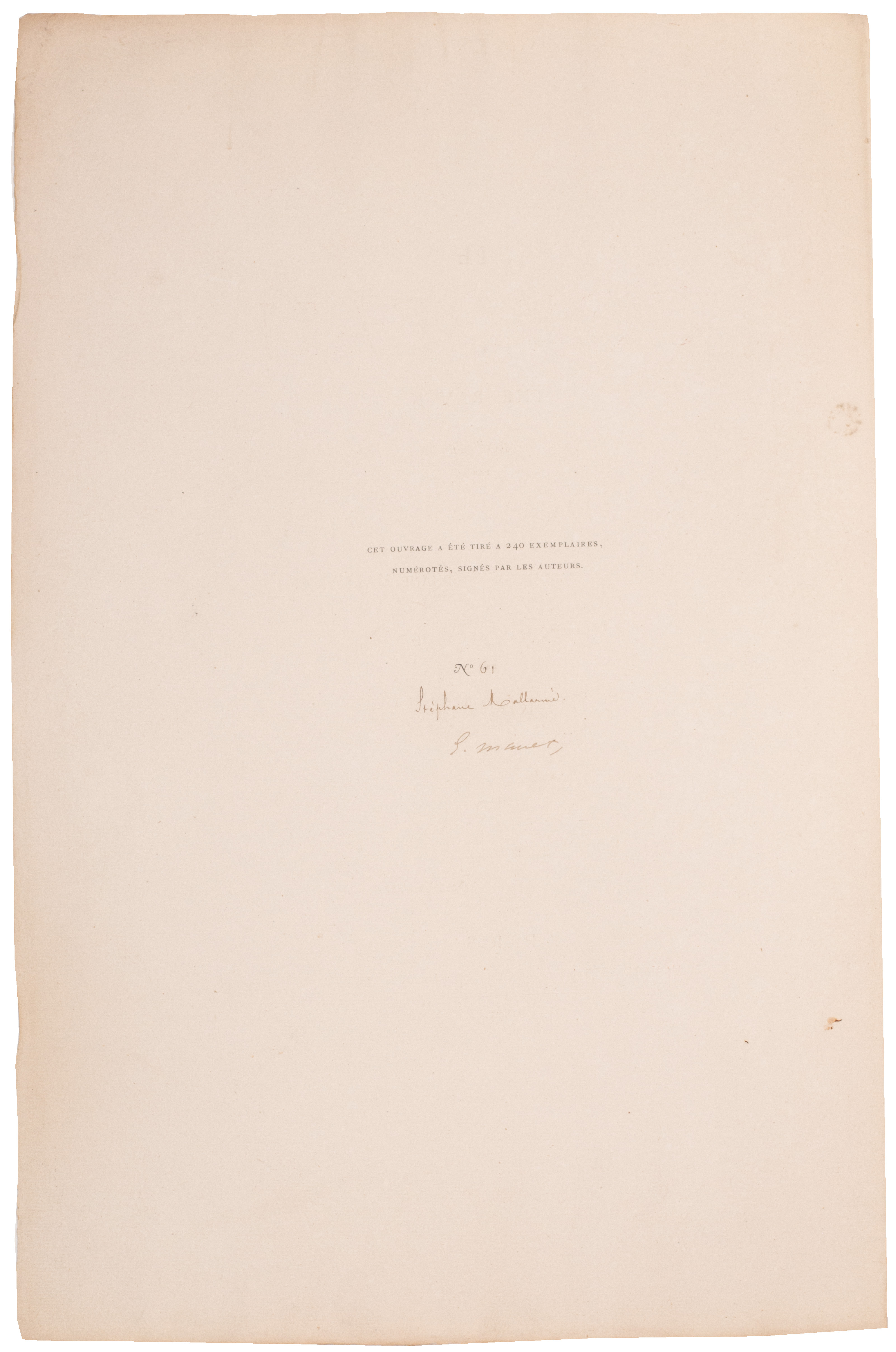
From the edition limited to 240 copies (although only 150 were printed - see below), with this copy signed by Manet and Mallarmé in ink to the justification, with the additional suite of lithographs on Chine, the original poster on papier parcheminé and in the original portfolio with Manet's raven's head to front cover and the list of publications to the rear.
The copy presented here, with the very rare suite, the rarer original portfolio and the even rarer poster is a remarkable survival and represents one of the finest copies of the work to remain extant. Juliet Wilson-Bareau in her census (see below) records only six copies with the plates on both papers as here; she notes that, of these, four are in institutional collections.
The large and striking 'Le Corbeau' is always cited as one of the high points of French book illustration. Considered 'an astonishingly modern illustrated book for 1875' (The Artist and the Book), 'Le Corbeau' represents a turning-point in the history of the illustrated book. Book illustration was subsequently 'liberated' from literal interpretation.
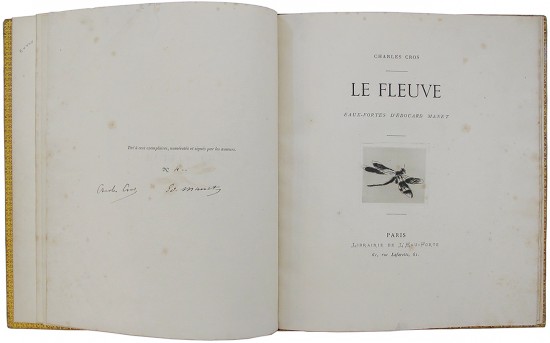
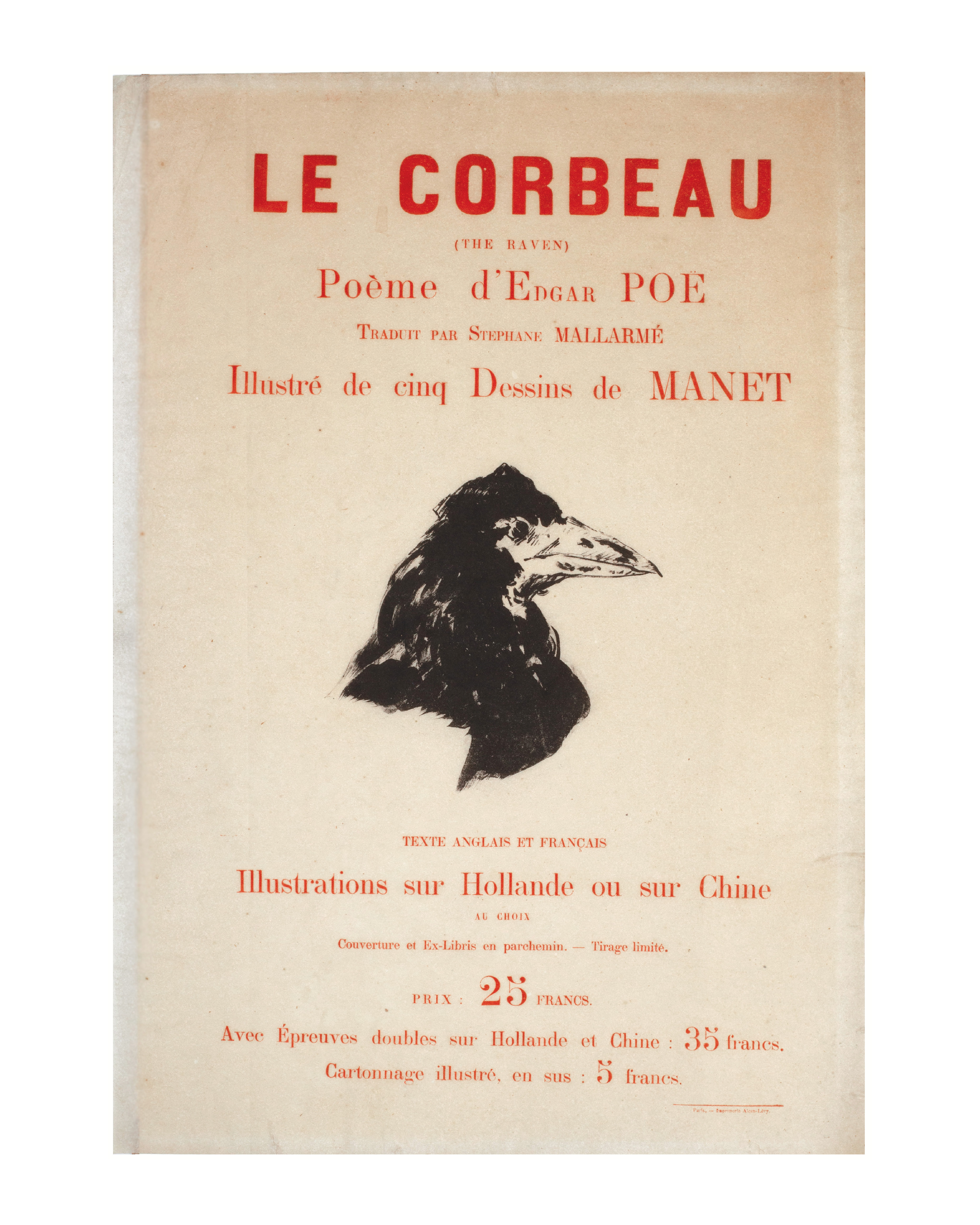
The poster is printed with red text around a central raven's head (as for the cover) on papier parcheminé (524 x 358 mm) and was designed by Mallarmé himself. As noted by Wilson-Bareau: 'The poster ... gives equal prominence to the author 'Edgar POE' and the illustrator 'MANET', while Mallarmé as translator appears in a modestly smaller size of type ... '. The poster lists copies as available at '25 FRANCS', copies with the additional suite as at '35 francs' while the 'cartonnage illustré' was an additional '5 francs'. The portfolio features Manet's raven's head to the front cover and advertisements for the Librairie de l'Eau-Forte to the rear. Among the advertisements are listings for Manet's earlier illustrated book 'Le Fleuve' (1874) and for Mallarmé's translation of Poe's poems.
The technique used by Manet for the Corbeau plates was transfer lithography, which 'was a method ideally suited to the brush-and-ink drawing style ... [Manet] brushed in his designs with transfer ink on sheets of paper that Lefman, the specialist printer for this technique, then transferred to zinc plates for printing ... '. (Wilson-Bareau).
'Whether one regards Le Corbeau as a work of its own time, however, or as a harbinger of the modern book, it is one of the high points of French illustration.' (Ray p. 369).
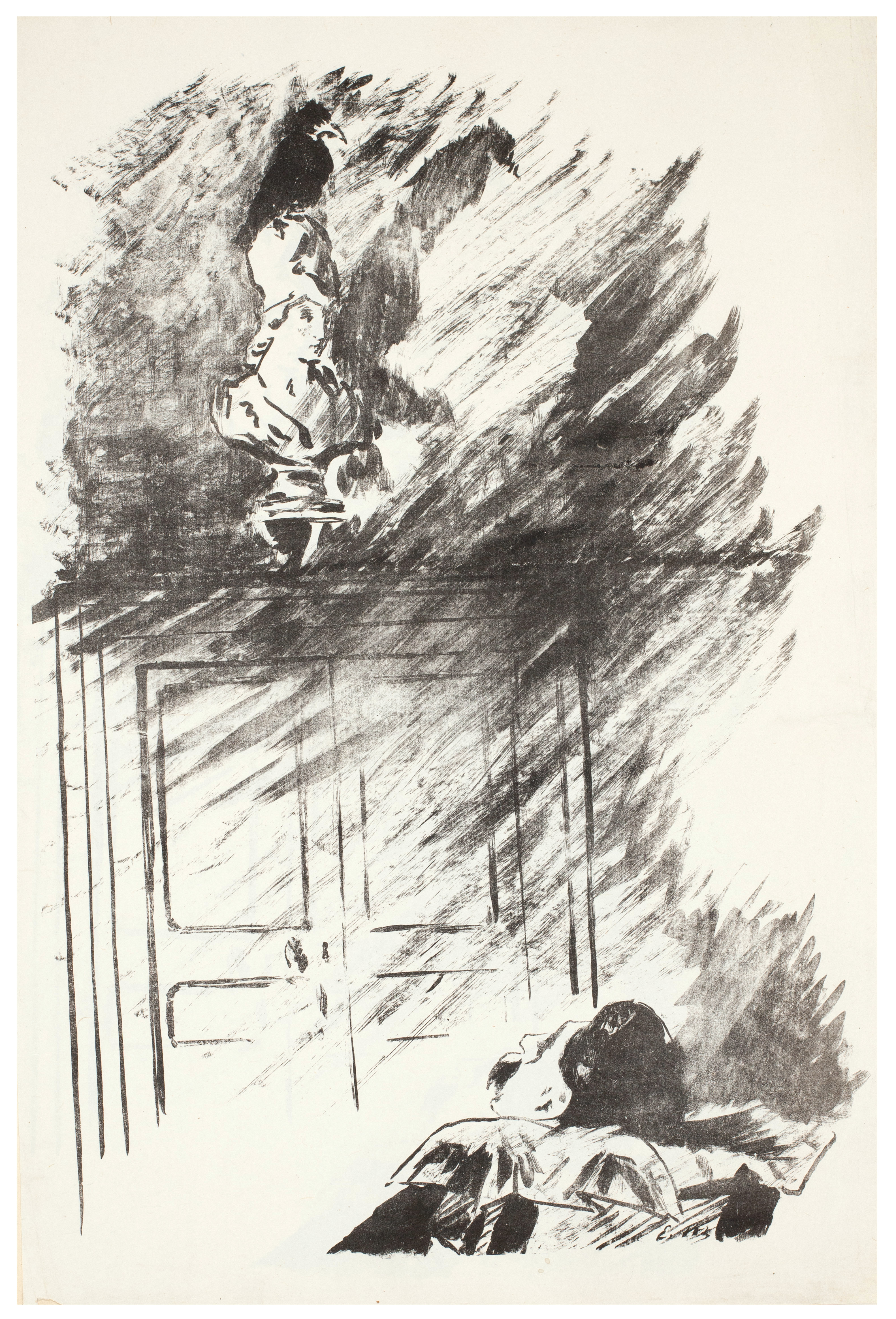
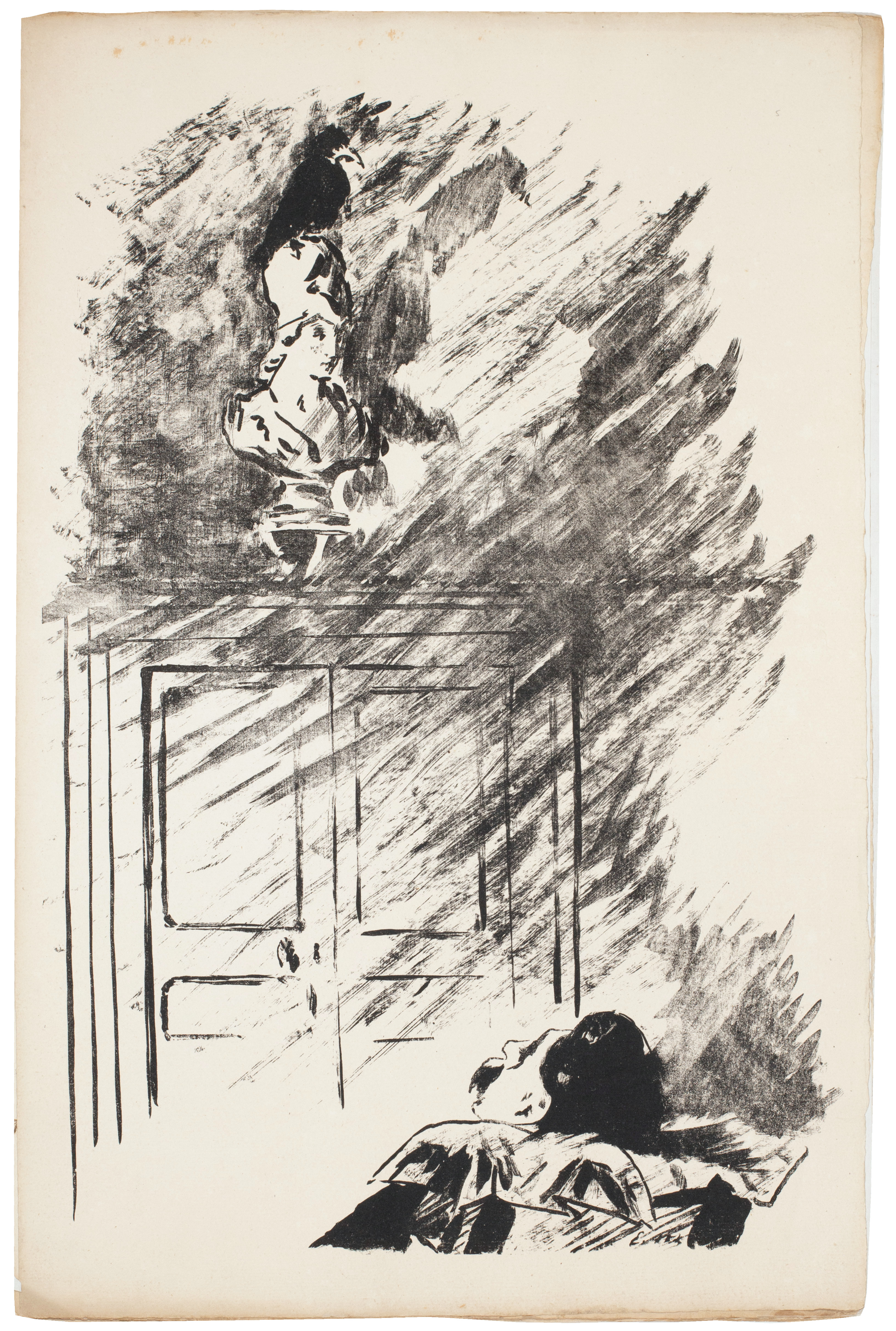
'The last image is almost indecipherable in the density of its real and abstract references. The bottom of the door, an empty chair, and the shadows that menace like living evils spirits are brushed in with a suggestive force that defines description and is without analogy in other contemporary works'. (Wilson-Bareau).
It is documented in Lesclide's 'Déclarations d'imprimer' at the Dépôt légal de Paris on 14 June 1875, that apart from the few trial copies, the publisher printed only 150 copies as opposed to the 240 announced on the justification. This copy is listed by Juliet Wilson-Bareau in her census ('T/H. + P/H + C')('T/H. + P/H + C’ i.e. ’Text / Hollande + Plates / Hollande + Chine') and conforms to the first group published and issued, numbered from 1 to 100. Wilson-Bareau records only six further copies with the text and plates as for the present example, of which four are detailed as in institutional collections; she adds Mallarmé and Manet's own copies with additional material together with a copy that also featured the plates on Japon.
[Guérin 85 - 86; Harris 83; The Artist and the Book 178; Ray, Art of the French Illustrated Book 277; Fischer 65 - 71; see Henri Mondor, Vie de Mallarmé, Paris, 1941; see Wilson-Bareau, Manet 1832- 1883, Metropolitan Museum of Art, 1983].
From the edition limited to 240 copies (although only 150 were printed - see below), with this copy signed by Manet and Mallarmé in ink to the justification, with the additional suite of lithographs on Chine, the original poster on papier parcheminé and in the original portfolio with Manet's raven's head to front cover and the list of publications to the rear.
The copy presented here, with the very rare suite, the rarer original portfolio and the even rarer poster is a remarkable survival and represents one of the finest copies of the work to remain extant. Juliet Wilson-Bareau in her census (see below) records only six copies with the plates on both papers as here; she notes that, of these, four are in institutional collections.
The large and striking 'Le Corbeau' is always cited as one of the high points of French book illustration. Considered 'an astonishingly modern illustrated book for 1875' (The Artist and the Book), 'Le Corbeau' represents a turning-point in the history of the illustrated book. Book illustration was subsequently 'liberated' from literal interpretation.
The poster is printed with red text around a central raven's head (as for the cover) on papier parcheminé (524 x 358 mm) and was designed by Mallarmé himself. As noted by Wilson-Bareau: 'The poster ... gives equal prominence to the author 'Edgar POE' and the illustrator 'MANET', while Mallarmé as translator appears in a modestly smaller size of type ... '. The poster lists copies as available at '25 FRANCS', copies with the additional suite as at '35 francs' while the 'cartonnage illustré' was an additional '5 francs'. The portfolio features Manet's raven's head to the front cover and advertisements for the Librairie de l'Eau-Forte to the rear. Among the advertisements are listings for Manet's earlier illustrated book 'Le Fleuve' (1874) and for Mallarmé's translation of Poe's poems.
The technique used by Manet for the Corbeau plates was transfer lithography, which 'was a method ideally suited to the brush-and-ink drawing style ... [Manet] brushed in his designs with transfer ink on sheets of paper that Lefman, the specialist printer for this technique, then transferred to zinc plates for printing ... '. (Wilson-Bareau).
'Whether one regards Le Corbeau as a work of its own time, however, or as a harbinger of the modern book, it is one of the high points of French illustration.' (Ray p. 369).
'The last image is almost indecipherable in the density of its real and abstract references. The bottom of the door, an empty chair, and the shadows that menace like living evils spirits are brushed in with a suggestive force that defines description and is without analogy in other contemporary works'. (Wilson-Bareau).
It is documented in Lesclide's 'Déclarations d'imprimer' at the Dépôt légal de Paris on 14 June 1875, that apart from the few trial copies, the publisher printed only 150 copies as opposed to the 240 announced on the justification. This copy is listed by Juliet Wilson-Bareau in her census ('T/H. + P/H + C')('T/H. + P/H + C’ i.e. ’Text / Hollande + Plates / Hollande + Chine') and conforms to the first group published and issued, numbered from 1 to 100. Wilson-Bareau records only six further copies with the text and plates as for the present example, of which four are detailed as in institutional collections; she adds Mallarmé and Manet's own copies with additional material together with a copy that also featured the plates on Japon.
[Guérin 85 - 86; Harris 83; The Artist and the Book 178; Ray, Art of the French Illustrated Book 277; Fischer 65 - 71; see Henri Mondor, Vie de Mallarmé, Paris, 1941; see Wilson-Bareau, Manet 1832- 1883, Metropolitan Museum of Art, 1983].
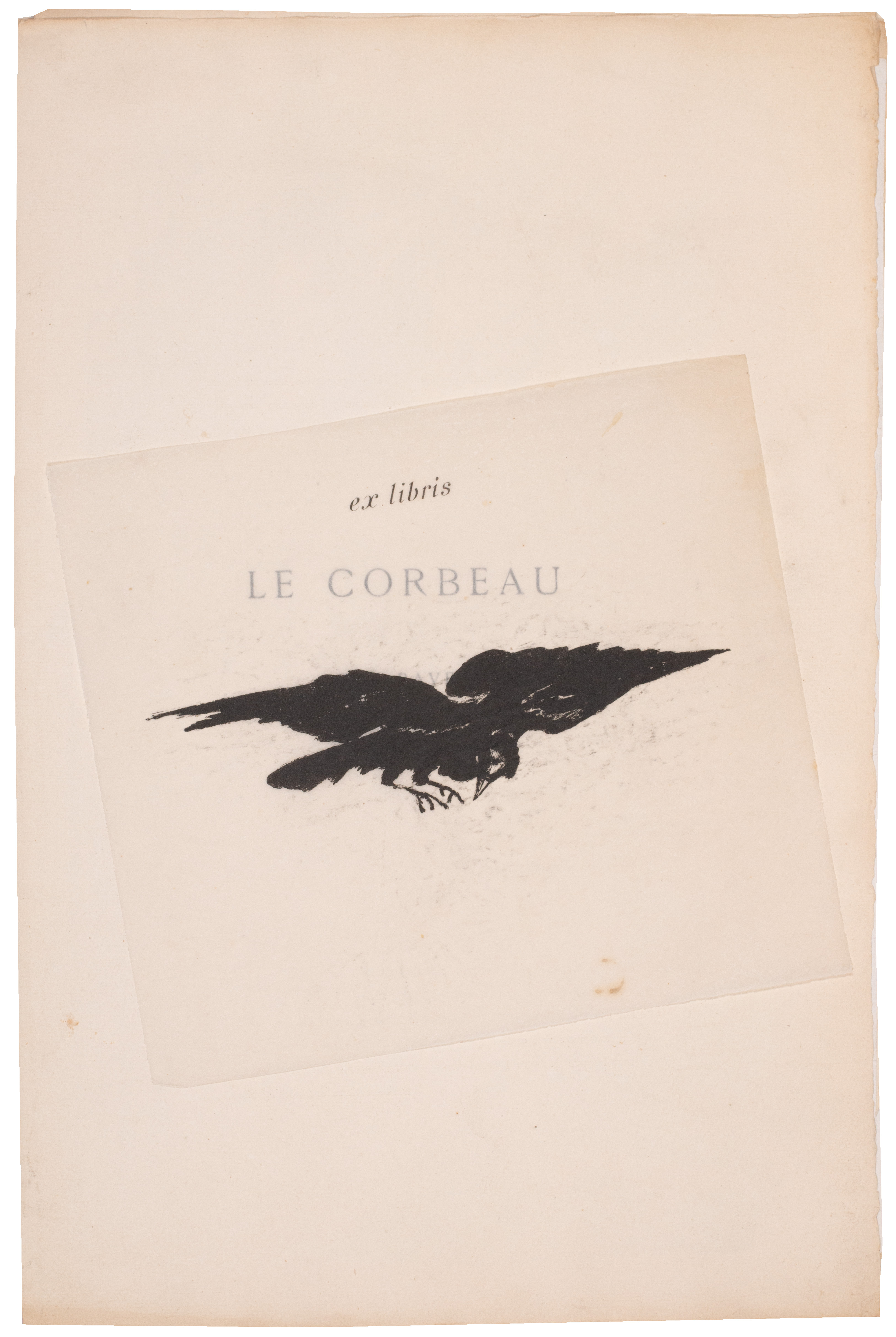
[10 leaves of Hollande + four leaves of Chine + parchment ex-libris + poster]. Folio. (548 x 372 mm). Contents: 14 unnumbered leaves: six leaves of Hollande with printed title in red and black, justification verso, half-title and parallel text in English (Poe) and French (Mallarmé's translation), final leaf with 'achevé d'imprimer' dated 'le Vingt Mai Mil Huit Cent Soixante-Quinze' verso; four leaves of Hollande with Manet's monochrome lithographs printed recto only, each signed 'E. M.' in the stone (sheet size: c.545 x 355 mm.) together with the suite of the same four lithographs on Chine and smaller loosely inserted parchment 'Ex Libris' leaf (c.260 x 290 mm) with monochrome printed text and lithograph raven in flight by Manet. Loose in the original publisher's portfolio, the 'cartonnage illustré' of parchment with Manet's raven's head to front cover in black and the advertisements of Librairie de l'Eau-Forte to the rear, the portfolio with later cloth backing and new ties.
#48750