'To the Wesleyan People (who attended the meeting.) - a footnote to my lecture of January 13th, 1966'
Ono, Yoko
New York. (By the artist). 1966
An excellent copy of Yoko Ono's artistic and spiritual catechism, her manifesto of being and creating.
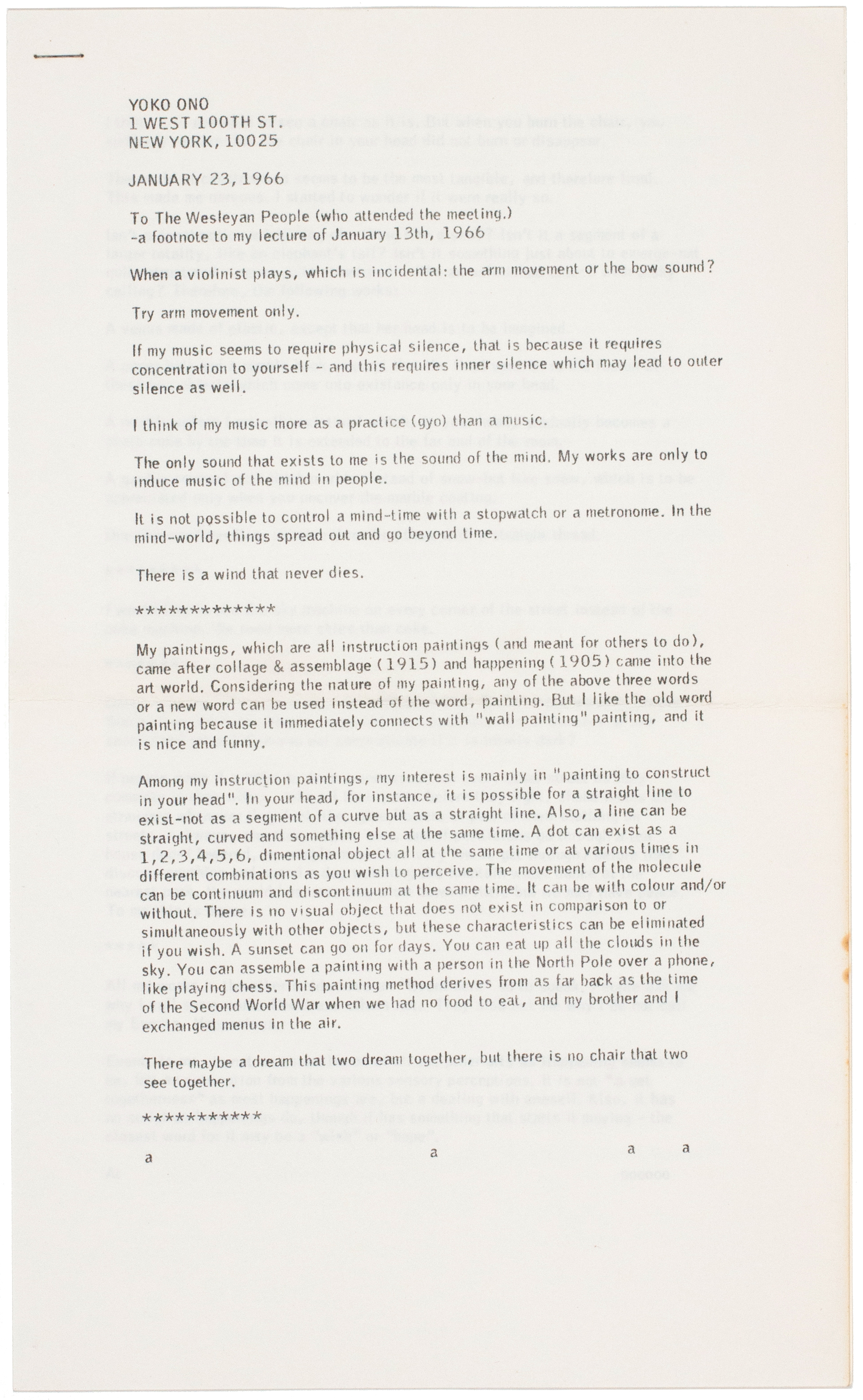
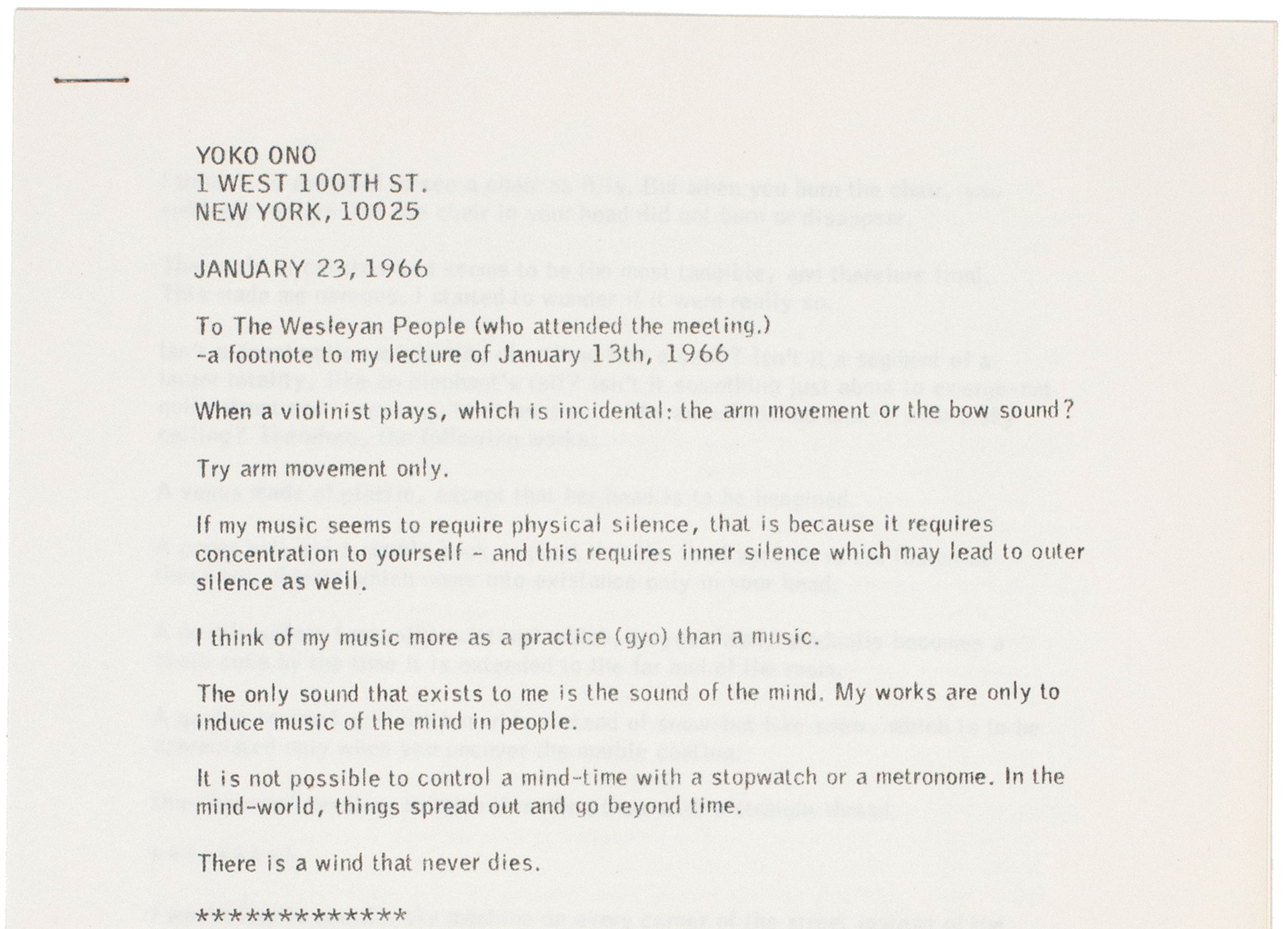
At once biographical, visionary, and catechistic, Yoko Ono's text 'To the Wesleyan People' was written ten days after her concert / performance / event / lecture 'Avant Garde in Japan' at the Davison Art Center, Wesleyan University in Middletown, Connecticut on January 13th, 1966. Ono's performance of 'Breath Piece' (this was the first performance of 'Breath Piece' when a card with the instruction 'breathe' was passed around the audience three times), 'Wind Piece' ('Make a way for the wind') and 'Wall Piece' ('Hit a wall with your head') at 'Avant Garde in Japan' apparently caused her to feel she had not been understood. Ono therefore composed 'To the Wesleyan People' - in her own words - as a 'footnote'. While Ono's book 'Grapefruit' (Tokyo, Wunternaum Press, 1964 for the first edition) is a compendium of her work, a catalogue raisonné of instructions to that date, 'To the Wesleyan People' represents a profound synthesis of artistic, spiritual and philosophical belief; as a document, it remains Yoko Ono's most important and most explicit manifesto of artistic intent.
'My works are only to induce music of the mind in people ... My paintings, which are all instruction paintings (and meant for others to do), came after collage & assemblage (1915) and happening (1905) came into the art world ... Among my instruction paintings, my interest is mainly in 'painting to construct in your head'. In your head, for instance, it is possible for a straight line to exist - not as a segment of a curve but as a straight line. Also, a line can be straight, curved and something else at the same time ... A sunset can go on for days. You can eat up all the clouds in the sky. You can assemble a painting with a person in the North Pole over a phone, like playing chess. This painting method derives from as far back as the time of the Second World War when we had no food to eat, and my brother and I exchanged poems in the air.' (From Ono's text).
The text opens with statements regarding Ono's music ('I think of my music more as a practice (gyo) than a music') before moving on to painting (see above), contruction (she lists several works such as 'A marble sphere (actually existing) which, in your head, gradually becomes a sharp cone by the time it is extended to the far end of the room'), dance (' ... once the way people communicated with God and godliness in people ... ' now become ' ... a pasted-face exhibitionism of dancers on the spotlighted stage ... ') and event (' ... an extrication from the various sensory perceptions').She continues with anecdotes related to her work and philosophy, events at the Nanzenji Temple in Kyoto, interactions with the 'High Monk' at Yamaichi Hall before discussing happening and art ('To assimilate art in life, is different from art duplicating life') and the clarity or lack of it of the mind ('See little, hear little, and think little'). Ono's document concludes with two Buddhist verses by Tang dynasty Buddhist masters. The complementary verses were composed as part of a competition to demonstrate the level of attainment of monks in order to determine the 'Sixth Patriarch' of the Chan school, the successor for the robe of Bodhidharma to Hongren. The first is by the Chan master Yu-ch'uan Shen-hsiu (Yuquan Shenxiu) and the second by the illiterate monk Ta-chien Hui-neng (Dajian Huineng). Yoko Ono signs 'To the Wesleyan Peiople' with her initials in lowercase: 'y.o.'.
'The mind is omnipresent, events in life never happen alone and the history is forever increasing its volume. The natural state of life and mind is complexity. At this point, what art can offer (it it can at all - to me it seems) is an absence of complexity, a vacuum through which you are led to a state of complete relaxation of mind. After that you may return to the complexity of life again, it may not be the same, or it may be, or you may never return, but that is your problem.' (From Ono's text).
'To the Wesleyan People' is a scarce document and we locate no other examples in institutions or museums. The text was reprinted in Simon & Schuster's 1970 edition of 'Grapefruit'.
[see 'Grapefruit', New York, Simon & Schuster, 1970; see 'Yoko Ono: Music of the Mind', London, Tate, 2024].
At once biographical, visionary, and catechistic, Yoko Ono's text 'To the Wesleyan People' was written ten days after her concert / performance / event / lecture 'Avant Garde in Japan' at the Davison Art Center, Wesleyan University in Middletown, Connecticut on January 13th, 1966. Ono's performance of 'Breath Piece' (this was the first performance of 'Breath Piece' when a card with the instruction 'breathe' was passed around the audience three times), 'Wind Piece' ('Make a way for the wind') and 'Wall Piece' ('Hit a wall with your head') at 'Avant Garde in Japan' apparently caused her to feel she had not been understood. Ono therefore composed 'To the Wesleyan People' - in her own words - as a 'footnote'. While Ono's book 'Grapefruit' (Tokyo, Wunternaum Press, 1964 for the first edition) is a compendium of her work, a catalogue raisonné of instructions to that date, 'To the Wesleyan People' represents a profound synthesis of artistic, spiritual and philosophical belief; as a document, it remains Yoko Ono's most important and most explicit manifesto of artistic intent.
'My works are only to induce music of the mind in people ... My paintings, which are all instruction paintings (and meant for others to do), came after collage & assemblage (1915) and happening (1905) came into the art world ... Among my instruction paintings, my interest is mainly in 'painting to construct in your head'. In your head, for instance, it is possible for a straight line to exist - not as a segment of a curve but as a straight line. Also, a line can be straight, curved and something else at the same time ... A sunset can go on for days. You can eat up all the clouds in the sky. You can assemble a painting with a person in the North Pole over a phone, like playing chess. This painting method derives from as far back as the time of the Second World War when we had no food to eat, and my brother and I exchanged poems in the air.' (From Ono's text).
The text opens with statements regarding Ono's music ('I think of my music more as a practice (gyo) than a music') before moving on to painting (see above), contruction (she lists several works such as 'A marble sphere (actually existing) which, in your head, gradually becomes a sharp cone by the time it is extended to the far end of the room'), dance (' ... once the way people communicated with God and godliness in people ... ' now become ' ... a pasted-face exhibitionism of dancers on the spotlighted stage ... ') and event (' ... an extrication from the various sensory perceptions').She continues with anecdotes related to her work and philosophy, events at the Nanzenji Temple in Kyoto, interactions with the 'High Monk' at Yamaichi Hall before discussing happening and art ('To assimilate art in life, is different from art duplicating life') and the clarity or lack of it of the mind ('See little, hear little, and think little'). Ono's document concludes with two Buddhist verses by Tang dynasty Buddhist masters. The complementary verses were composed as part of a competition to demonstrate the level of attainment of monks in order to determine the 'Sixth Patriarch' of the Chan school, the successor for the robe of Bodhidharma to Hongren. The first is by the Chan master Yu-ch'uan Shen-hsiu (Yuquan Shenxiu) and the second by the illiterate monk Ta-chien Hui-neng (Dajian Huineng). Yoko Ono signs 'To the Wesleyan Peiople' with her initials in lowercase: 'y.o.'.
'The mind is omnipresent, events in life never happen alone and the history is forever increasing its volume. The natural state of life and mind is complexity. At this point, what art can offer (it it can at all - to me it seems) is an absence of complexity, a vacuum through which you are led to a state of complete relaxation of mind. After that you may return to the complexity of life again, it may not be the same, or it may be, or you may never return, but that is your problem.' (From Ono's text).
'To the Wesleyan People' is a scarce document and we locate no other examples in institutions or museums. The text was reprinted in Simon & Schuster's 1970 edition of 'Grapefruit'.
[see 'Grapefruit', New York, Simon & Schuster, 1970; see 'Yoko Ono: Music of the Mind', London, Tate, 2024].
[4 unnumbered leaves]. Folio. (358 x 218 mm). Letterhead address and date at upper right above title and typed text reproduced in offset lithography in black recto only on four leaves of cream wove paper, each folded once and stapled at upper left, small corrections in black ink to third and fourth leaves.
#48799
![Untitled. [Four postcards]](https://media.books.simsreed.com/img/stockimages/sized/47138.jpg)