Collection of the Société Anonyme: Museum of Modern Art 1920
Picabia, Francis. Dreier, Katherine S., Marcel Duchamp & George Heard Hamilton
New Haven, Connecticut. Case, Lockwood & Brainard / Yale University Art Gallery. 1950
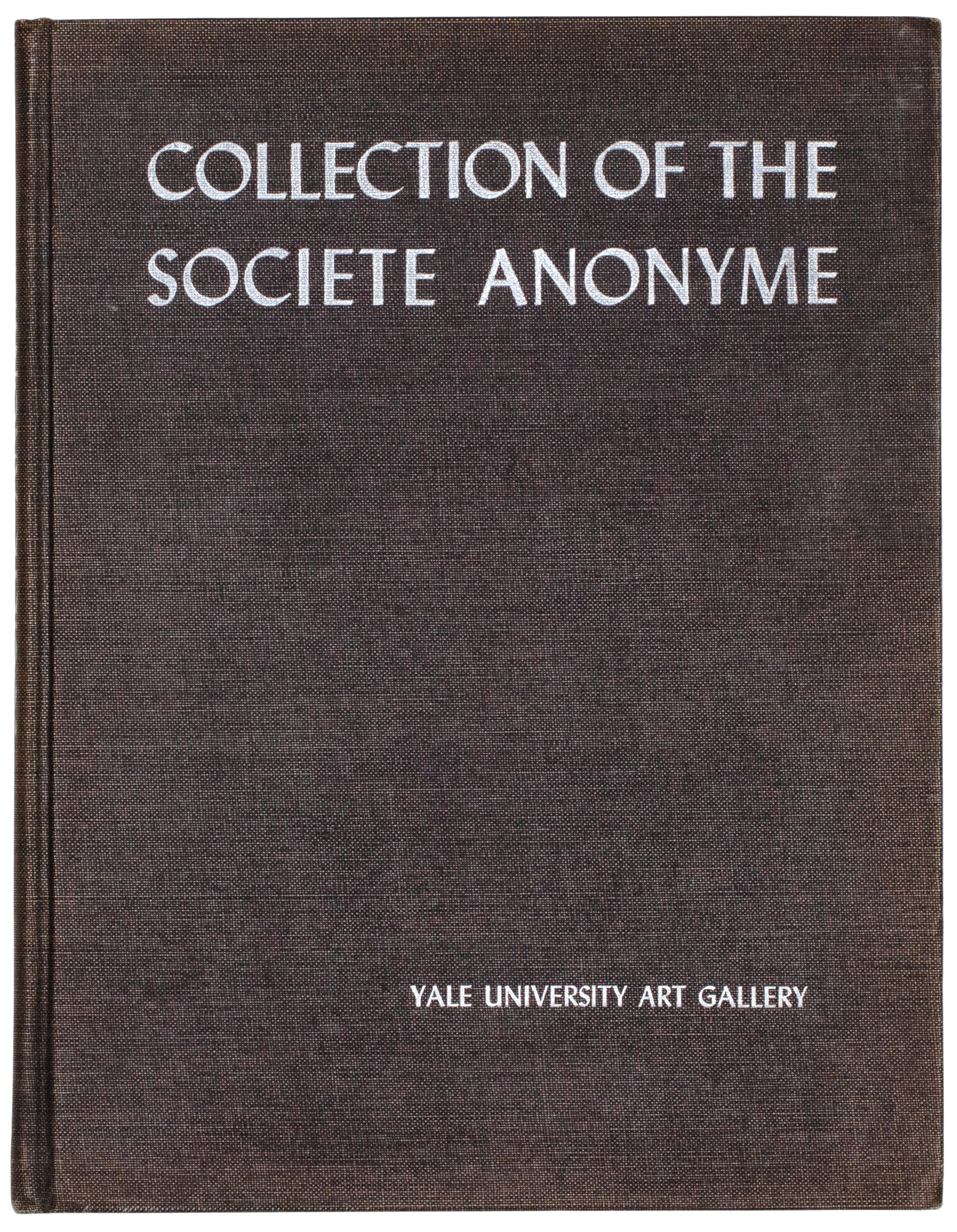
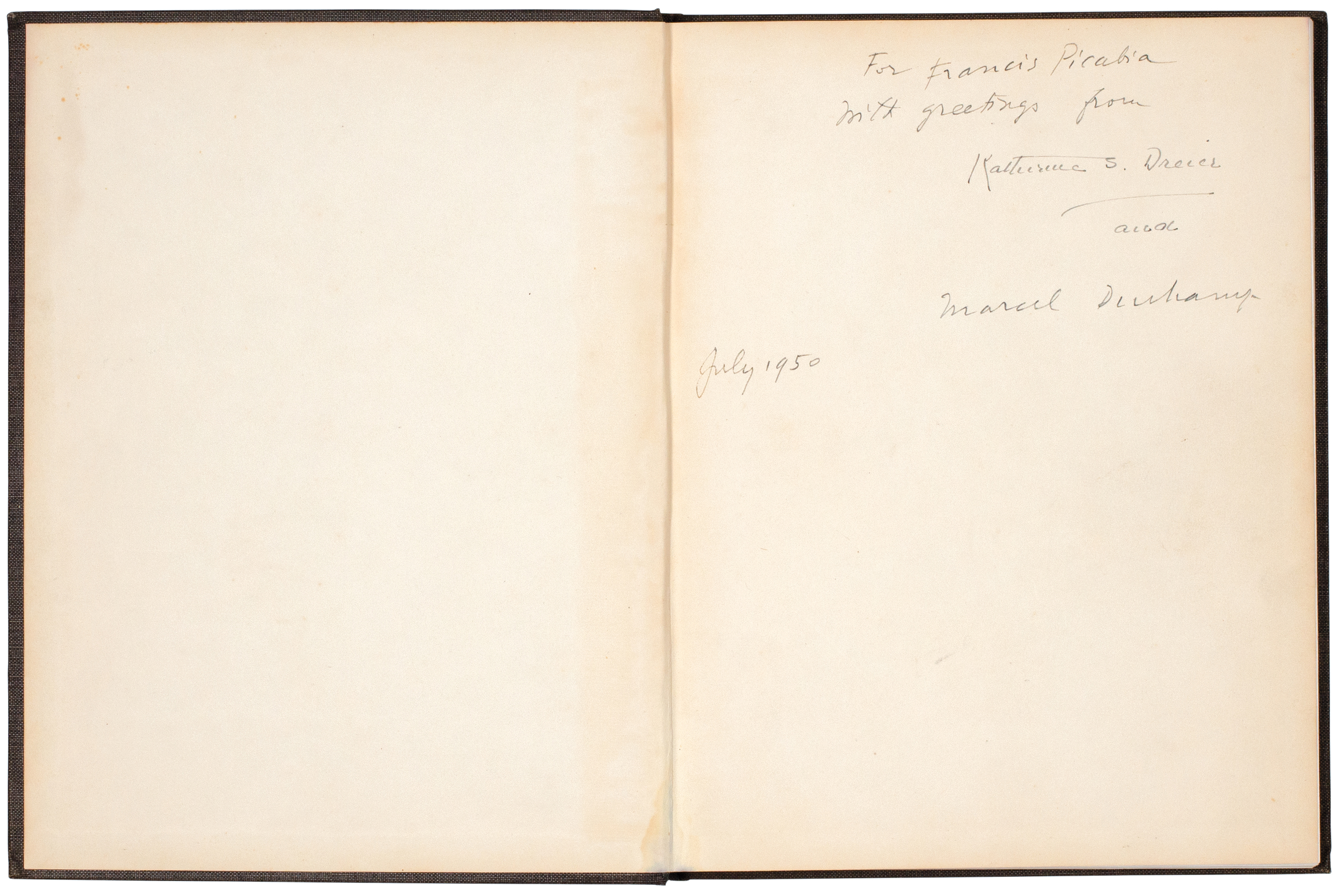
Francis Picabia's copy of the first edition of the catalogue of the Collection of the Société Anonyme, presented by Duchamp and Dreier at the time of publication.
The presentation - it appears to be largely in the hand of Duchamp with only Dreier's signature and her 'and' - is in black ink to the initial blank: 'For Francis Picabia / with greetings from / Katherine S. Dreier / and / Marcel Duchamp / July 1950'.
The Société Anonyme, founded in 1920 by Marcel Duchamp, Man Ray and Katherine Dreier, was intended as a collection to promote the contemporary European art in America. In the years of its existence it produced over 80 exhibitions but was also responsible for publications, concerts and lectures. The collection - unusual in that it had been assembled by artists rather than collectors or curators - was donated en bloc by Dreier to Yale University in 1941. This catalogue was produced a decade later to mark the formal closure of the Socété Anonyme and a dinner was held to mark the event on the 30th anniversary of its foundation.
Picabia was an early entrant to the Société, contributing to both the first and the third exhibitions in 1920. Indeed, after Kandinsky and Duchamp's brother Raymond Duchamp-Villon, Picabia is listed third in the catalogue. As noted in his biographical entry, Picabia had in ' ... 1917 formed the Dada group in New York with Marcel Duchamp and Man Ray'. Dreier thanks Picabia (among many others) on her own behalf and that of Duchamp, in her 'Acknowledgement', as one of the artists whose donated work had made the Société Anonyme possible.
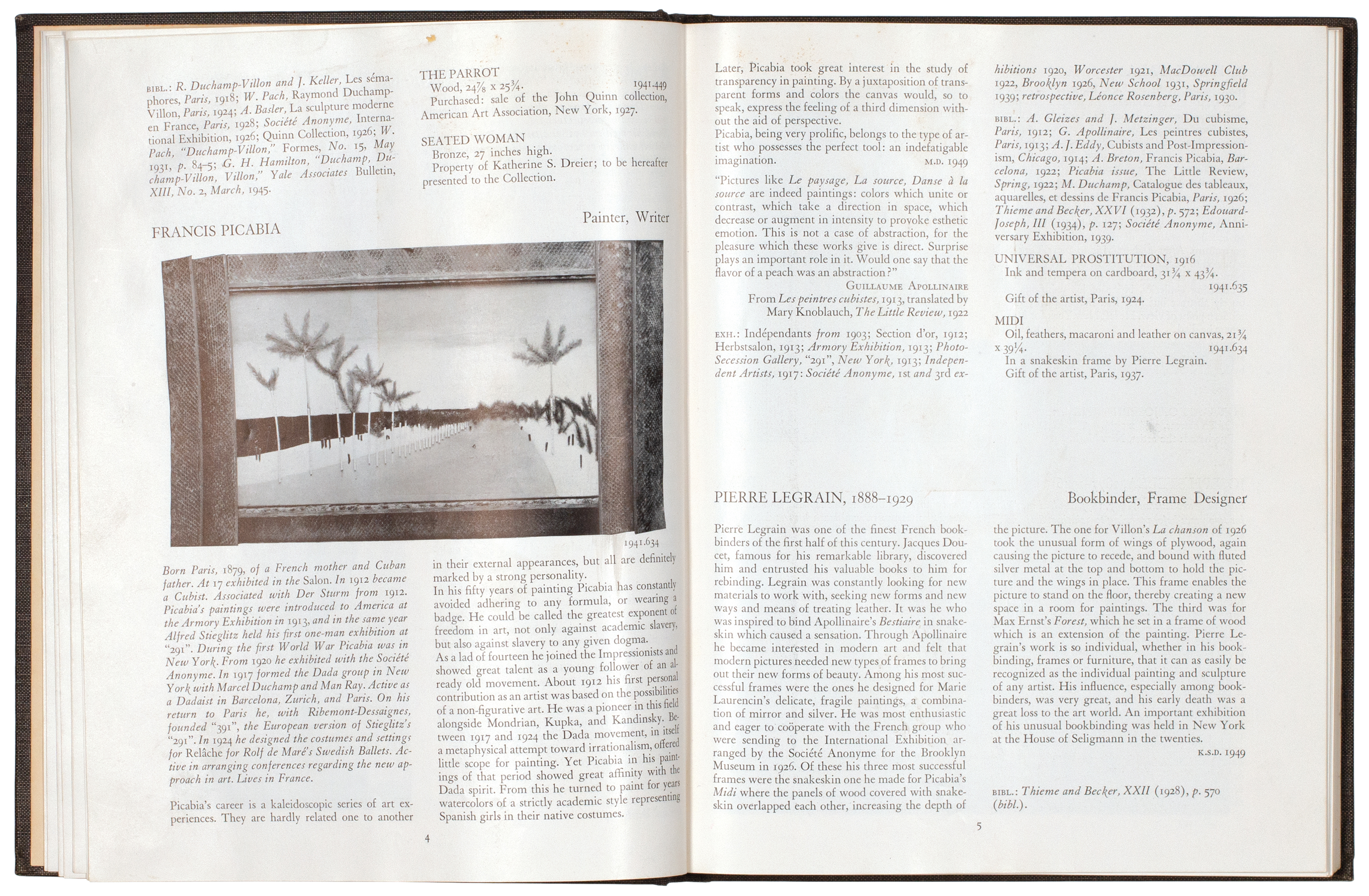
Each artist, and Picabia is fairly typical in this respect, is represented with an image, a biography, an analysis (by Dreier or Duchamp), exhibition history and bibliography as well as details of any works in the collection itself. Picabia's contributions are his 1916 work on paper 'Prostitution Universelle' (Universal Prostitution) donated in 1924 and his collage painting 'Midi' featuring feathers, pasta and leather together with paint in a snakeskin frame by Pierre Legrain donated in 1937; Legrain, as bookbinder and frame designer, follows Picabia in the catalogue.
'The Collection represents 169 artists from 23 countries and includes 616 items: oils, watercolors, scupture etchings, woodcuts, commercial designs, etc. from 1909 to 1950.' (From the Catalogue).
'Picabia's career is a kaleidoscopic series of art experiences. They are hardly related one to another in their external appearances, but all are definitely marked by a strong personality ... In his fifty years of painting Picabia has constantly avoided adhering to any formula, or wearing a badge. He could be called the greatest exponent of freedom in art, not only against academic slavery, but also against slavery to any given dogma ... Picabia, being very prolific, belongs to the type of artist who possesses the perfect tool: an indefatigable imagination.' (Marcel Duchamp writing in the text).
The presentation - it appears to be largely in the hand of Duchamp with only Dreier's signature and her 'and' - is in black ink to the initial blank: 'For Francis Picabia / with greetings from / Katherine S. Dreier / and / Marcel Duchamp / July 1950'.
The Société Anonyme, founded in 1920 by Marcel Duchamp, Man Ray and Katherine Dreier, was intended as a collection to promote the contemporary European art in America. In the years of its existence it produced over 80 exhibitions but was also responsible for publications, concerts and lectures. The collection - unusual in that it had been assembled by artists rather than collectors or curators - was donated en bloc by Dreier to Yale University in 1941. This catalogue was produced a decade later to mark the formal closure of the Socété Anonyme and a dinner was held to mark the event on the 30th anniversary of its foundation.
Picabia was an early entrant to the Société, contributing to both the first and the third exhibitions in 1920. Indeed, after Kandinsky and Duchamp's brother Raymond Duchamp-Villon, Picabia is listed third in the catalogue. As noted in his biographical entry, Picabia had in ' ... 1917 formed the Dada group in New York with Marcel Duchamp and Man Ray'. Dreier thanks Picabia (among many others) on her own behalf and that of Duchamp, in her 'Acknowledgement', as one of the artists whose donated work had made the Société Anonyme possible.
Each artist, and Picabia is fairly typical in this respect, is represented with an image, a biography, an analysis (by Dreier or Duchamp), exhibition history and bibliography as well as details of any works in the collection itself. Picabia's contributions are his 1916 work on paper 'Prostitution Universelle' (Universal Prostitution) donated in 1924 and his collage painting 'Midi' featuring feathers, pasta and leather together with paint in a snakeskin frame by Pierre Legrain donated in 1937; Legrain, as bookbinder and frame designer, follows Picabia in the catalogue.
'The Collection represents 169 artists from 23 countries and includes 616 items: oils, watercolors, scupture etchings, woodcuts, commercial designs, etc. from 1909 to 1950.' (From the Catalogue).
'Picabia's career is a kaleidoscopic series of art experiences. They are hardly related one to another in their external appearances, but all are definitely marked by a strong personality ... In his fifty years of painting Picabia has constantly avoided adhering to any formula, or wearing a badge. He could be called the greatest exponent of freedom in art, not only against academic slavery, but also against slavery to any given dogma ... Picabia, being very prolific, belongs to the type of artist who possesses the perfect tool: an indefatigable imagination.' (Marcel Duchamp writing in the text).
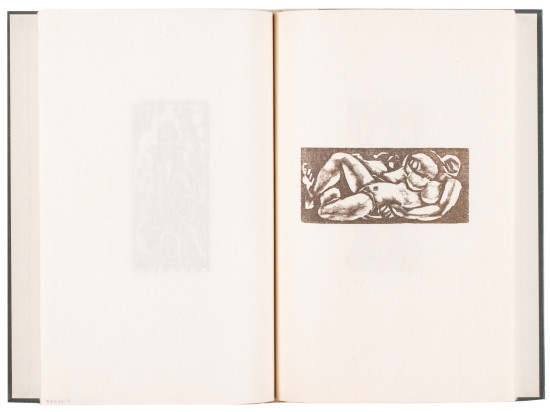
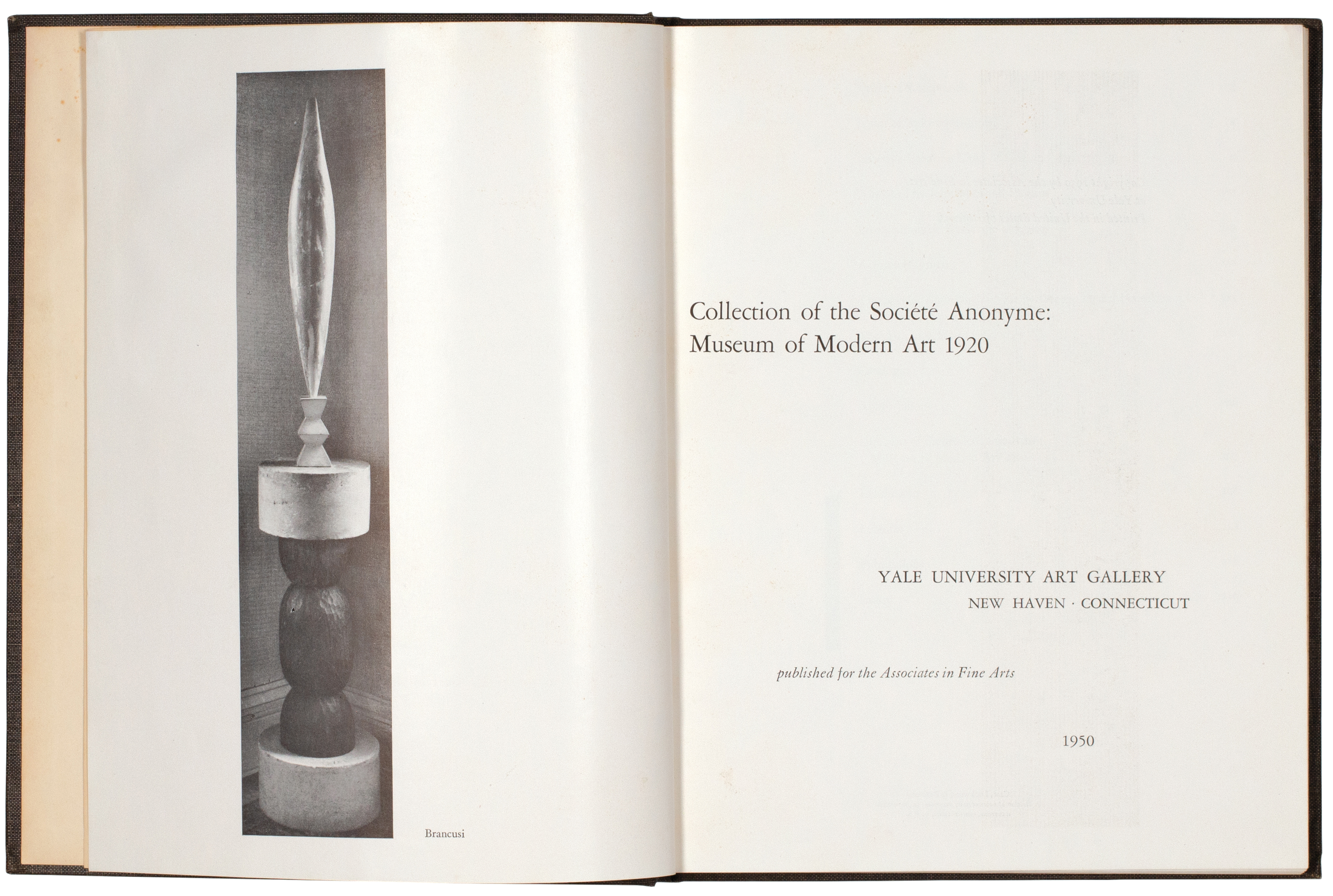
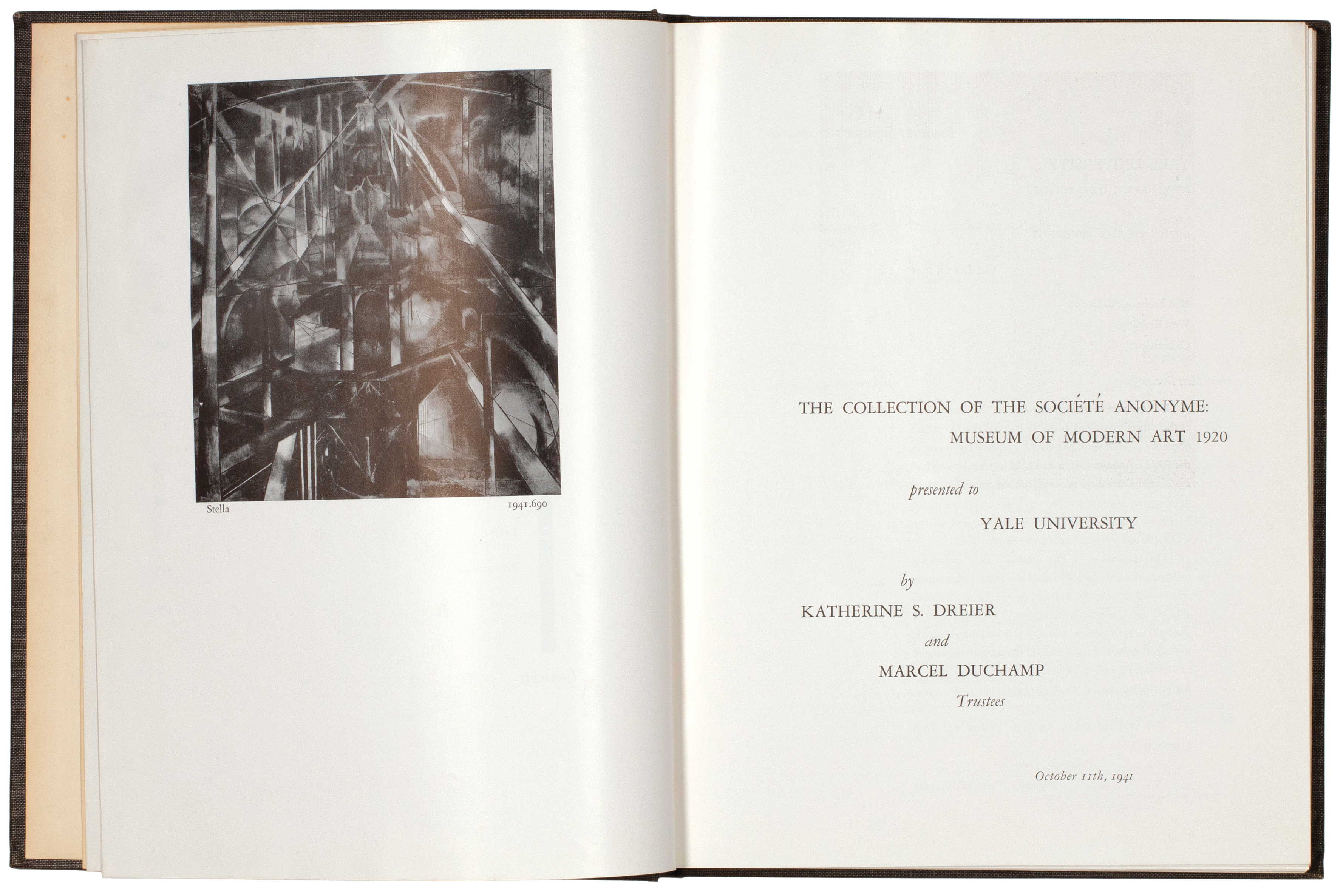
pp. xxiv, 223. 4to. (262 x 204 mm). Leaf with monochrome reproduction photograph of a sculpture by Brancusi as frontispiece, title with copyright verso, , leaf with contents and monochrome reproduction photograph of a work by Joseph Stella verso, note and correspondence regarding the donation of the collection to Yale, , 'Foreword' by John Marshall Phillips, 'Introduction' and 'Acknowledgement' by Dreier, George Heard Hamilton's essay as 'Curator' and 'The Catalogue' detailing 169 artists and their work and illustrated throughout with monochrome images, final leaves with abbreviations, list of Directors, list of Exhibitions, list of Lectures and Index. Original publisher's dark grey / purple cloth, argent titles to front cover and spine, cream endpapers.
#48804